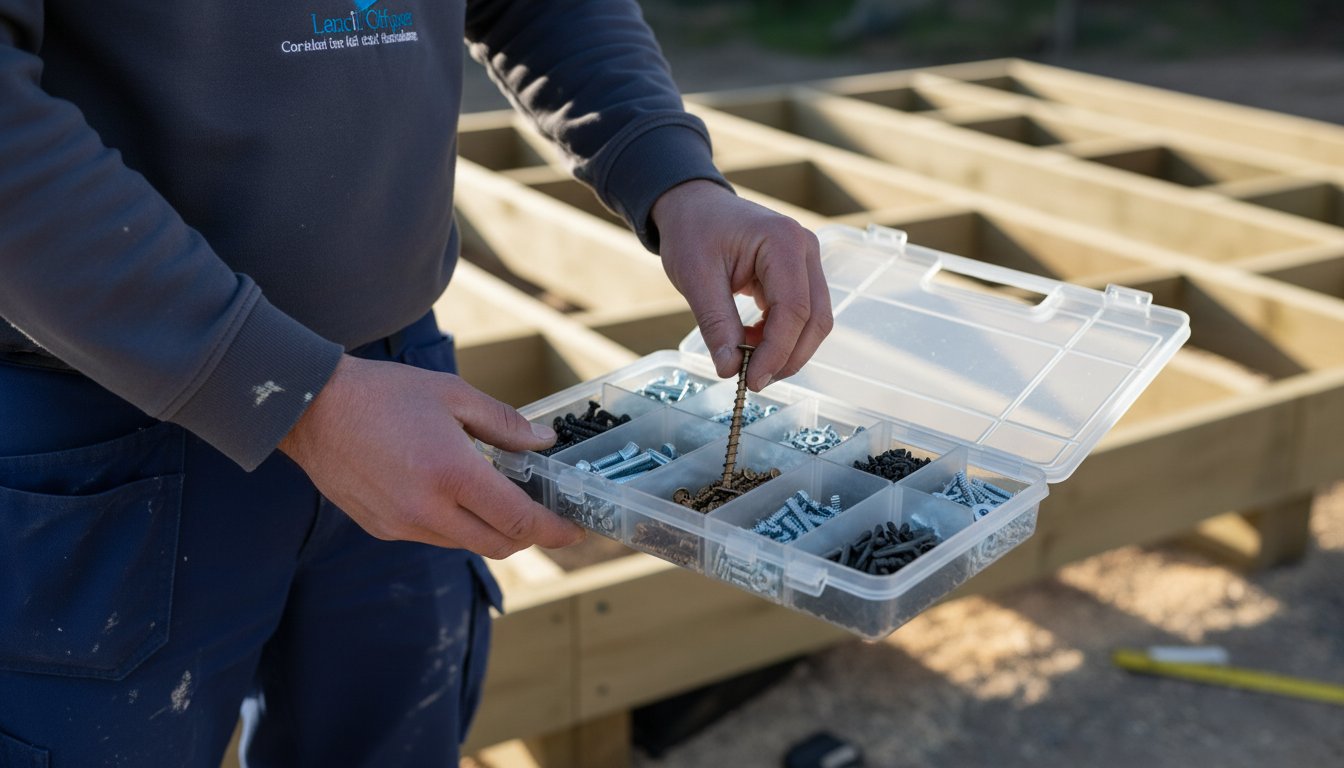
Using the wrong fixing is one of the most common, and costly, points of failure in Essex construction projects. It’s a frustratingly simple mistake that can undermine even the highest quality materials. We see it at Essex Board & Timber; a tradesperson has sourced premium carcassing timber, only for the project’s integrity to be compromised by a snapped screw in hardwood or the tell-tale signs of rust on an outdoor structure after just one wet Braintree winter.
This guide cuts through the confusion. We’ll provide the practical knowledge you need to confidently select the correct screws, nails and bolts from our extensive stock for any job. You’ll master the technical differences between essential fixings, learning how to match the right gauge to structural timber and choose the correct coating for long-lasting exterior work. We will cover everything you need to know to ensure your next project has the structural integrity and professional finish required to meet local building standards.
Key Takeaways
- Understand the critical difference between shear strength and pull-out resistance to choose the correct fixing for structural work.
- Move beyond guesswork by learning how to properly specify the right screws, nails and bolts for any Braintree construction or carpentry job.
- Select the correct fixings for specific materials, such as C24 structural timber and CLS stud work, to ensure project integrity.
- Discover why standard ‘bright’ fixings are unsuitable for outdoor use in the Essex climate and which anti-corrosion alternatives to use instead.
Essential Fixings for Braintree Construction Projects
Every successful construction project, from a garden deck to a new build in Braintree, is built upon the quality of its smallest components. While timber and sheet materials form the structure, it’s the fixings that hold it all together. The structural integrity of your work depends directly on the performance of every screw, nail, and bolt you use. Substandard fasteners don’t just compromise safety; they actively cost you time and money on site.
At Essex Board & Timber, we understand this principle. It’s why our Braintree yard is stocked exclusively with trade-grade fixings from trusted manufacturers. We’ve seen firsthand how a cheap, unhardened screw can snap on entry, forcing a contractor to waste 15 minutes extracting the sheared shank. This kind of delay, repeated across a project, erodes profit margins and pushes back deadlines. The initial saving of a few pounds on a box of fixings is a false economy that Braintree’s professional builders simply can’t afford.
Our commitment is to provide reliable, high-performance components that do the job right the first time. This section provides an overview of the primary categories of screws, nails and bolts we supply and explains why choosing professional-grade fixings is a non-negotiable for any serious project in Essex.
The Importance of Quality in Local Trades
For Braintree contractors, efficiency is paramount. Professional fixings are engineered to improve workflow. Features like self-drilling tips, lubrication coatings, and superior drive heads reduce installation time and minimise the physical strain on both the user and their power tools. Using fasteners that meet or exceed current UK building regulations, including relevant UKCA marking for structural applications, is also critical for project compliance and client peace of mind. Essex Board & Timber is committed to stocking reliable, certified brands that local trades depend on, ensuring you have access to the right product for every application.
DIY vs. Trade Grade: What’s the Difference?
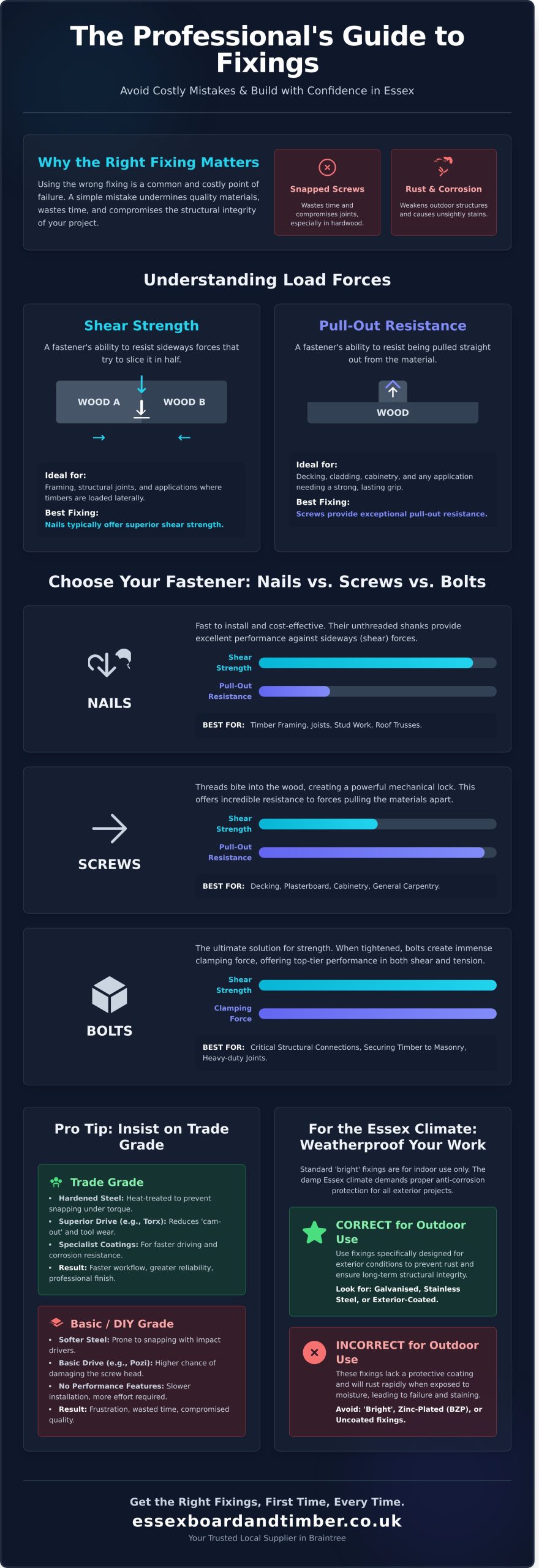
The distinction between DIY and trade-grade fixings is significant. Professional screws, for instance, undergo specific heat treatment processes to harden the steel, preventing them from snapping under the high torque of an impact driver. The drive type also matters; while Pozi drives are common, the Torx drive system offers superior engagement, dramatically reducing the chance of ‘cam-out’ which can damage the screw head and the driver bit. For Braintree’s dedicated DIYers, opting for the same trade-standard fixings stocked at Essex Board & Timber means a better finish, less frustration, and a more durable final result for your home projects.
Our Braintree yard stocks a comprehensive selection covering most common types of fasteners, ensuring you can find the right product for any task. Our range includes:
- Wood Screws: From general-purpose single-thread to high-performance structural timber screws.
- Nails: Including round wire, lost head, and galvanised options for framing, finishing, and exterior work.
- Bolts & Masonry Fixings: A robust selection of coach bolts, anchor bolts, and chemical fixings for securing timber to brickwork and concrete.
- Specialist Fixings: Covering everything from plasterboard and decking screws to roofing bolts and joist hangers.
Screws, Nails, and Bolts: Understanding the Technical Differences
Selecting the correct fixing is fundamental to any construction project in Braintree. While often grouped together, the choice between screws, nails and bolts dictates a structure’s strength, longevity, and the efficiency of its assembly. The decision hinges on understanding two key mechanical principles: shear strength and pull-out resistance. Shear strength is a fastener’s ability to resist sideways forces, while pull-out (or withdrawal) resistance measures its ability to resist being pulled straight out. Each fixing performs differently under these loads.
Nails, with their thicker, unthreaded shanks, generally offer superior shear strength, making them ideal for framing applications where timbers are loaded laterally. Screws, conversely, provide exceptional pull-out resistance because their threads bite deep into the wood grain, creating a secure mechanical lock. For a deeper dive into the engineering principles, the U.S. Forest Products Laboratory provides an excellent guide on the technical differences in fasteners. Bolts, when correctly tightened, offer the highest performance in both shear and clamping force, making them the default choice for critical structural connections.
Screws: Precision and Grip
A screw’s primary advantage is its controlled grip. For general carpentry, standard wood screws are sufficient. However, for structural work like constructing roof joists or timber frames, modern structural timber screws are a far better choice. These are engineered from hardened steel with specialised coatings and thread designs that can often replace traditional coach bolts, significantly speeding up installation. Many of our stocked screws feature self-drilling tips, which cut their own thread in softwoods and eliminate the need for a pilot hole, and twin-thread designs that drive in twice as fast per rotation.
Nails: Speed and Flexibility
For sheer speed, nothing beats a nail. In Essex carpentry, the choice is often between a common wire nail, with its large flat head for maximum holding power in rough framing, and a lost-head nail for finishing work like attaching skirting or architraves, where the small head can be punched below the surface and filled. For any outdoor project, from fencing to shed building, galvanised nails are essential; their zinc coating provides crucial protection against rust. For high-volume work, our full range of fixings includes collated nails for nail guns, allowing trade professionals to assemble frames and cladding with maximum efficiency.
Bolts: Maximum Structural Strength
When you need to secure heavy timber frames or attach a ledger board to a house, only a bolt will do. Coach bolts are perfect for applications where one side needs a clean, domed finish, as the square section under the head bites into the timber to prevent spinning. For maximum clamping force, M12 or M16 hex head bolts, tightened with a spanner, are the standard. When fixing timber to masonry, threaded rod cut to length or heavy-duty shield anchors provide a non-negotiable connection. Always use a large, heavy-duty washer under both the head and the nut; this distributes the load and prevents the bolt from crushing the wood fibres, ensuring the connection remains tight for years.
Matching Your Fixings to Essex Board & Timber Materials
Selecting the correct fixing is as critical as choosing the right timber. The wrong choice can lead to weak joints, split materials, or premature failure. At Essex Board & Timber, we supply a comprehensive range of screws, nails and bolts specifically suited to the materials we stock, ensuring your Braintree construction project is built to last. From structural frames to decorative finishes, here’s how to match your fixings to the job.
Fixing Structural C24 and CLS Timber
For structural applications using our high-grade C24 Treated Timber, modern structural screws are rapidly replacing traditional coach bolts. Their advanced design offers exceptional tensile and shear strength, often without the need for pre-drilling, saving valuable time on site. When joining timber, achieving the correct penetration depth is vital for structural integrity. A reliable guideline for secure timber-to-timber joints is ensuring the screw penetrates the second piece of timber by at least two-thirds of its thickness. The official guidance on fixings for timber materials underscores the importance of proper embedment for load-bearing capacity. For joining two standard 47mm thick C24 joists, a 100mm structural screw is an excellent choice, providing over 50mm of embedment into the adjoining piece. For CLS stud work, 90mm galvanised nails are standard for framing, while specialist framing screws offer superior pull-out resistance.
Sheet Materials and Specialist Fixings
Sheet materials demand their own specific fixings to prevent common issues like splitting or pull-through. When laying plywood or OSB subfloors, always use ring-shank nails. Their unique threaded design grips the timber joists tightly, significantly reducing the chance of floorboards squeaking over time. For an 18mm board, a 50mm ring-shank nail provides a secure hold. MDF, while versatile, is notorious for splitting at the edges. We recommend specialist MDF screws, which feature a self-countersinking head and a fine thread designed to cut into the material without causing it to bulge or split. For plasterboard, the fixing depends entirely on the application. For securing boards to timber studs, use 32mm or 38mm coarse-thread drywall screws. If you need to hang fixtures from the board itself in an Essex home renovation, you’ll need a suitable anchor, such as a self-drive metal plug for light loads or a hollow wall anchor for heavier items like radiators.
For external applications like timber cladding or composite decking in Braintree, the choice of fixing is critical for longevity and appearance. Stainless steel fixings are essential for cedar or oak cladding to prevent black rust stains. With composite decking, always use the manufacturer-recommended screws. These are specifically designed with features like reverse threads to prevent the material from mushrooming around the screw head, guaranteeing a clean, professional finish that will stand up to the Essex weather. Our trade counter team can always provide specific advice on the best screws, nails and bolts for your project.
Weatherproofing Your Work: Anti-Corrosion Fixings for the Essex Climate
Selecting the right fixing is more than a matter of size and strength; it’s about ensuring your work stands up to the Essex climate. Our county’s damp winters and the salt-laden air along the coast from the Blackwater to the Thames Estuary will quickly expose any weakness in your choice of fixings. A project’s longevity is determined not just by the timber, but by the small metal components holding it all together. Using the wrong ones can lead to premature failure and unsightly rust staining.
The problem begins with basic chemistry. Standard ‘bright’ steel fixings, which have no protective coating, will begin to oxidise (rust) almost immediately when exposed to moisture. This corrosion compromises the structural integrity of the fixing, weakening the joint and ultimately ruining the work. For any external Braintree construction, from a simple garden gate to a complete decking structure, using uncoated steel is a false economy that Essex Board & Timber strongly advises against.
Zinc, Galvanised, and Stainless Steel
Understanding the different levels of protection is key to specifying the correct fixing. At our trade counter, we categorise them by their resistance to the elements.
- Zinc Plated (BZP): With a thin coating of just 3-12 microns, these fixings offer minimal defence against moisture. They are designed strictly for internal, dry applications such as fitting kitchen units or indoor joinery. They will fail rapidly if used outdoors in Essex.
- Hot-Dipped Galvanised: This is the industry standard for most external work. The process involves dipping the steel in molten zinc, creating a thick, robust coating of 45-85 microns that provides excellent, long-lasting corrosion resistance. It’s the correct specification for projects like garden fencing, sheds, and non-acidic timber decking subframes.
- Stainless Steel (A2/A4): For maximum longevity, stainless steel is the ultimate choice. A2 (304 grade) is suitable for general outdoor use, while A4 (316 grade) contains molybdenum for superior protection against chlorides. This makes A4 marine-grade steel essential for any construction near the Essex shoreline or for use with acidic timbers like Oak and Western Red Cedar, which can cause black chemical staining on lesser fixings.
Specialist Coatings for Treated Wood
Modern pressure-treated timber, often referred to as tanalised, presents a unique challenge for fixings. The copper-based biocides used in the treatment process are highly effective at preserving the wood but are also corrosive to unprotected steel and even standard zinc coatings. This chemical reaction will accelerate the failure of the wrong fixing, compromising the entire structure.
To counter this, specialist organic or ceramic coatings have been developed. These are specifically formulated to be chemically resistant to timber treatments and are often green or tan to match the wood itself. When constructing a deck or pergola with treated softwood from Essex Board & Timber, using screws with these modern coatings isn’t just recommended; it’s essential for the lifespan of the project. For critical structural work in high-salt environments, such as a coastal property in East Essex, A4 stainless steel remains the safest and most durable specification.
Choosing the correct screws, nails and bolts is fundamental to the quality and durability of your work. A fixing that fails due to corrosion can compromise an entire project, leading to costly repairs. If you’re unsure which fixing your Braintree project requires, our experienced trade team can provide the right advice. Get in touch to discuss the correct specification for your job.
Why Local Braintree Trades Trust Essex Board & Timber for Fixings
For any construction project in Braintree, efficiency is key. Professional tradespeople understand that time spent travelling between different suppliers is time wasted. That’s why Essex Board & Timber has become the trusted single-source supplier for the region’s leading contractors and developers. Sourcing your carcassing timber, sheet materials, and all the essential fixings from one reliable yard simplifies logistics, streamlines your purchasing, and keeps your project on schedule. You can collect your structural timber and the exact screws, nails and bolts required for the job in a single, efficient visit.
Our trade counter isn’t just a point of sale; it’s a hub of practical expertise. Our experienced team understands the demands of the job site. We can help you calculate precise quantities, ensuring you don’t over-order or, even worse, run short. Whether you need advice on the correct length of screw for a specific timber thickness or the best type of anchor bolt for a masonry application, we provide straightforward, knowledgeable answers that save you time and money.
Nothing stalls a project faster than running out of basic materials. At Essex Board & Timber, we invest heavily in maintaining deep stock levels of all essential fixings. We hold extensive stock of everything from standard wood screws and galvanised nails to high-performance concrete bolts and specialised hardware. This commitment to availability means you can rely on us to have what you need, when you need it, preventing costly delays and keeping your team productive on-site. For added convenience, our dedicated delivery fleet operates daily across Braintree and the wider Essex area, bringing your full order directly to your site.
Trade Accounts and Bulk Savings
For our regular trade customers, opening a trade account with Essex Board & Timber is the most effective way to manage costs. Account holders benefit from preferential pricing and simplified invoicing, making project budgeting more predictable. For large-scale housing developments and commercial builds across Essex, we offer significant discounts on bulk box quantities of fixings, helping you secure better margins on major projects. Consistent, competitive pricing is a cornerstone of our service.
Visit Our Braintree Yard Today
Our yard is conveniently located for quick collections, allowing you to get back to the job with minimal downtime. While you’re here, you can also browse our range of professional hand tools from trusted brands like Ox and Spear & Jackson to ensure you’re fully equipped. Before you visit, feel free to call our team to check stock on specific items or ask for technical specifications. We’re here to help you get the job done right.
Secure Your Next Braintree Project with the Right Fixings
Selecting the correct fixing isn’t a minor detail; it’s fundamental to the structural integrity and professional finish of your work. Matching the fixing to the timber and choosing the right anti-corrosion coating for the variable Essex climate are critical decisions. These choices ensure your construction stands strong for years to come, protecting both your materials and your reputation.
That’s why local trades trust Essex Board & Timber. As your independent Essex timber merchant, we provide more than just materials. We offer expert technical advice at our trade counter and maintain an extensive on-site stock of professional-grade screws, nails and bolts from trusted brands like Ox and Spear & Jackson. You’ll find precisely what your project demands, right when you need it.
For fast, reliable access to our complete range and competitive trade pricing, the next step is straightforward. Open a Trade Account with Essex Board & Timber today and partner with a supplier that truly understands the demands of your trade. Let’s get the job done right.
Frequently Asked Questions About Fixings
What size screw should I use for 47mm C24 timber?
For joining two pieces of 47mm C24 timber, a 5.0 x 80mm or 5.0 x 90mm screw is the standard choice. This length ensures the screw passes fully through the first piece of timber and achieves a deep, secure fixing into the second. Pre-drilling is always good practice, especially near the edge of a board, to prevent splitting and ensure a clean finish. At Essex Board & Timber, we stock a comprehensive range of sizes for any carcassing job.
Can I use interior screws for a garden fence in Braintree?
No, you should never use interior screws for exterior projects like a garden fence. Interior screws lack a protective coating and will rust very quickly when exposed to the Essex weather. This corrosion will weaken the fixing, stain your timber, and ultimately cause the fence to fail. Always use exterior-grade, galvanised, or stainless steel screws for outdoor work. We can supply the correct weather-resistant fixings to ensure your fence lasts for years.
What is the difference between a coach bolt and a carriage bolt?
The key difference is the head. A coach bolt has a hexagonal head, designed to be tightened with a spanner. A carriage bolt has a smooth, domed head with a square section underneath. This square neck bites into the timber as the nut is tightened, preventing the bolt from turning. Carriage bolts are ideal for security and a snag-free finish on gates, while coach bolts are used for heavy-duty structural connections where you need high torque.
Do I need to pre-drill holes for all timber screws?
While many modern screws are designed to be self-drilling, it’s still best practice to pre-drill, especially when working close to the end of a board or with hardwoods. Pre-drilling a pilot hole prevents the timber from splitting as the screw is driven in, which guarantees a stronger joint and a more professional finish. For softwood applications away from an edge, you can often get away without it, but we always advise drilling first to be safe.
Which fixings are best for securing 18mm plywood?
For securing 18mm plywood sheets to a timber frame, a 4.0 x 40mm wood screw is an excellent choice. This provides a strong fixing without punching through the other side of standard 47mm framing timber. If joining two pieces of 18mm plywood directly, a 30mm screw is sufficient. For high-load applications like flooring, using a construction adhesive alongside the screws will provide the most robust and squeak-free result. Ask the Essex Board & Timber team for advice.
Are stainless steel screws worth the extra cost for Essex projects?
Yes, for certain applications, stainless steel is a crucial investment. In coastal areas or for projects using acidic timber like oak or cedar, they provide unmatched corrosion resistance. While galvanised fixings are suitable for most jobs, stainless steel screws, nails and bolts eliminate the risk of rust streaks and structural failure in harsh environments. The higher initial cost is offset by the longevity and low maintenance of the finished project, making them a smart choice for quality builds.
How many nails do I need for a standard fence panel?
For a standard 6ft wide fence panel, you should use a minimum of six fixings: three for each post. Secure the panel by nailing through its vertical battens into the fence post. We recommend using 50mm galvanised nails to provide a strong, weather-resistant hold. Using fewer fixings can compromise the panel’s stability, especially in high winds. Essex Board & Timber stocks galvanised nails in project packs and bulk quantities for your convenience.
What drive type is best for avoiding cam-out?
The Torx drive, also known as a star drive, is superior for preventing cam-out. Its six-point design allows for much higher torque transfer from the driver to the screw head compared to Phillips or Pozi-drive. This means the bit is far less likely to slip and strip the screw head, even when driving long screws into dense material. For a faster, more efficient, and less frustrating job, we always recommend using Torx drive screws.
