Is the structural plywood you’re specifying for your Braintree project actually fit for purpose, or could a poor-quality sheet lead to costly call-backs and project delays? It’s a critical question for any job that needs to stand the test of time.
We know the pressure is on to keep projects on schedule and on budget. Choosing between different grades, from general-purpose hardwood ply to marine-grade sheets, can be a minefield, and the risk of warping from inferior stock is a genuine concern for any serious tradesperson in Essex. Trying to transport a full 8×4 sheet from the yard without a trade van is a challenge in itself, often wasting valuable time you don’t have.
This guide from Essex Board & Timber cuts through the confusion. We’ll provide the practical knowledge to master plywood specifications and grading systems, ensuring you select the correct sheet for any application, from carcassing to joinery. You’ll learn how to source reliable stock locally and arrange efficient delivery, making certain your Braintree project is built to last and fully compliant with building regulations.
Key Takeaways
- Understand the ‘cross-graining’ technique that provides plywood with its superior strength and resistance to warping.
- Confidently select the correct plywood for any job by mastering the EN 636 classification system for dry, humid, or exterior use.
- Determine when to specify plywood for structural integrity and when OSB offers a more practical, cost-effective solution.
- Learn essential techniques for cutting and fixing your boards to achieve a clean, splinter-free finish every time.
What is Plywood and Why is it Essential for Braintree Construction?
For any Braintree trade professional or serious DIYer, understanding your core materials is fundamental. Plywood is one of the most versatile and reliable sheet materials available, forming the backbone of countless local construction projects. At its core, it’s an engineered wood panel constructed from thin layers, or ‘plies’, of wood veneer bonded together with strong adhesive. For a detailed technical overview, it’s useful to understand What is Plywood? in its historical and manufacturing context.
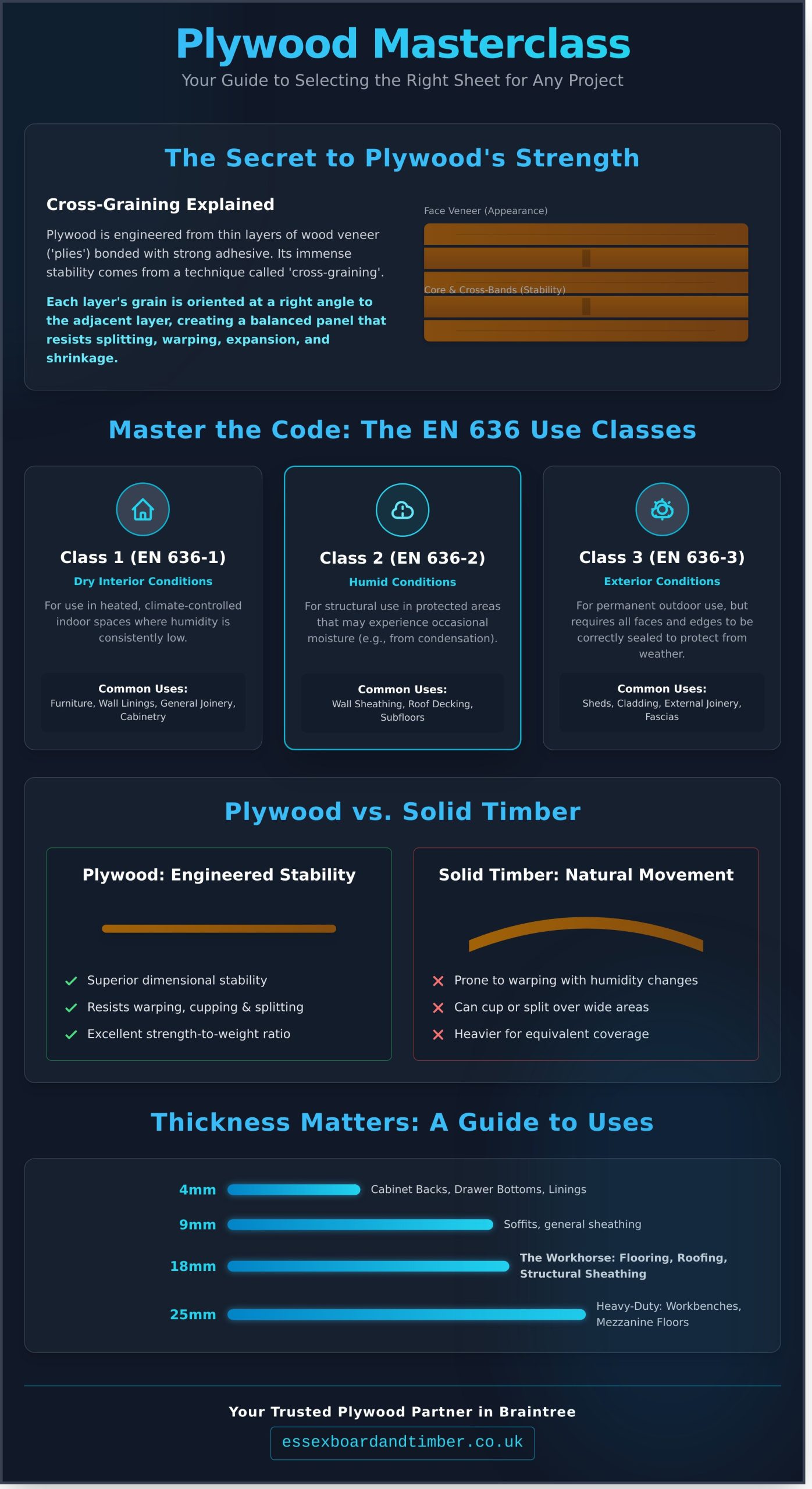
The real genius of its construction lies in ‘cross-graining’. Each veneer layer is oriented with its grain running at a right angle to the adjacent layer. This simple technique is what gives the board its immense structural advantage; it resists splitting, reduces expansion and shrinkage, and ensures the panel remains flat and stable. From large-scale new builds in Great Notley to period property renovations in the town centre, this stability makes it an indispensable material. At Essex Board & Timber, we ensure our stock supports these projects with a commitment to sustainability, sourcing FSC and PEFC certified sheets wherever possible.
The Anatomy of a Plywood Sheet
A standard sheet is more than just layers of wood. It has a central core, cross-bands that provide stability, and face veneers on the front and back which determine its final appearance and grade. The adhesive used to bond these layers is critical. Boards rated WBP (Weather and Boil Proof) use a resin that can withstand moisture, making them suitable for exterior sheathing or applications in damp environments. In contrast, interior-grade adhesives are for dry, internal use only. We hold vast stocks of standard 8×4 (2440mm x 1220mm) sheets at our Braintree yard, with various thicknesses ready for immediate collection or delivery.
Plywood vs. Solid Timber: The Structural Case
While solid timber has its place, plywood offers superior dimensional stability, especially over wide areas. A single wide plank of solid wood is prone to cupping or warping with changes in humidity; a sheet of ply is engineered to resist these movements. This makes it the preferred choice for subfloors, wall sheathing, and roof decking. Its excellent strength-to-weight ratio means it provides significant load-bearing capacity without adding excessive weight to the structure. This is why Essex trades frequently pair it with a robust timber frame, using our C24 graded timber for joists and rafters and then sheathing with plywood to create a solid, integrated floor or roof system.
Decoding Plywood Grades and Technical Specifications
Selecting the right sheet material goes far beyond simply choosing a thickness. To ensure your project is safe, compliant, and performs as expected, it’s essential to understand the technical standards that govern plywood production. At Essex Board & Timber, we stock sheets for every application, and our team is always on hand to help you match the right grade to your job.
The first key standard is EN 636, which classifies plywood based on its intended use environment. Understanding this is the first step to avoiding costly mistakes.
- Class 1 (EN 636-1): For dry interior conditions only. This is suitable for wall linings, furniture, and general joinery in heated, climate-controlled spaces.
- Class 2 (EN 636-2): For use in humid conditions. This grade is required for structural use in protected applications, such as wall sheathing, roof decking, and flooring. It can withstand occasional moisture but not constant exposure.
- Class 3 (EN 636-3): For exterior conditions. This is the specification for permanent outdoor use, such as sheds, cladding, and external joinery, provided all edges and faces are correctly sealed.
Beyond the use class, the visual quality of the face veneer is graded from ‘A’ (the highest quality, for decorative finishes) down to ‘C’ (a utility grade where structural integrity is more important than appearance). For a detailed overview of manufacturing and grading, the Engineered Wood Association provides excellent guides on Plywood Basics. The choice between hardwood species like Birch and softwood from Pine or Spruce depends entirely on the job; hardwood offers superior durability and a finer finish for joinery, while softwood provides a cost-effective solution for structural work.
Thickness is equally critical. We stock a full range, from 4mm ply perfect for cabinet backs and drawer bottoms, through to the workhorse 18mm plywood for structural flooring and roofing applications, and up to 25mm sheets for heavy-duty workbenches and mezzanine floors. If you’re unsure which specification your project requires, our team can help you select the right sheet from our extensive in-stock sheet materials.
Structural Plywood and Building Regulations
For any load-bearing application in Braintree, from a domestic loft conversion to a commercial timber frame, structural plywood is non-negotiable. It must be certified to EN 314-2 (Bond Quality) and carry a CE2+ mark. This confirms the glue bond can withstand the stresses of construction and ensures it will pass building control inspections. Using non-structural ply for roofing or flooring is a critical failure that can compromise the entire build.
Specialised Boards: Marine and Film-Faced Plywood
For the most demanding environments, specialised boards are required. Marine Plywood is manufactured to BS 1088 standard with a waterproof glue and a core free of voids, making it the premium choice for high-moisture areas or boat building. Meanwhile, Film-Faced Plywood, with its tough phenolic resin coating, is the industry standard for concrete formwork, providing a smooth finish. It’s also increasingly popular for durable van linings and workshop surfaces.
Plywood vs. OSB and MDF: The Trade Comparison
On any building site in Braintree, the choice between plywood, Oriented Strand Board (OSB), and Medium-Density Fibreboard (MDF) is a constant topic of discussion. Each has its place, but understanding the specific strengths and weaknesses is key to a professional job. It’s not just about price; it’s about matching the right material to the application for performance that lasts.
For structural work, plywood remains the gold standard. Its cross-laminated construction provides exceptional dimensional stability and uniform strength, making it the preferred choice for flooring and roof decking. While OSB is a structurally sound and cost-effective engineered panel, plywood’s layered build gives it superior stiffness and screw-holding power. You can feel the difference underfoot. For heavy fixings, like mounting kitchen cabinets or supporting heavy-duty shelving, the veneers in plywood offer a far more reliable anchor than the compressed wood strands of OSB or the fine fibres of MDF.
Moisture performance is another critical dividing line. In damp Essex utility rooms or bathrooms, MDF is a liability. It absorbs moisture readily, swelling and losing its structural integrity permanently. Plywood, particularly exterior or marine grades, offers significantly better resistance to humidity and occasional water exposure, making it a more durable choice for any area where moisture is a concern.
Plywood vs. OSB for Roofing and Flooring
When decking out a residential extension, plywood’s superior stiffness provides a firmer feel underfoot, reducing floor squeaks and flex between joists. In roof voids, the materials handle moisture differently; OSB is more vapour permeable, which can be an advantage in certain breathable roof constructions. For Braintree developers working on rapid builds, the consistent dimensions and T&G profiles of OSB can speed up installation, but for a premium finish, nothing beats a solid plywood subfloor.
Plywood vs. MDF for Internal Joinery
For bespoke joinery, the differences are stark. The layered edge of a quality birch plywood is often left exposed as a design feature, requiring only a light sanding and sealing. MDF edges, by contrast, are porous and demand extensive filling and priming for a clean finish. Plywood also holds a distinct weight advantage; an 18mm sheet of MDF can be up to 20% heavier than its plywood equivalent, a crucial factor for large wardrobe doors or long-span shelving where hinge stress and sagging are concerns.
So, is the higher price of plywood justified?
For many projects, absolutely. The initial saving on a sheet of OSB for a subfloor might be £5-£10, but that saving is quickly forgotten if it leads to a bouncy floor and a client call-back. Likewise, choosing MDF for a vanity unit in a poorly ventilated bathroom is a false economy. The higher upfront cost of plywood often translates into:
- Greater Longevity: Superior resistance to moisture and delamination.
- Better Performance: Unmatched stiffness and screw-holding capability for structural and joinery work.
- Reduced Labour: Less finishing required for visible edges in high-end joinery.
At Essex Board and Timber, we stock a comprehensive range of all three materials because we know every job has different demands. Our team can advise on the precise specification you need, ensuring you get the best value and performance for your project.
Practical Guidance: Working with Plywood in Braintree
Once you’ve selected the right grade of plywood for your Braintree project, achieving a professional result depends on correct handling, cutting, and finishing. A high-quality sheet can be let down by poor technique. At Essex Board & Timber, we not only supply the materials but also provide the practical support and services to ensure your project succeeds, from initial cut to final fix.
Precision Cutting at Essex Board & Timber
Save hours on-site and guarantee accuracy from the start. Our industrial-grade beam saw provides perfectly square, clean cuts to a tolerance of +/- 1mm, an accuracy that’s difficult to replicate with a track saw on a dusty site. Simply provide us with a clear cutting list with your dimensions, and we’ll machine your sheets for you. This service reduces material waste, eliminates splintering, and means you can often transport a full project’s worth of components in a smaller vehicle.
For any exterior project in our local Essex climate, from shed construction to garden planters, sealing the edges of your plywood is non-negotiable. The exposed end grain acts like a sponge, absorbing moisture which leads to delamination and rot. The best practice is to apply at least two coats of a suitable exterior-grade primer, followed by a flexible sealant or high-quality exterior paint. This simple step is the single most effective way to protect your work from the elements. For outdoor structures that require minimal maintenance, consider composite decking materials for your Braintree garden projects, which offer superior weather resistance without the need for regular sealing and treatment.
Proper storage is also critical. The unpredictable Essex weather can quickly warp and damage improperly stored sheets. Always store your boards flat on level bearers (dunnage) to keep them off the ground and allow air to circulate. Keep them in a dry, covered space, away from direct rain and sunlight. Never lean a full sheet against a wall for an extended period, as this will inevitably cause it to bow.
Fixing and Finishing Techniques
To avoid splitting the delicate veneers, always drill pilot holes for your screws, especially when working within 50mm of an edge. Use sharp drill bits and select a countersunk screw for a flush finish. For a permanent, structural bond, combine mechanical fixings with a quality adhesive; a D3 or D4 rated PVA is ideal for most interior and moisture-resistant applications. Our team can always advise on the best fixings for your specific sheet material.
A high-end finish relies on good preparation.
- Sanding: Start with a 120-grit sandpaper to remove any surface imperfections, then move to a finer 180 or 240-grit for a smooth-to-the-touch finish. Always sand with the grain of the face veneer.
- Priming: A good quality wood primer is essential before painting. It seals the surface, prevents the grain from showing through, and provides a solid base for your topcoats.
- Finishing: Whether you choose paint, varnish, or wax oil, apply thin, even coats for the best result. For bespoke furniture or cabinetry, applying a real wood veneer can elevate the finish to a professional standard.
Getting the preparation right makes all the difference. For a precise quote on your next project, submit your cutting list to our team and let us handle the machining for you.
Essex Board & Timber: Your Trusted Plywood Partner in Braintree
For Braintree’s tradespeople and dedicated DIYers, choosing a materials supplier is a decision that impacts project timelines, budgets, and the final quality of the work. While national DIY chains offer convenience, they often fall short on specialist knowledge, consistent stock, and the flexibility that professionals require. This is where an independent timber merchant like Essex Board & Timber makes a significant difference. We are grounded in the local trade community, providing a reliable service built on expertise and trust.
Our commitment is simple: to be the most dependable supplier for your project. That’s why Braintree contractors choose us over larger, impersonal retailers. Our team offers practical, no-nonsense advice backed by years of hands-on experience with sheet materials and construction. We understand the demands of a busy site, which is why our local delivery service is structured for reliability, with our own fleet ensuring your materials arrive on time across Essex and the surrounding areas.
For professional contractors, a trade account with Essex Board & Timber streamlines the entire procurement process. It provides access to consistent trade pricing and a simplified ordering system, allowing you to manage multiple projects efficiently. We act as an extension of your team, ensuring you have the materials you need, when you need them.
Supporting the Braintree Trade Community
At our Bakers Lane yard, we maintain consistent and deep stock levels of essential sheet materials, including a comprehensive range of structural and decorative plywood. This reliability means you can plan your work with confidence. Our competitive trade pricing helps keep your projects profitable, and because we are an independent merchant, we have the agility to source specialised timber products that aren’t available in a standard retail catalogue, getting them to you quickly.
Visit Our Braintree Yard or Order Online
We always encourage customers to visit us in person. There is no substitute for inspecting the face veneer quality of a sheet before you buy, especially for joinery or furniture projects. Our team is on hand to offer immediate advice. For those who need materials delivered directly to site, our efficient delivery radius covers Braintree, Chelmsford, and beyond, ensuring a prompt and professional service. Whether you need a few sheets for a home project or a bulk order for a commercial build, we have the stock and logistics to support you.
For a quote, expert advice, or to discuss your material requirements, contact the Essex Board & Timber team today and find out how we can help you build better.
Source Your Plywood from Braintree’s Trusted Supplier
Choosing the correct sheet material is fundamental to the success of any project. Whether you’re selecting between structural grades for a carcassing job or weighing the merits of plywood against OSB, having the right technical knowledge ensures a professional finish every time. It’s the difference between a job done, and a job done right.
As Braintree’s independent timber merchant, Essex Board & Timber provides more than just materials. We offer the expertise you need, with an extensive stock of structural and decorative grades ready for collection or delivery. Our bespoke on-site cutting service ensures your sheets arrive machined to your exact specifications, saving you valuable time.
For construction professionals seeking reliable timber merchants near me who understand the demands of modern construction, Essex Board & Timber delivers the consistency and expertise that keeps projects on track. Order your plywood sheets or request a quote from Essex Board & Timber.
We’re ready to help you get the job done.
Frequently Asked Questions About Plywood
What is the difference between WBP plywood and Marine plywood?
The main difference is the manufacturing standard they adhere to. WBP (Weather and Boil Proof) is an older term for a glue line that resists water, now covered by BS EN 314-2. Marine Plywood, however, must conform to the rigorous BS 1088 standard. This specifies not only a fully waterproof glue but also requires the veneers to be from durable hardwood species with no core gaps. For full submersion or boat building, BS 1088 Marine grade is essential.
Can I use 18mm plywood for a flat roof in Braintree?
Yes, 18mm structural plywood is the standard material for flat roof decking. It’s crucial to use a structural grade board, typically with tongue and groove (T&G) edges, to ensure a strong, interlocking surface. For optimal support, joists should be spaced at 400mm or 600mm centres. At Essex Board & Timber, we stock the correct grade of 18mm T&G structural plywood specifically for local roofing jobs, ensuring you meet building regulations.
Does Essex Board & Timber offer a cut-to-size service for plywood?
Yes, we provide a full cut-to-size service at our Essex facility. Our on-site machining capabilities allow us to cut any plywood sheet to your exact dimensions, saving you time and reducing waste. Simply provide our team with your cutting list, and we’ll prepare your boards with precision, ready for collection or delivery. This service is ideal for both tradespeople requiring multiple identical components and DIYers needing a single, accurately sized panel.
Is structural plywood required for an internal stud wall?
No, for a standard, non-load-bearing internal stud wall, structural plywood is not necessary. A general-purpose sheathing plywood or OSB3 is more than adequate for this application and offers a more cost-effective solution. Structural grades are specified for components that contribute to the building’s integrity, such as flooring, roof decks, and wall sheathing in timber frame construction. We can advise on the right board for your job to prevent over-specifying.
How do I prevent plywood from warping in an Essex garden shed?
To prevent warping, it’s vital to seal all surfaces of the sheet, including the faces and all four edges, with a suitable primer, paint, or wood preserver. Warping occurs when the board absorbs moisture unevenly. Sealing the entire panel before installation creates a balanced barrier against the damp Essex climate. Storing the sheets flat in a dry place before you use them also helps to keep them stable and straight.
What is the best plywood thickness for van lining?
For professional van lining, we typically recommend two thicknesses. A 5.5mm or 6mm hardwood plywood is ideal for the sides, as it’s lightweight and flexible enough to follow the contours of the vehicle’s interior panels. For the floor, a more robust 9mm or 12mm sheet is advised to withstand heavy loads and impact. Essex Board & Timber stocks these thicknesses, which are perfect for creating a durable and practical finish.
Does plywood come in different sheet sizes than 2440 x 1220mm?
Yes, it does. While 2440 x 1220mm (commonly known as 8′ x 4′) is the industry standard and most widely stocked size, other dimensions are available. We often carry smaller ‘handy panels’ for repair jobs and can source larger, oversized sheets for specific commercial projects. Furthermore, our cut-to-size service at Essex Board & Timber means you are never limited to standard sheet sizes for your work.
How do I know if the plywood I am buying is sustainably sourced?
You can identify sustainably sourced plywood by looking for official certification marks on the product or its packaging. The two most recognised global standards are FSC (Forest Stewardship Council) and PEFC (Programme for the Endorsement of Forest Certification). These logos guarantee the timber comes from responsibly managed forests with a full chain of custody. Essex Board & Timber is committed to responsible sourcing and can supply certified materials for your project.
