Why should your garden become a maintenance liability every time the Essex weather turns damp? At Essex Board & Timber, we know that traditional softwood boards often become slippery and prone to rot after just a few wet winters. It’s a common frustration for Braintree residents who want a functional outdoor space without the endless cycle of sanding and staining. This guide explains how to select and install high-performance composite decking that stays slip-resistant and durable, ensuring your investment stands up to the local climate for decades.
You’ll discover the technical differences between hollow and solid boards so you don’t make an expensive mistake on your subframe. Essex Board & Timber provides the practical expertise you need to plan a professional-grade installation, covering everything from the 400mm joist centres required for stability to hidden fastening systems. We’ll outline the exact materials held at our Braintree yard and explain how our local delivery team supports projects within our 15-mile radius. This is the straightforward, trade-level advice you need to create a rot-proof garden retreat that adds long-term value to your property.
Key Takeaways
- Learn how to distinguish between hollow and solid board profiles to select the most durable material for your specific garden project.
- Understand why a high-quality C24 graded timber subframe is a non-negotiable requirement for a stable composite decking installation.
- Discover professional techniques for managing drainage in Braintree’s clay soil to protect your deck’s structural integrity.
- Gain insights into planning for thermal expansion to ensure your boards remain perfectly aligned across changing Essex weather conditions.
- Identify the practical benefits of sourcing materials from Essex Board & Timber for expert local knowledge and reliable site delivery.
Table of Contents
- What is Composite Decking and Why is it Dominating Braintree Gardens?
- Hollow vs. Solid Boards: Technical Selection for Your Project
- The Structural Skeleton: Why the Subframe is Non-Negotiable
- Installation Guidance for the Essex Landscape
- Why Source Your Composite Decking from a Braintree Merchant?
What is Composite Decking and Why is it Dominating Braintree Gardens?
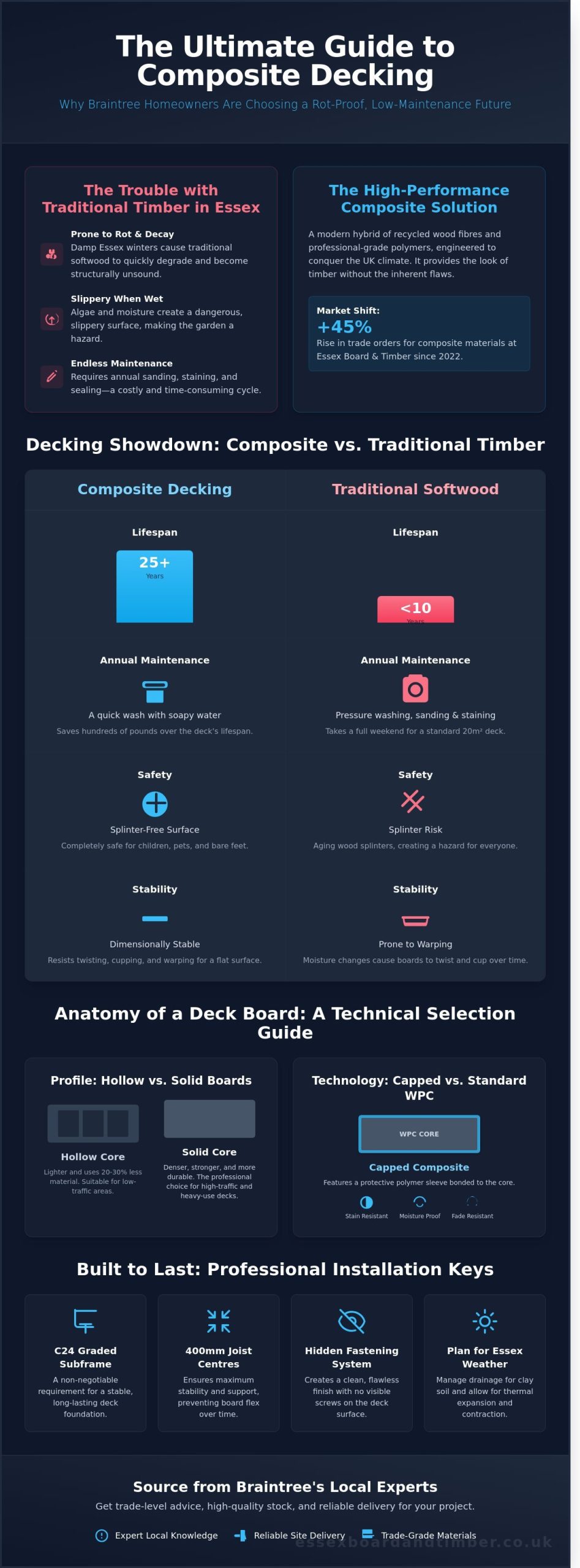
Homeowners across Braintree are increasingly moving away from traditional timber in favour of more resilient materials. Composite decking has become the primary choice for local renovation projects because it solves the age-old problem of rot in the damp Essex climate. This material isn’t just a plastic substitute; it’s a high-performance hybrid. Wood-plastic composites (WPCs) are manufactured by bonding recycled wood fibres with professional-grade polymers. The result is a deck board that looks like natural timber but behaves like a modern engineered product. At Essex Board & Timber, we’ve observed a 45% rise in trade orders for these materials since 2022, as builders look for products that won’t result in callbacks due to warping or decay.
The shift in Braintree is driven by a desire for longevity. Traditional softwood decks often require replacement after 10 to 12 years if they aren’t meticulously maintained. In contrast, the composite decking we supply is designed to withstand the 600mm of annual rainfall common in the East of England without absorbing moisture. Our local customers value the UV stability of these boards. While timber often turns a dull grey after a single summer of sun exposure, high-quality composite retains its deep pigment for decades. As an independent merchant, Essex Board & Timber prioritises sourcing boards that handle temperature fluctuations without the excessive expansion or contraction seen in cheaper, hollow-core alternatives found at national retail chains.
The Composition: Wood-Plastic vs. Capped Composite
Understanding what goes into your deck is vital for a long-lasting installation. Standard WPC boards consist of a uniform mix of wood flour and plastic throughout the entire profile. These are reliable, but the industry has moved forward with “capped” technology. Capped boards feature an extra protective polymer sleeve that’s bonded to the core during the extrusion process. This outer shell acts as a shield against wine stains, grease, and heavy foot traffic. Essex Board & Timber stocks these premium capped options because they offer superior moisture resistance. We don’t believe in “budget” boards that sacrifice density for price. Our trade-grade stock is built to be heavy, durable, and structurally sound for years of use.
Composite vs. Traditional Timber: A Fair Comparison
The most significant difference lies in the maintenance cycle. A timber deck requires an annual routine of pressure washing, sanding, and staining, which can take a full weekend for a standard 20-square-metre area. With composite, that workload is reduced to a quick wash with soapy water once or twice a year. There’s no need for chemical treatments or expensive oils. This saves Braintree residents hundreds of pounds in maintenance costs over the lifespan of the deck.
- Lifespan: Quality composite lasts 25+ years, whereas untreated softwood may fail in under 10 years.
- Safety: Composite boards don’t splinter. This makes them much safer for families with children or pets.
- Visuals: Modern manufacturing creates deep, embossed grain patterns that mimic oak, teak, or charcoal timber.
- Stability: Unlike natural wood, these boards won’t twist or “cup” as they age, ensuring the walking surface remains flat and safe.
Essex Board & Timber provides the technical expertise to help you choose the right board for your specific site conditions. Whether you’re a contractor managing a large housing development in Great Notley or a DIYer tackling a garden upgrade in the town centre, our team ensures you get the right specification. We maintain high stock levels at our local depot, meaning you don’t have to wait weeks for delivery. Our focus is on providing materials that stand up to the practical realities of UK weather while looking exceptional for the long term.
Hollow vs. Solid Boards: Technical Selection for Your Project
Selecting the right profile for your project in Braintree involves more than just picking a colour. At Essex Board & Timber, we find that the decision between hollow and solid boards is the most common technical query at our trade counter. The structural difference is straightforward. Hollow boards contain internal longitudinal chambers to reduce material volume, while solid boards consist of a dense, continuous mass of wood-plastic composite. Each has a specific role depending on the site conditions and the intended use of the outdoor space.
Hollow composite decking profiles typically use 20% to 30% less material than solid versions. This design choice represents an environmentally friendly approach that reduces the weight of each individual component. For instance, a standard 3.6m hollow board often weighs around 9kg, whereas a solid board of the same length can reach 14.5kg. This weight disparity is a vital consideration for Braintree builders working on elevated structures. If you’re installing a deck on a second-storey balcony or a roof terrace with strict load-bearing limits, the lighter hollow profile is usually the safer specification. It places less stress on the substructure and makes the manual handling of materials much easier for the site team.
Regarding footfall and furniture, the density of the board dictates its performance under pressure. Solid boards are much less prone to compression or indentation from heavy items like large planters, hot tubs, or cast-iron garden furniture. If the project involves a high-traffic area, such as a local Essex pub garden or a primary walkway, the solid option is superior. It doesn’t flex as much as a hollow board, provided the joist centres are correctly spaced. For hollow boards, Essex Board & Timber recommends a maximum joist spacing of 300mm to ensure the surface remains rigid and doesn’t bounce underfoot.
When to Specify Hollow Composite Boards
Hollow boards are the most cost-effective solution for standard residential gardens in Braintree. They’re excellent for DIY enthusiasts because they’re easier to cut and move. Because the air pockets within the boards allow for heat dissipation, they can stay slightly cooler in direct sunlight during the peak of summer. You’ll need to pay close attention to the finishing. Since the internal “honeycomb” structure is visible at the ends, you must use colour-matched end caps or wrap-around fascia trims from Essex Board & Timber to achieve a professional, closed-off look. This prevents insects and moisture from nesting inside the chambers.
The Case for Solid Composite Decking
Solid composite decking is the gold standard for durability and sound insulation. One of the biggest complaints with cheaper materials is the hollow “click-clack” sound when walking in heels or heavy boots. Solid boards dampen this noise effectively, creating a premium feel that mimics traditional hardwood. From a trade perspective, solid boards are significantly easier to work with when creating intricate designs. You can mitre the edges, create picture-frame borders, and sand down cut ends without needing any plastic caps. They also offer better screw-holding strength for perimeter boards and stairs, which is why they’re the preferred choice for commercial projects across Essex where longevity is the primary requirement.
The team at Essex Board & Timber can help you calculate the exact quantities needed for either profile. Whether you’re a professional contractor or a homeowner, you can check our current stock levels at our local yard to see the physical difference between these boards before you commit to a purchase. Choosing the right profile now saves time on maintenance and ensures the deck remains a permanent fixture of the property for decades.
The Structural Skeleton: Why the Subframe is Non-Negotiable
Many homeowners in Braintree believe that choosing composite decking means they can ignore the risks of rot and decay entirely. This is a dangerous myth. While the surface boards are manufactured from durable wood-plastic polymers, the underlying structure is almost always timber. If your subframe fails, the entire investment collapses regardless of how expensive the top boards were. According to academic research into composite decking, the longevity of these systems is heavily dependent on how the material interacts with its environment, particularly regarding moisture management and structural support. A deck is only as strong as the skeleton it sits on.
Using C24 Treated Timber for Structural Integrity
At Essex Board and Timber, we only recommend C24 Treated Timber for decking carcassing. While C16 is the standard for many UK builds, C24 is graded for higher loads and features a tighter grain, making it the superior choice for the heavy weight of composite materials. It’s not just about the grade; it’s about the treatment level. We supply timber pressure-treated to Use Class 4 (UC4) specifications for any posts or joists intended for direct ground contact. This ensures the wood survives the damp Essex soil for 15 years or more, whereas standard UC3 timber often fails in under 5 years when used in the wrong application.
Essential Fixings and Joist Protection
Precision matters when building the skeleton. You must set your joist centres at a maximum of 400mm for residential projects. For commercial builds or high-traffic areas in Braintree, we often advise 300mm centres to prevent the boards from sagging or “springing” underfoot. Essex Board and Timber stocks specialised joist protection tape, which creates a waterproof seal over the top of the timber. This prevents water from pooling in screw holes and rotting the frame from the inside out. When laying the composite decking, hidden clip systems provide a clean finish, but you’ll still need high-quality stainless steel screws for the perimeter boards to handle the natural expansion and contraction of the material.
Drainage and ventilation represent the final piece of the structural puzzle. A 50mm clearance between the ground and the joists is the minimum requirement for adequate airflow. Without this gap, humidity builds up and even the best-treated timber will eventually succumb to fungal decay. We suggest using a weed membrane topped with 40mm of clean gravel to assist with drainage and keep the subframe dry. Essex Board and Timber provides all the necessary components to ensure your build meets these trade-standard specifications, protecting your property and your wallet from future repairs.
Installation Guidance for the Essex Landscape
Braintree sits on a foundation of heavy London clay, which presents specific challenges for any outdoor construction project. This soil type retains water for long periods, leading to boggy conditions that can compromise the structural integrity of your subframe. When installing composite decking in Braintree, you must prioritise airflow and drainage. Without a clear path for water to escape, moisture sits against the timber joists, accelerating rot despite the durability of the surface boards. We recommend a minimum clearance of 50mm between the ground and the underside of your joists to ensure adequate ventilation.
A critical technical detail often overlooked is the 1:100 fall required for effective water runoff. For every 1 metre of decking, the frame should slope 10mm away from the property. This prevents standing water from pooling in the grooves of the boards, which is a common cause of slip hazards and surface staining. While timber boards expand across their width, composite decking experiences linear thermal expansion. A 5-metre board can expand by as much as 15mm in direct sunlight. You must use the correct T-clip hidden fasteners supplied by Essex Board & Timber to allow the boards to slide and breathe without warping or buckling the frame.
Safety and legal compliance are non-negotiable for Essex homeowners. Under UK Building Regulations, any deck platform that sits more than 300mm above ground level requires planning permission in certain contexts and must feature protective railings. These railings should stand at least 900mm high for domestic installs and 1100mm for commercial projects. Our team at Essex Board & Timber can provide the specific dimensions and load-rated timber required to meet these safety standards.
Ground Preparation and Weed Control
Low-maintenance claims only hold true if the ground beneath the deck is properly treated. We advise excavating 100mm of topsoil and replacing it with a layer of compacted MOT Type 1 sub-base. It’s essential to lay a 100gsm heavy-duty geotextile weed membrane before adding any supports. This prevents growth from pushing through the gaps in your boards. For the most stable results on Essex clay, use concrete pads or adjustable pedestals. These tools allow you to achieve a perfectly level subframe even if the ground is uneven, protecting your timber carcassing from direct contact with damp earth.
Finishing Touches: Trims, Fascias, and Edging
A professional finish depends on how you handle the visible edges and transitions. Planning your layout to avoid small “off-cuts” or “slivers” at the ends of the deck will significantly reduce waste. We stock matching bullnose boards at Essex Board & Timber, which provide a rounded, safe edge for steps and perimeter borders. These boards hide the honeycomb internal structure of the composite planks, creating a solid, high-end look. If your garden has complex curves or awkward angles, our bespoke cutting services at the Essex Board & Timber yard can pre-cut materials to your exact specifications, saving you hours of work on-site. For projects requiring additional structural support or backing materials, our comprehensive plywood supplies in Braintree offer the perfect complement to your decking installation.
Ready to start your project? Contact Essex Board & Timber today to source high-quality decking materials and professional advice for your Braintree home.
Why Source Your Composite Decking from a Braintree Merchant?
Selecting the right materials for an outdoor project involves more than just scrolling through a digital catalogue. At our Braintree timber yard, you have the distinct advantage of inspecting our composite decking range in person. Seeing the boards under natural light allows you to judge the true colour and grain texture, which is often misrepresented on computer screens. This tactile experience ensures you don’t face the disappointment of a mismatched delivery. Our team provides technical advice based on 25 years of industry experience, helping you calculate precise joist spacings and expansion gaps that are specific to the Essex climate. National retailers rarely offer this level of granular, practical expertise.
Professional contractors understand that project profitability depends on reliable supply chains. Essex Board & Timber maintains high stock volumes to ensure that your build doesn’t stall due to back-orders. While national suppliers often quote lead times of 10 to 14 days for specialist items, our independent status allows us to react faster. We currently house over 5,000 linear metres of various decking profiles at our local site. This immediate availability, combined with competitive trade pricing, makes us the preferred choice for Braintree builders. Our trade accounts can provide up to a 15% cost reduction on bulk orders, directly improving your bottom line on every installation.
Local Knowledge and Personal Service
Essex Board & Timber supports local Braintree DIYers by taking the guesswork out of complex material lists. We don’t just sell boards; we review your measurements and identify potential issues before you leave the yard. Unlike anonymous national retailers where staff might rotate between departments, our team focuses exclusively on timber and sheet materials. This depth of knowledge is vital for ensuring your subframe is structurally sound and your fixings are corrosion-resistant. We understand the specific soil conditions in Essex and how they might affect ground-level deck installations.
Our independent status means we prioritise the needs of the local building community over corporate quotas. You won’t find the “out of stock” frustrations common in big-box stores because we manage our inventory based on local demand. If a specific trim or clip is required, we can usually source it through our established network within 24 hours. This personalised approach creates a partnership where your project success is our primary goal. We treat every customer with the same level of professional respect, whether you’re buying a single replacement board or materials for a 100-square-metre commercial terrace.
The Essex Board & Timber Delivery Guarantee
Reliable logistics are the backbone of our service. We operate a dedicated fleet of 3.5-tonne and 7.5-tonne vehicles specifically designed to navigate narrow Essex lanes and busy Braintree residential streets. Unlike national couriers who often use standard pallet networks, our drivers are trained to handle 4.8-metre composite decking boards with care. We ensure that 95% of our local deliveries arrive within a 48-hour window, allowing you to schedule your labour force with total confidence. We don’t just drop materials at the kerbside; we work with you to ensure the load is placed safely and efficiently.
- Dedicated local drivers who know the Braintree and wider Essex road networks.
- Specialist handling for heavy sheet materials and long-length timber to prevent edge damage.
- Flexible delivery slots that align with your site’s specific access requirements.
- Direct communication with our transport team for real-time arrival updates.
Choosing a local merchant means you’re investing in the Essex economy while receiving a superior level of service. Our commitment to quality and reliability has made us a staple for the region’s tradespeople. Whether you need composite decking boards or structural plywood supplies for your Braintree project, we maintain comprehensive stock levels to support both trade professionals and DIY enthusiasts. Open a trade account or visit our Braintree shop today to see our full range of materials and discuss your next project with our expert team.
Start Your Braintree Garden Transformation
Building a high-quality outdoor space requires a balance of technical selection and reliable supply. Choosing solid boards over hollow profiles ensures your project handles heavy foot traffic, while a robust subframe built from C24-graded timber prevents structural failure. It’s vital to get these specifications right from the start to avoid costly repairs later. Since our founding, Essex Board & Timber has operated as an expert independent merchant, providing the professional-grade materials needed for a successful installation.
We maintain a massive on-site stock of C24 treated timber and sheet materials at our Braintree yard to support your build. Our team offers direct technical advice to trade professionals and DIY enthusiasts alike, ensuring you have the correct fixings and carcassing for the job. We operate a dedicated local delivery service across the whole of Essex, bringing everything from composite decking to heavy-duty joists directly to your site. This ensures your project stays on schedule without the delays often found at national retailers.
Creating a complete garden transformation often involves more than just decking. Many Braintree homeowners find that upgrading their boundary structures with high-quality fence panels provides the perfect complement to their new outdoor space, creating a cohesive and professional finish that enhances both privacy and property value.
Visit Essex Board & Timber in Braintree for your composite decking and C24 carcassing to see our full range in person. We look forward to helping you get your next project off the ground.
Frequently Asked Questions
Is composite decking more slippery than timber when wet?
No, high-quality composite decking is engineered to be less slippery than traditional timber because it does not absorb water or support algae growth. Most boards supplied by Essex Board & Timber carry an R11 slip-resistance rating, which is significantly safer than wet softwood. While timber becomes a hazard when organic film builds up, composite remains stable underfoot during the 150 average days of rainfall Essex receives each year.
How much does composite decking cost per square metre in Braintree?
You should budget between £45 and £95 per square metre for composite decking materials at Essex Board & Timber. Entry-level hollow boards start at the lower end of that range, while premium capped solid boards represent the higher end. This price covers the boards themselves; you must also factor in approximately £15 per square metre for the subframe and fixings. We provide specific trade rates for Braintree contractors who manage large-scale residential projects.
Can I install composite decking directly onto a concrete patio?
You cannot lay composite decking directly onto concrete because the system requires a 50mm minimum gap for airflow and drainage. Without this ventilation, moisture accumulates and causes the boards to expand or warp over time. At Essex Board & Timber, we advise using a joist system or adjustable plastic pedestals to create a level subframe. This setup ensures your 25-year manufacturer warranty remains valid and protects your investment from water damage.
Do I really need a C24 timber frame for a composite deck?
Yes, using C24 graded timber for your subframe is the professional choice for any composite installation. C24 timber is grown slower and has fewer knots than C16, providing the structural integrity needed for a deck that can last 30 years. Since composite decking is heavier than standard softwood, you need a high-performance carcassing timber that won’t sag. Essex Board & Timber stocks pressure-treated C24 joists in various lengths to suit any Braintree garden layout.
How do I clean and maintain my composite deck in the Essex weather?
Cleaning your deck only requires a soft-bristle brush and warm soapy water every 6 months to remove surface dust. You don’t need to sand, stain, or oil the boards, which saves you roughly 10 hours of labour every year compared to timber. For stubborn spots, a pressure washer can be used at a maximum of 1500 PSI, provided the nozzle is kept 300mm from the surface. Essex Board & Timber stocks specialist cleaning solutions that remove 99% of seasonal debris without damaging the boards.
Will the colour of my composite boards fade in the sun?
Most composite decking boards undergo a minor weathering process during the first 12 weeks of UV exposure, where the shade lightens by roughly 5% to 8%. After this initial period, the colour remains stable for the rest of its lifespan thanks to built-in UV inhibitors. This is a major advantage over timber, which turns silver-grey within 12 months if not treated. Essex Board & Timber offers samples so you can see how different tones look in your specific garden aspect.
What is the difference between capped and uncapped composite decking?
Capped composite decking features a protective polymer sleeve that wraps around the core to provide 100% protection against stains and moisture. Uncapped boards are a more budget-friendly option but are more porous, meaning they can absorb oils or tannins if spills aren’t cleaned immediately. At Essex Board & Timber, we recommend capped products for 90% of domestic projects. The extra protection ensures the deck is easy to wipe clean after a summer barbecue or a spill.
How do I calculate how many boards I need for my garden project?
Calculate the total square metreage of your area and divide it by the coverage of a single board, then add 10% for cutting waste. For a standard 3.6m board with a 143mm width, you’ll generally need 2 boards per square metre of deck. If your Braintree project includes complex patterns like a 45-degree herringbone, increase your waste margin to 15%. You can bring your measurements to the Essex Board & Timber trade counter for a precise calculation and quote.
