
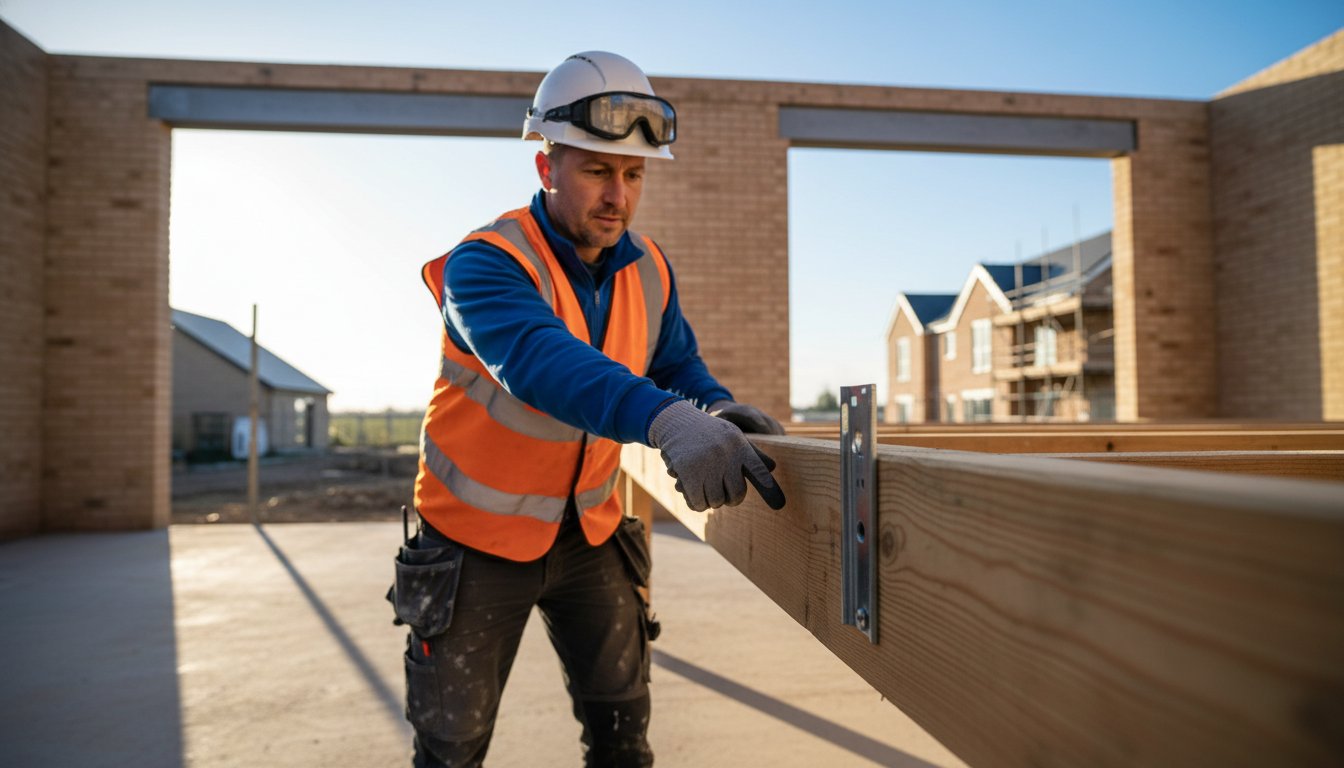
Using the wrong joist hangers is one of the most common, and costly, mistakes made on building sites across Braintree and Essex. It’s a critical detail that’s often overlooked when project deadlines are tight, but the structural integrity of your entire project depends on making the correct connection, whether it’s timber-to-timber or fixing into masonry.
This practical 2026 guide from Essex Board & Timber cuts through the confusion. We’ll provide the straightforward, professional advice you need to confidently select the right metalwork for your specific application, understand load-bearing requirements, and ensure a secure, regulation-compliant installation every time.
Read on to get the job done correctly from the start and see how our massive on-site stock ensures you can source high-quality components for immediate delivery to your Braintree site.
Key Takeaways
- Learn to distinguish between face-fix and masonry hangers to ensure you select the correct type for your specific application, whether fixing to timber beams or blockwork.
- Understand why matching your hanger width to the exact dimensions of your C24 graded timber is critical for achieving a secure, load-bearing connection.
- Discover the correct installation techniques for joist hangers, including the essential role of 30mm x 3.75mm square twist nails for structural integrity.
- Find out how sourcing your structural metalwork from a local Braintree supplier like Essex Board & Timber ensures you get the right advice and stock for your project.
What are Joist Hangers and Why are They Vital for Braintree Builds?
At the core of any stable timber frame, from a loft conversion to a garden deck, are the critical connections that hold it all together. Joist hangers are precisely engineered metal connectors, typically U-shaped, designed to create strong, 90-degree joints between timber elements. Their primary function is to transfer the vertical load from a joist down into a supporting ledger board, beam, or masonry wall, ensuring the structural integrity of the entire frame. For a foundational overview of their role in preventing floor sagging, you can explore the engineering principles behind what are joist hangers. Without these vital components, the long-term stability of a structure is seriously compromised.
For construction projects across Braintree and wider Essex, meeting modern building standards isn’t just good practice; it’s a legal requirement for a safe and durable build. Current regulations, such as Eurocode 5, demand robust, tested solutions for all timber connections, rendering older carpentry methods non-compliant for load-bearing structures. This is why high-specification metalwork is essential for any new build or major renovation. At Essex Board & Timber, we supply a comprehensive range of hangers manufactured from pre-galvanised mild steel. This material provides the necessary tensile strength and durability to support specified loads and resist deformation over the life of the structure, giving both tradespeople and their clients complete peace of mind.
The Consequences of Improper Joist Support
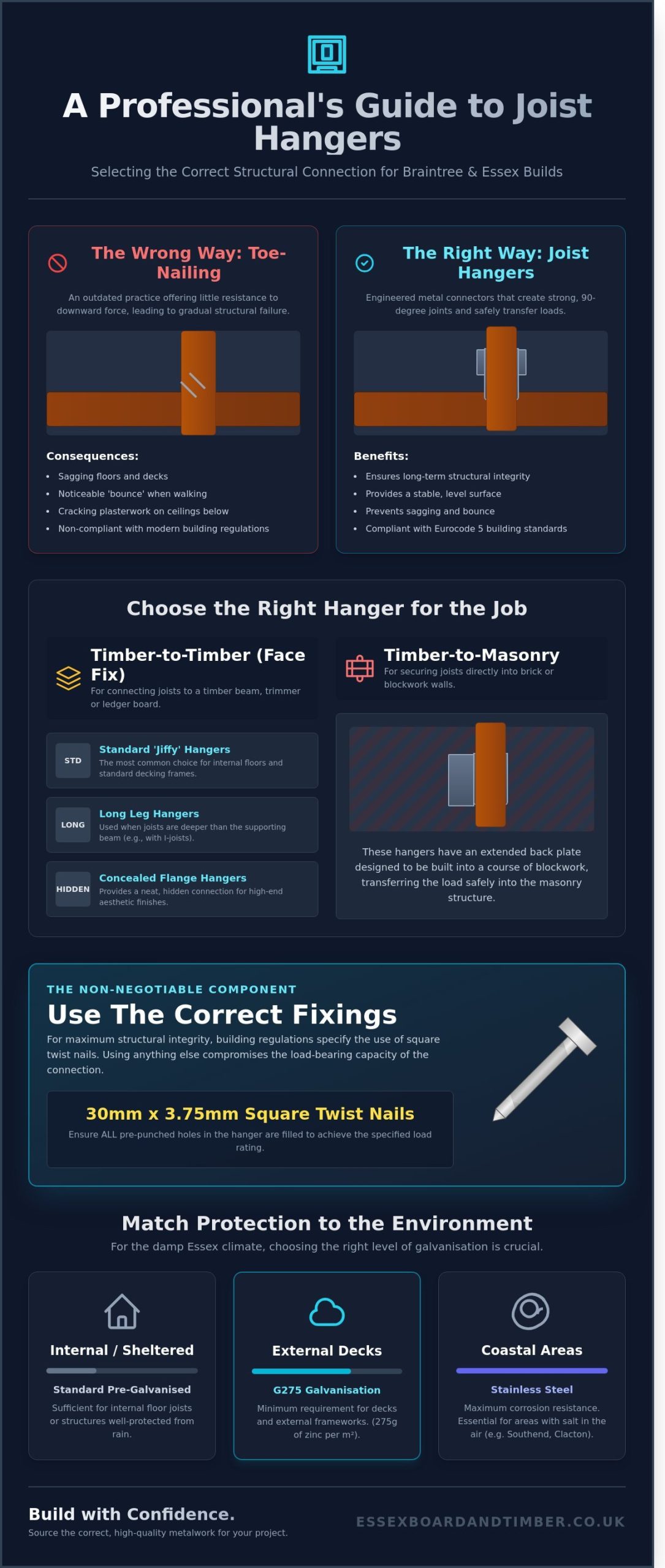
In many older Essex properties, common issues like sagging floors, noticeable ‘bounce’ when walking, and even cracking plasterwork can often be traced back to inadequate joist support. The outdated practice of “toe-nailing” – driving nails at an angle through the joist end into the beam – offers very little resistance to downward force and can lead to gradual structural failure as the timber dries and shrinks over time. Essex Board & Timber helps local trades avoid these common pitfalls by supplying the correct, load-rated fixings for every application, ensuring a solid and compliant finish.
Galvanisation and Weather Resistance in Essex
Galvanisation is a protective zinc-coating process that prevents rust in structural steel. When selecting fixings for a deck, it’s crucial to understand the different levels of protection. Standard pre-galvanised hangers are fine for internal or well-sheltered use, but the damp Essex climate means external frameworks demand higher corrosion resistance. For decking projects in Braintree, we recommend a minimum of G275 galvanisation (275g of zinc per square metre) or stainless steel for maximum longevity, especially in coastal areas like Southend or Clacton where salt in the air accelerates corrosion.
Choosing the correct structural fixings is not just about ticking a box for building control. It’s about professional pride and building structures that last. A properly supported deck frame, built with high-quality, correctly specified metalwork, will remain safe, stable, and level for decades. At Essex Board & Timber, we stock the full range of sizes and specifications you need to get the job done right. Our knowledgeable team is always on hand at our trade counter to provide practical advice, ensuring you leave with the materials to build with absolute confidence.
Timber-to-Timber vs. Timber-to-Masonry: Choosing the Right Hanger
Selecting the correct joist hanger isn’t just about matching the timber size; it’s about understanding the material you’re fixing to. A hanger designed for a timber ledger board will fail if used on a brick wall, and vice-versa. The fundamental difference lies in how the hanger transfers the load from the joist to the main structure. Making the right choice is critical for the safety and longevity of any decking or flooring project. At Essex Board & Timber, we stock a comprehensive range to ensure you have the correct component for your specific job.
Timber-to-Timber (Face Fix) Hangers
These are the most common type of hanger used in timber-frame construction. A “face fix” hanger is designed to be fixed directly onto the vertical face of a timber beam, trimmer, or ledger board. Their design is straightforward, relying on specified nails or screws through pre-punched holes to achieve their load-bearing capacity. They come in several variations:
- Standard ‘Jiffy’ Hangers: The go-to for standard internal floor joists and decking frames where the joist height is conventional.
- Long Leg Hangers: Used where joists are deeper than the supporting beam, allowing for fixings into both the top and bottom chords of an I-joist or the full depth of solid timber.
- Concealed Flange Hangers: Offer a neat, hidden connection, perfect for architectural builds where aesthetics are a priority.
Their primary applications include connecting floor joists to supporting beams, roof trusses to wall plates, and, crucially for outdoor projects, building robust deck frames from high-quality C24 treated timber. We keep extensive stock of the most common sizes at our Essex depot, including 47mm, 75mm, and 100mm widths, ready for same-day collection or fast local delivery.
Timber-to-Masonry Hangers
When connecting a new timber floor or deck structure to an existing brick or blockwork wall, a masonry hanger is essential. Unlike a face-fix hanger, this component features a top flange designed to be built directly into a mortar course. The back plate sits flush against the masonry, while the top strap provides a physical key into the structure, transferring the load directly into the wall itself. This makes them indispensable for new-build extensions and renovations across Braintree and the wider Essex area.
Using these hangers correctly requires attention to detail. The masonry must be of sufficient strength, and the mortar must be allowed to cure for the manufacturer-specified time before any load is applied to the joists. Building the hanger into a joint with a frogged brick placed upside down, for example, would seriously compromise the connection’s strength. For any heavy-duty commercial decking planned for sites in Braintree, load-bearing calculations are paramount. Proper installation is non-negotiable, and this guide on how to fit joist hangers correctly offers a reliable overview of the process. If you’re tackling a project with significant structural loads, our trade team can advise on the specific heavy-duty joist hangers required.
Specifying Hangers for C24 Graded Timber and Structural Loads
Selecting the right joist hanger is not just about finding one that fits; it’s about creating a structural connection that is as strong as the timber it supports. A poorly specified hanger can compromise the entire deck structure, turning high-quality timber into a potential failure point. At Essex Board & Timber, we supply the materials and the expertise to ensure every component of your project meets the required structural standards.
Matching Metalwork to Timber Grade
Your decking frame is only as strong as its weakest link. For most load-bearing applications in Braintree and across Essex, the standard is high-strength C24 structural timber. This grade provides superior strength and durability, but it’s essential that the metalwork used can handle the same loads. Using an underrated hanger with C24 joists is a false economy that undermines the integrity of the build.
Precision is critical. The width of the hanger must match the width of the timber exactly. For example, a 47mm joist requires a 47mm hanger to avoid structural gaps. Any gap, however small, can allow for movement, which reduces the connection’s load capacity and can lead to long-term structural issues. Because we supply precision-cut timber, you can be confident that the metalwork we recommend will provide a snug, secure fit every time.
The depth of the hanger is just as important. A common rule of thumb is that the hanger should support at least 60% of the joist’s height to provide adequate stability. For a 150mm deep joist, this means sourcing a hanger with a depth of at least 90mm. You will also encounter “Short Leg” and “Long Leg” hangers. Short leg versions are designed for applications where space is restricted, such as fixing a joist close to the top of a ledger beam, while long leg hangers offer more fixing points for maximum load capacity where space allows.
Load Tables and Safety Factors
Professional hanger manufacturers like Simpson Strong-Tie provide detailed technical data sheets with load capacity tables. These charts specify the Safe Working Load (SWL) a hanger can support, usually measured in kilonewtons (kN). However, these figures are based on perfect installation conditions. Several factors can significantly reduce a hanger’s performance:
- Incorrect Fixings: Using standard screws instead of the specified 3.75mm square twisted sherardized nails will drastically lower the load capacity.
- Improper Nailing: Every hole in a hanger is there for a reason. Leaving holes empty or partially driving nails reduces the connection’s strength.
- Skewed Joists: Attaching joists at an angle requires a specific skewed or adjustable hanger. Forcing a standard hanger to fit a skewed joist will compromise its structural performance.
All structural work must comply with building regulations. The manufacturer’s data provides the technical specification, but it’s your responsibility to ensure the final installation meets the standards outlined in the UK building regulations for structural safety. For any significant project, we always recommend consulting with your local building control office in Braintree or the relevant Essex authority to confirm specific requirements. The team at Essex Board & Timber can help you interpret technical data to ensure you purchase the correct joist hangers for your plans.
Professional Installation: How to Fit Joist Hangers Correctly
Correctly fitting joist hangers is not a step to be rushed; it’s fundamental to the structural integrity and safety of your decking. A perfectly level joist means nothing if its connection is weak. Before you begin, gather the right tools for the job: a quality claw hammer, a spirit level, and a tape measure. Most importantly, you need the correct fixings. At Essex Board & Timber, we can’t stress this enough: your choice of nail is as critical as the hanger itself.
For a secure, regulation-compliant installation, you must use 30mm x 3.75mm square twist nails. Their unique profile is engineered to bite into the timber fibres, providing exceptional grip and preventing withdrawal under load. Unlike standard round wire nails, they offer superior shear strength, which is essential for withstanding the vertical forces exerted on the joist. Using the wrong fixings is a direct compromise on safety and will not pass a building inspection.
The installation process is methodical and precise:
- Positioning: Use your spirit level and a timber offcut to mark the exact height for the bottom of your joist on the ledger board or header. Place the hanger against this mark.
- Tacking: Secure the hanger with one or two nails in the header flange. Don’t drive them all the way home yet. This allows for minor adjustments.
- Checking: Slide the joist into the hanger. Check it’s level and sits perfectly flush and square in the base.
- Full-Nailing: Once you’re satisfied with the position, drive nails into every single hole on the hanger-both into the header and into the joist itself. This is non-negotiable for maximum strength.
A common and dangerous shortcut is to use standard woodscrews instead of the specified nails. Don’t do it. Screws are hardened to resist pull-out forces, which makes them brittle. They are not designed to handle the lateral, or shear, forces that a joist connection endures. A screw under shear load can snap suddenly and without warning, leading to catastrophic failure. Using them invalidates the manufacturer’s load rating for the hanger.
The Nailing Pattern: Every Hole Matters
Manufacturers place holes in specific locations for a reason. Filling every hole ensures the load is distributed correctly across the fitting. Some installations require “double shear” nailing, where the nail passes through the hanger, into the joist, and then into the header beam. This creates two shear planes and dramatically increases the connection’s load capacity. Skipping holes is a false economy that weakens the entire structure and is a common failure point during building inspections across Essex.
Common Mistakes to Avoid in Braintree DIY Projects
We see a few recurring errors in local projects, from Braintree to Chelmsford. Avoid these simple mistakes to ensure a professional result. Don’t use a hanger that is too wide for your timber; a 50mm hanger on a 47mm joist allows for twisting and instability. Always ensure the joist is fully seated and sits flat in the bottom of the hanger, with no gaps. Finally, never install hangers upside down or fix them to damaged or crumbling masonry.
Getting the installation right guarantees a safe, long-lasting deck. At Essex Board & Timber, we stock the correct galvanised 30mm x 3.75mm square twist nails alongside our full range of joist hangers. Contact our team today to ensure you have the right fixings for your project.
Essex Board & Timber: Your Local Braintree Supplier for Metalwork
Selecting the right supplier is as crucial as choosing the right materials for your decking project. As Braintree’s independent timber merchant, Essex Board & Timber provides a level of service and technical expertise that large national chains simply cannot replicate. We understand the specific demands of local Essex construction, from modern new builds to sensitive period property renovations. Our focus is on providing reliable solutions and the correct structural components to ensure your project is built to last.
A successful project depends on having the right materials on site, on time. That is why we maintain an extensive stock of structural metalwork ready for immediate collection or delivery. Our range includes everything needed for a solid deck frame and other construction applications:
- A comprehensive selection of galvanised and stainless steel joist hangers in all standard sizes.
- Restraint straps, angle brackets, and framing anchors for secure connections.
- A full inventory of high-performance screws, nails and bolts for every construction application.
Our rapid delivery service operates across Braintree and the wider Essex area. With our own fleet of vehicles, we ensure critical materials arrive at your site promptly, keeping your project on track and minimising downtime.
For professional contractors, an Essex Board & Timber trade account is an essential tool. It streamlines procurement, simplifies invoicing, and gives you access to consistent, competitive pricing. Building a relationship with our team means you have a reliable partner who understands your business, helping you manage project costs and material logistics more effectively. It’s a straightforward way to make your local construction projects run more smoothly.
Expert Advice at the Trade Counter
Our team’s practical knowledge sets us apart. The experts at our Braintree trade counter possess years of direct industry experience, offering technical advice that goes far beyond a product code. We can help you source bespoke metalwork for unique heritage renovations or specify the correct grade of timber for your load-bearing structures. We’ll ensure the joist hangers you choose are perfectly matched with your carcassing timber and recommend the best tools from our premium Ox and Spear & Jackson ranges to complete the job efficiently.
Supporting the Braintree Building Community
Essex Board & Timber is proud to be part of the local trade network. We are committed to supporting local contractors with competitive pricing that helps protect your profit margins. Our convenient location in Braintree allows for quick and easy collection when you need materials urgently. We are more than just a supplier; we are a dependable resource for the Braintree building community. Visit Essex Board & Timber today for expert advice and reliable stock.
Secure Your Braintree Projects with the Right Metalwork
The structural integrity of your build depends on getting the details right. As we’ve covered, selecting the correct hanger for the application, whether timber-to-timber or masonry, is critical. It’s equally vital to ensure your specifications match the C24 timber grade and anticipated loads, followed by a professional installation that guarantees safety and compliance.
At Essex Board & Timber, we simplify the supply of essential structural components. As an independent Braintree-based merchant, we maintain a vast on-site stock of metalwork, ensuring you can get what you need without delay. Our trade-focused team offers practical advice backed by decades of combined experience, making sure you leave with the correct joist hangers and materials for the job.
Start your next project on a solid foundation. Browse our range of joist hangers and C24 timber at Essex Board & Timber or visit our yard to discuss your requirements. We’re ready to help you build with confidence.
Frequently Asked Questions About Joist Hangers
Can I use screws instead of nails for joist hangers?
Yes, but you must use specialist structural connector screws, not standard woodscrews. Ordinary screws don’t have the required shear strength to support the load and can snap under pressure, leading to structural failure. Always use the specific fixings recommended by the hanger manufacturer. At Essex Board & Timber, we stock the correct, manufacturer-approved nails and structural screws to ensure your decking project is built safely and to a professional standard.
What size joist hanger do I need for a 47mm C24 timber joist?
For a 47mm wide C24 timber joist, you need a 47mm joist hanger. The hanger’s width must match the timber’s actual width to provide a secure fit. You also need to match the hanger’s depth to the depth of your joist, whether it’s 100mm, 150mm, or 200mm. It’s always best practice to measure your timber before purchasing fixings. Our team at Essex Board & Timber can help you select the exact size for your project.
Do joist hangers need to be galvanised for internal use in Braintree?
No, for most dry internal applications in a property in Braintree, standard pre-galvanised joist hangers are sufficient. The pre-galvanised coating provides adequate protection against corrosion in a controlled indoor environment. However, for external use like decking or for internal areas with high humidity such as bathrooms, you must use heavy-duty hot-dip galvanised or stainless steel hangers to prevent rust and ensure long-term structural integrity.
How many nails should be used in a standard joist hanger?
You must use a nail in every single hole provided on the joist hanger. The manufacturer’s stated load capacity is based on all holes being filled with the correct type of fixing, typically 3.75mm square twisted nails. Leaving holes empty significantly weakens the connection and compromises the safety of the structure. This isn’t a place to cut corners; a secure connection is critical for the stability of your frame.
Can I install joist hangers onto an existing brick wall?
Yes, it’s possible to attach joists to a brick wall using masonry joist hangers. These are designed to be built into the mortar course of the brickwork. For an existing wall, a more common method is to first fix a timber ledger board securely to the wall using appropriate masonry anchors, such as M10 or M12 sleeve anchors. You can then attach standard joist hangers to this ledger board, which provides a solid and reliable fixing point.
What is the difference between a long leg and a short leg joist hanger?
The main difference is the length of the return flange that fits over the top of the supporting timber beam. A short leg hanger is used when the joist is the same depth as the beam, creating a flush top surface. A long leg hanger, sometimes called a Jiffy hanger, is used when the joist is shallower than the supporting beam. The longer legs provide a secure wrap-over fixing, ensuring a strong connection in this common construction scenario.
Are joist hangers required by building regulations for decking?
While UK Building Regulations may not name joist hangers specifically, they do require structural connections to be robust and safe. Using engineered joist hangers is the industry-standard method for achieving a connection that meets these requirements. They provide a far superior load-bearing capacity compared to outdated methods like end-nailing. For any raised deck, using hangers is considered best practice and essential for a safe, regulation-compliant build.
Where can I buy joist hangers in Braintree for same-day collection?
You can purchase a full range of joist hangers for same-day collection from Essex Board & Timber. Our trade counter is conveniently located for builders and DIY customers throughout Braintree and the surrounding Essex area. We keep high levels of stock for all standard sizes, including galvanised and masonry options, so you can get the materials you need to keep your project moving. Just visit our yard or give us a call to check availability for large orders.
