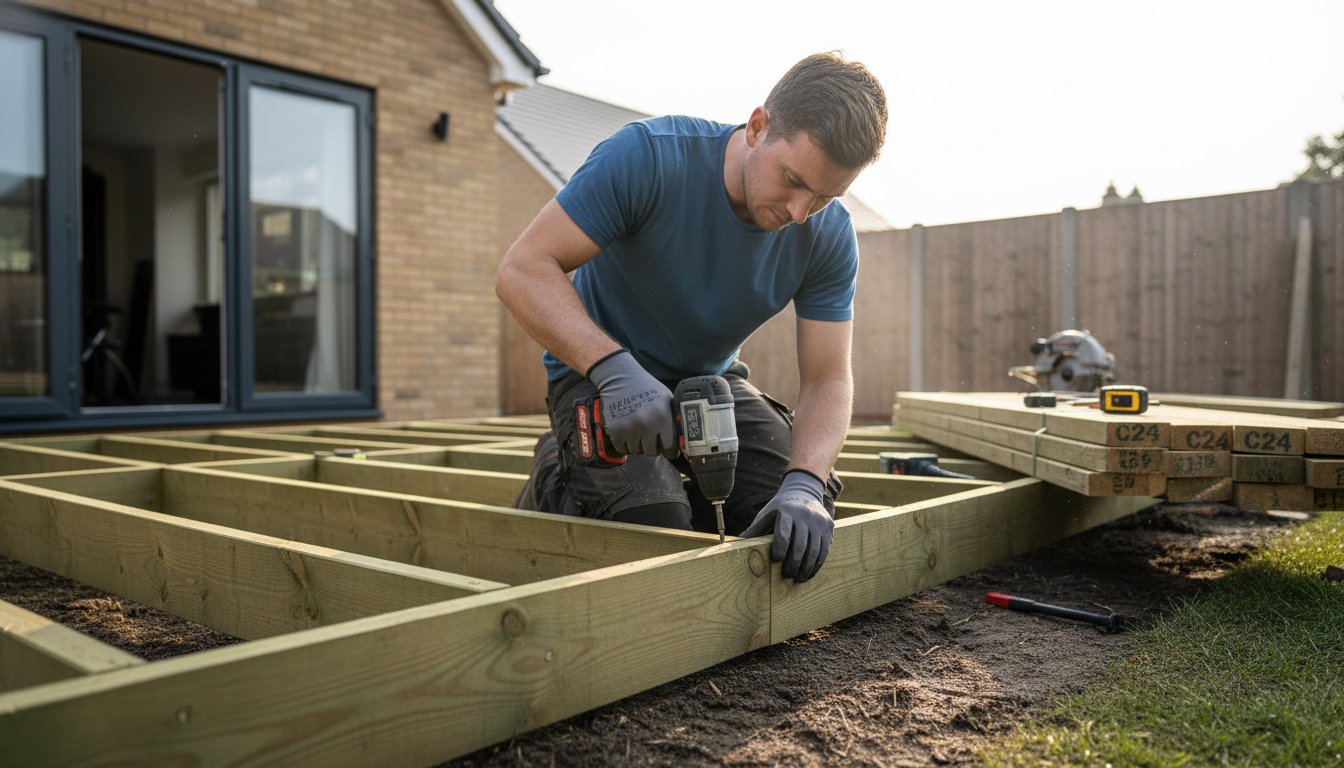
Last winter, a local contractor in Braintree discovered that a deck frame installed only 24 months earlier had already succumbed to severe ground rot. This failure wasn’t down to poor craftsmanship, but rather a simple misunderstanding of how different levels of treated timber react to moisture. Selecting the wrong use class for a project is a costly mistake that many tradespeople and DIYers in Essex face when they can’t find clear technical advice or consistent stock levels at national retailers.
At Essex Board & Timber, we understand that you want your construction projects to stand the test of time without the risk of structural failure. We’ve put together this definitive guide to help you master the technical specifications of timber grading and treatment levels. You’ll learn how to distinguish between C16 and C24 carcassing, how to select the correct treatment for ground contact, and how to ensure your work remains fully compliant with current building regulations.
We’ll also show you why relying on an independent merchant like Essex Board & Timber provides the reliability that larger chains often lack. From our extensive on-site stock to our bespoke cutting services, we’re here to ensure Braintree builders have the right materials exactly when they’re needed for their next build.
Key Takeaways
- Understand why the vacuum-pressure impregnation process is vital for ensuring your external projects survive the specific environmental demands of Braintree.
- Clarify the relationship between C16/C24 strength grading and chemical preservation to ensure your structural carcassing meets UK building regulations.
- Master the British Standard Use Class (UC) system to select the correct treated timber for your project and avoid the common pitfalls of premature rot.
- Learn professional handling and maintenance techniques, including how to properly seal cut ends to preserve the integrity of the wood’s protective barrier.
- Access expert technical advice and bespoke cutting services by sourcing your materials directly from Essex Board & Timber’s local Braintree yard.
What is Treated Timber and Why is it Essential for Braintree Construction?
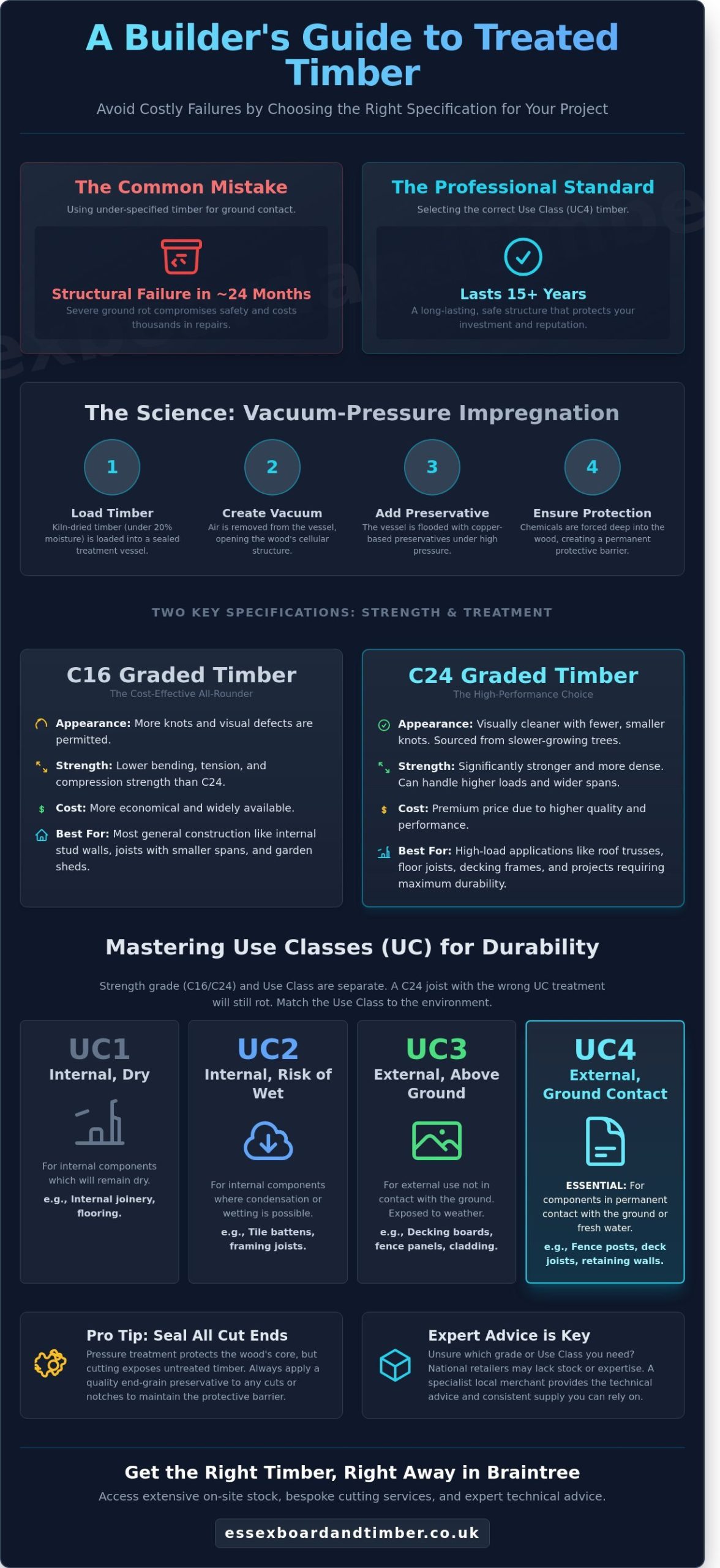
Understanding What is Treated Timber involves looking beyond the surface of the wood. At Essex Board & Timber, we supply treated timber that’s undergone a rigorous industrial process known as vacuum-pressure impregnation. This isn’t a simple DIY application of wood stain or a quick dip in a tank. We stock timber that’s been placed into a sealed hydraulic chamber where air is removed to create a vacuum. This allows high-pressure pumps to force preservative chemicals deep into the wood’s cellular structure. This creates a permanent barrier that protects the core of the wood, not just the outer millimetre.
Surface-applied treatments found in hardware shops often fail within 24 months when exposed to the British weather. In contrast, the industrial pressure-treated stock we provide at Essex Board & Timber is designed for decades of service. Since the 2006 UK regulations moved away from older CCA (Chromated Copper Arsenate) treatments, the industry has adopted more sustainable, copper-based alternatives. These modern chemicals are highly effective against rot while meeting strict environmental safety standards for residential gardens and public spaces.
The Science of Pressure Treatment
The effectiveness of our treated timber relies on copper-based preservatives which act as a powerful fungicide and insecticide. These chemicals bond with the wood fibres to prevent the biological breakdown that usually occurs in damp conditions. At Essex Board & Timber, we ensure our stock is properly seasoned. Kiln-drying the wood to a moisture content below 20% before treatment is vital. It opens the timber’s pores to accept the maximum amount of preservative. We also allow for proper drying after the process to ensure dimensional stability. This means the joists or deck boards you buy from us won’t warp or twist excessively once they’re installed on-site.
Why Braintree Builders Prioritise Treated Stock
Local ground conditions in Braintree and across the wider Essex area are notorious for heavy clay content. This soil retains significant moisture throughout the year, especially during the winter months when rainfall averages 60mm per month in the region. For any timber in ground contact, such as fence posts or sleeper walls, untreated wood will succumb to “soft rot” fungi within 3 to 5 years. Essex Board & Timber recommends pressure-treated stock for these applications to extend the lifespan of the structure to 15 or even 25 years.
The cost-benefit analysis for Braintree developers is clear. While untreated carcassing timber might seem cheaper initially, the labour costs of replacing a failed garden structure after five years are three times the original investment. Our trade customers at Essex Board & Timber understand that using the right specification from the start protects their reputation and saves the homeowner money in the long run. We maintain high stock levels of various grades, ensuring that whether you’re building a simple pergola or a complex tiered deck, you have access to the most durable materials available in the county. Our team provides the technical expertise needed to match the right treatment class to your specific project requirements.
C16 vs C24: Choosing the Right Graded Treated Timber for Your Essex Project
Selecting the correct treated timber for a project in Braintree requires a clear understanding of the difference between strength grading and preservative treatment. These are two distinct processes. Grading refers to the structural integrity and load-bearing capacity of the wood, while treatment involves pressure-impregnating the timber with chemicals to prevent rot and insect attack. For most external or structural applications in Essex, your material must satisfy both requirements. At Essex Board & Timber, we ensure our carcassing timber meets these rigorous standards so your build remains safe and durable for decades.
You will often encounter the term “regularised” when browsing our stock. This means the timber has been kiln-dried and machine-planed to a consistent width and thickness, usually featuring slightly rounded edges for easier handling on-site. This differs from rough-sawn timber, which can have slight dimensional variations and a coarse finish. For precise framing and joist work, Essex Board & Timber recommends regularised stock because it saves time during installation and provides a more professional finish. All our structural softwood adheres to UK timber construction standards, ensuring that the moisture content and strength profiles are appropriate for the British climate.
Understanding C24 Graded Timber
C24 is the premium grade for structural softwood in the UK. It’s sourced from slower-growing climates where the higher wood density results in fewer, smaller knots and a tighter grain. This makes it significantly stronger than C16. Braintree contractors prefer C24 for demanding applications like C24 Treated Timber for structural floor joists and roof rafters. Because C24 can support heavier loads over wider spans, it allows for more open-plan designs in home extensions and loft conversions. At Essex Board & Timber, we see a 35% higher demand for C24 in commercial builds where structural performance is non-negotiable.
When is C16 Sufficient?
C16 is a cost-effective alternative that remains a staple for many Braintree residential projects. While it has a higher frequency of knots and a slightly less uniform grain than C24, it’s perfectly suitable for vertical applications like internal stud walls or shorter rafter spans. If your project doesn’t require the maximum load-bearing capacity of C24, C16 offers a way to manage your budget without compromising on the quality of the treated timber. It’s frequently used in garden room framing and general decking sub-structures where the spans are modest. We maintain deep stock levels of both grades at our yard to ensure you have the right material for every specific task.
Whether you’re a developer managing a large site or a homeowner tackling a renovation, getting the right specification is vital. Our team at Essex Board & Timber provides expert advice on which grade suits your specific span tables and loading requirements. You can check our current stock availability or speak to one of our specialists at the trade counter to ensure your Braintree project stays on track and within budget.
Understanding Use Classes: From Garden Trellises to Structural Joists
Not all wood treatment provides the same level of protection against the elements. The British Standard Use Class (UC) system defines exactly where a piece of timber can be safely installed to ensure it lasts. At Essex Board & Timber, we ensure our customers understand these distinctions to avoid costly structural failures. The Wood Protection Association provides the industry guidelines that dictate these standards, ensuring every piece of wood is fit for purpose. UC1 and UC2 are strictly for internal applications. UC1 covers internal joinery in permanently dry buildings, such as floorboards. UC2 is suitable for internal roofing timbers or tiling battens where there’s a slight risk of moisture. These materials typically last the entire life of the building if they remain protected from direct wetting.
Disaster strikes when homeowners or contractors use UC2 timber for external projects. This mistake is the single biggest cause of rot in Braintree gardens. It’s often done to save a small amount of money upfront, but the wood will likely fail within 24 months when exposed to the British weather. Essex Board & Timber staff are trained to spot these errors before you leave the yard, helping you select the correct treated timber for the specific environment of your project.
UC3: Above Ground External Use
UC3 timber is the standard for outdoor projects where the wood doesn’t touch the ground. This category includes deck boards, fence panels, and external cladding. While this treated timber resists rain and snow, it requires proper drainage to reach its 15 to 30 year expected lifespan. Essex Board & Timber organises our stock by use class to make selection simple for our customers. If water pools on a UC3 deck board without a way to escape, the treatment will eventually be bypassed, leading to soft rot. We always recommend applying a brush-on preservative to any cut ends to maintain the integrity of the UC3 protection.
UC4: Direct Ground Contact and Water
Any timber touching the soil or submerged in water must be UC4. This includes fence posts, gravel boards, and heavy-duty sleepers. Essex soil, particularly the heavy clay found across much of Braintree, holds significant moisture throughout the year. UC4 treatment involves a much higher chemical concentration and deeper pressure penetration than UC3. It’s a massive false economy to use UC3 for a fence post. A proper UC4 post typically lasts 15 years, whereas a UC3 post often rots at the ground line in under 5 years. Essex Board & Timber stocks high-quality UC4 kiln-dried posts to ensure maximum preservative uptake, providing a sturdy foundation for any garden structure. We don’t cut corners on ground-contact specifications because we know the local conditions demand the best protection available.
How to Work with Treated Timber: Cutting, Sealing, and Maintenance
Many homeowners in Braintree assume that treated timber is a maintenance-free product that requires no further attention once installed. This is a misconception that often leads to premature rot. While the pressure-treatment process used by Essex Board & Timber provides a deep level of protection, it doesn’t make the wood invincible. Timber is a natural, hygroscopic material. It breathes, moves, and reacts to the Essex climate. Regular inspections are vital. You should look for signs of checking or splitting every 12 months, especially after a dry summer.
Safety is a priority when handling these materials. The chemicals used in the pressure-treatment process are fixed within the wood fibres, but they can be irritating in dust form. Always wear a P2-rated dust mask and eye protection when machining. Don’t burn off-cuts in domestic fireplaces or wood burners. The high temperatures can release chemical vapours. Instead, dispose of waste at a licensed site. Essex Board & Timber staff can provide safety data sheets if you’re managing a large-scale commercial site in the local area.
When you cut or drill a piece of treated timber, you break the protective “envelope” created by the tanalising process. The chemical penetration rarely reaches the very centre of thick structural beams. By sawing a 100mm post, you expose the untreated heartwood to the elements. This creates an entry point for fungi and moisture. Without immediate remedial action, the internal core will begin to decay while the exterior looks perfectly sound. This internal rot is the most common cause of fence post failure in the UK.
The Essential Cut-and-Seal Rule
Every single cut end must be re-treated with a dedicated end-grain preserver. This isn’t a suggestion; it’s a requirement for maintaining the structural integrity of your project. The process is simple. Brush the preservative onto the exposed grain until the wood stops absorbing the liquid. This restores the chemical barrier. Essex Board & Timber stocks 1-litre and 5-litre tins of high-quality end-grain sealants at our Braintree yard. Using these products ensures your 15-year service life remains valid. It’s a five-minute task that prevents a decade of headaches.
Choosing the Right Fixings for Treated Wood
Standard bright zinc-plated (BZP) screws are unsuitable for outdoor projects. Modern treatment chemicals contain copper, which triggers a galvanic reaction when it meets carbon steel. This reaction causes the screw to corrode from the inside out. In many cases, the head of a standard screw will snap off within 24 months of installation. This chemical reaction also causes “bleeding,” where unsightly black or blue streaks run down the face of your timber cladding or decking.
Essex Board & Timber recommends using hot-dipped galvanised or stainless steel fixings for all external work. For projects within 15 miles of the coast, 304 or 316-grade stainless steel is the only reliable choice. We stock a comprehensive range of Timco and Spax decking screws specifically coated to resist the salts found in pressure-treated wood. These fixings ensure your structure stays rigid and looks professional for its entire lifespan. Investing in the correct hardware is just as important as selecting the right grade of wood.
Ready to start your next garden project? Contact Essex Board & Timber today to discuss our current stock of treated joists, posts, and specialist fixings.
Essex Board & Timber: Your Trusted Local Source for Treated Timber in Braintree
Choosing a local independent merchant like Essex Board & Timber offers distinct advantages that national DIY chains simply cannot replicate. We don’t just move volume; we understand the specific technical requirements of Braintree construction projects. Our Braintree site features a dedicated machining facility where we provide a bespoke cutting service. Since our last facility upgrade in 2022, we’ve increased our precision capabilities, allowing us to offer a 24-hour turnaround on most custom orders. If your project requires non-standard lengths or specific dimensions for a unique garden structure, our team handles the machining on-site. This saves you valuable time and eliminates the hassle of on-site adjustments.
Reliability is the backbone of our operation. We operate a dedicated fleet of delivery vehicles to ensure your materials arrive exactly when promised. Our local delivery radius covers the entirety of Braintree and surrounding Essex towns, keeping trade professionals on schedule. For contractors working on multiple sites across the county, opening a trade account with Essex Board & Timber is a logical step. Over 85% of our regular trade clients benefit from these accounts, which provide access to consistent pricing and simplified monthly invoicing. It’s a system designed to let you focus on the build while we handle the logistics of supply.
Our Commitment to Reliable Stock Levels
We maintain an extensive on-site inventory to ensure we never let a customer down. Our yard is packed with C24 graded carcassing for structural integrity, CLS for internal studwork, and a vast array of fencing materials. This high-quality treated timber is processed to resist fungal decay and insect attack, ensuring longevity in the damp UK climate. We also pride ourselves on our ability to source specialist sizes that others don’t carry, such as oversized structural beams or specific decorative claddings. We take a no-nonsense approach to quality control. Every batch of timber is inspected to ensure it meets our rigorous standards before it’s loaded for delivery. Whether you need 200 linear metres of gravel boards or a single structural post, our stock levels are managed to meet immediate demand without delay.
Supporting the Braintree Building Community
Our trade counter on Bakers Lane is a vital resource for the local area. It’s a place where Braintree developers and competent DIY enthusiasts can access decades of combined industry expertise. We’ve spent the last 15 years building long-term relationships with Essex developers, helping them deliver successful projects ranging from minor garden renovations to significant housing developments. We’re proud of our Essex identity and our role in supplying the materials that build our local community. We don’t rely on flashy marketing; we rely on the quality of our softwood and the efficiency of our service. If you’re planning your next outdoor project, Contact the Essex Board & Timber team today to discuss your specifications or to set up a trade account for your business.
Build Your Next Essex Project with Confidence
Selecting the right materials is the foundation of any successful build. By choosing the correct C16 or C24 grading and understanding Use Class specifications, you’re ensuring your project stands the test of time against the elements. It’s vital to remember that any cut made to treated timber requires immediate resealing with an end-grain preservative to prevent moisture ingress and rot. Essex Board & Timber remains the primary partner for Braintree builders who value quality and efficiency. As an independent Essex merchant with over 25 years of industry experience, Essex Board & Timber stocks over 10,000 linear metres of timber at our local depot to ensure you never face site delays. Our team provides a bespoke cutting service on-site, allowing you to get the exact dimensions needed for complex joist layouts or garden structures. Essex Board & Timber prides itself on being a dependable local supplier that understands the specific needs of the Essex construction trade. Stop by our Braintree yard to see our extensive stock levels first-hand and speak with our knowledgeable staff about your requirements.
View Our Full Range of Treated Timber and Open a Trade Account Today
We look forward to helping you get your next project off the ground with the most reliable materials in the region.
Frequently Asked Questions
Is treated timber safe for use in raised vegetable beds in my Braintree garden?
Yes, modern pressure-treated timber is safe for vegetable beds because it no longer contains arsenic or chrome. Since 2004, UK regulations have mandated the use of copper-based preservatives that are safe for soil contact and food production. For extra peace of mind, Essex Board & Timber recommends lining the interior of your raised beds with a heavy-duty polythene sheet. This prevents direct soil-to-wood contact and helps your treated timber last even longer in damp Essex soil.
How long does pressure-treated timber typically last in the Essex climate?
You can expect UC4 ground-contact timber to last for 15 years, while UC3 components used above ground often reach a 30-year lifespan. Essex weather, with its average annual rainfall of 600mm, can be hard on wood. Using high-quality materials from Essex Board & Timber ensures your garden structures remain structurally sound despite seasonal moisture. Regular maintenance and ensuring proper drainage around the base of posts will help you reach these longevity benchmarks.
Can I paint or stain treated timber immediately after purchase?
No, you shouldn’t paint or stain newly delivered timber immediately. Pressure-treated wood is saturated with liquid during the preservation process and requires time to dry out completely. We recommend waiting between 2 and 4 months, or until the moisture content drops below 20 per cent. If you apply a finish too early, the moisture trapped inside will cause the paint to blister and peel within weeks.
What is the difference between green and brown treated timber?
The only difference is the aesthetic dye added during the pressure-treatment process; the level of rot protection remains identical. Green treatment leaves a subtle olive hue that fades to silver, while brown treatment provides a darker, cedar-like appearance from the start. Essex Board & Timber stocks both varieties to suit different garden styles. Choose the colour that fits your project’s look, knowing both options provide the same industrial-grade resistance to fungal decay.
Do I really need to use end-grain preserver if I cut a treated joist?
Yes, applying an end-grain preserver is essential every time you cut, notch, or drill a treated timber joist. While the pressure treatment penetrates deep into the wood, the very centre of thicker timbers may not be fully reached. Cutting exposes this vulnerable core to the elements and insects. Essex Board & Timber stocks specialist brush-on treatments specifically designed to reseal these exposed ends and maintain your timber’s 15-year or 30-year warranty.
Why is my treated timber turning a silver-grey colour over time?
This colour change is a natural result of UV weathering and doesn’t indicate that the wood is rotting. Exposure to sunlight breaks down the lignin in the wood’s surface, causing the original green or brown tint to fade into a silvery-grey patina. This process usually begins within 6 to 12 months of installation. If you prefer the original look, you can apply a UV-stabilised oil or stain once the timber is dry.
Does Essex Board & Timber deliver treated materials to surrounding areas like Chelmsford or Witham?
Yes, Essex Board & Timber operates a dedicated delivery fleet serving Braintree, Chelmsford, Witham, and the wider Essex area. We pride ourselves on a reliable service that gets your materials to the site exactly when you need them. Whether you’re a trade professional in CM1 or a DIY enthusiast in CM8, our team ensures prompt arrival. Contact our trade counter to discuss delivery slots and competitive rates for your specific postcode.
What is the best way to dispose of offcuts from treated timber projects?
You must never burn treated wood in garden fires or wood burners because the preservatives release toxic fumes when ignited. The correct method is to take your offcuts to a licensed household waste recycling centre or a commercial waste transfer station. In the UK, this material is classified as Grade C hazardous waste. Essex Board & Timber recommends keeping offcuts to a minimum by using our bespoke cutting service for your project requirements.
