Wasted hours and unexpected delivery fees from national chains are costing Braintree tradespeople more than the plywood itself. We know the frustration. You need reliable, structurally sound 18mm plywood for a critical job, but you’re met with inconsistent quality, steep delivery charges for heavy sheets, and a frustrating lack of precision cutting services when you need them most.
This guide cuts through the noise. We’ll show you exactly what to look for in high-grade structural and joinery plywood, how to get it delivered to your Essex site efficiently, and why sourcing from a local, independent timber merchant makes all the difference. We’ll cover everything from understanding EN 636 classifications to the practical benefits of our bespoke cutting service, ensuring your next project starts with the right materials, cut to the perfect size.
Key Takeaways
- Understand why 18mm plywood is the go-to structural sheet material for load-bearing applications like roofing and flooring across Essex.
- Learn to select the right grade for your project by comparing Hardwood vs. Softwood and understanding EN standards for humid or external conditions.
- Make an informed choice between plywood, OSB, and MDF to ensure you use the correct board for structural integrity versus internal joinery.
- Discover the recommended tools and screw specifications required to cut and fix 18mm sheets cleanly and securely for a professional finish.
Understanding 18mm Plywood: The Structural Workhorse for Braintree Projects
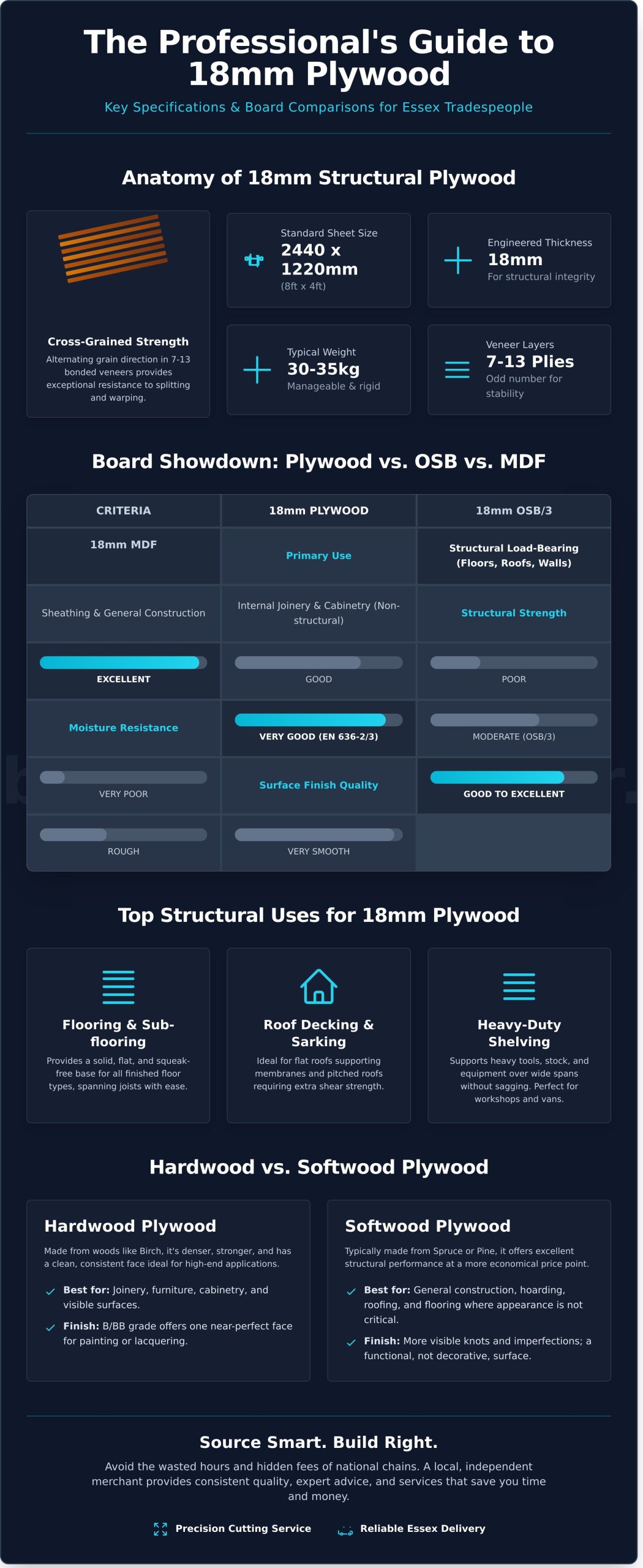
At its core, 18mm plywood is an engineered sheet material built for exceptional strength and dimensional stability. It’s constructed by bonding multiple thin layers of wood veneer, known as plies, with their grain direction alternating at 90-degree angles. This cross-graining technique is what gives the board its remarkable resistance to splitting, bending, and warping, making it a highly reliable choice for demanding structural applications. You can find a detailed overview of the manufacturing process for Plywood, but for UK tradespeople, the key takeaway is its predictable performance under significant load. This inherent strength and reliability are precisely why the 18mm thickness has become the established gold standard for countless construction jobs across Essex.
The standard sheet size stocked at our Braintree depot is 2440mm x 1220mm, or 8ft x 4ft in traditional measurements. This dimension is designed for efficiency, allowing for rapid coverage of large areas and aligning perfectly with standard UK joist centres of 400mm or 600mm. When you’re laying a sub-floor or decking a roof, this compatibility saves valuable time on cutting and fitting. Sourcing your sheets from a dedicated independent timber merchant like Essex Board & Timber is also critical. We ensure you receive consistently graded, high-quality material that meets the performance standards required for UK building regulations, a level of quality assurance not always guaranteed by larger, non-specialist retailers.
Why 18mm Thickness Matters for Structural Integrity
The 18mm specification isn’t arbitrary; it’s a precise thickness engineered for performance. One of the key design features is the use of an odd number of veneers. This creates a balanced panel where the forces are distributed evenly, which is crucial for preventing the warping and twisting that can compromise a structure over its lifespan. A typical 2440 x 1220mm sheet of 18mm hardwood plywood weighs between 30-35kg, a weight that is manageable for two people to handle on site but provides the substantial rigidity needed for load-bearing tasks. Structural 18mm plywood is an engineered wood panel constructed from an odd number of bonded wood veneers, typically ranging from 7 to 13 layers, for maximum dimensional stability.
Common Uses for 18mm Plywood in Essex Homes
Across Braintree and the surrounding Essex towns, from Halstead to Witham, 18mm plywood is the go-to material for a range of critical applications. Its combination of versatility and strength makes it indispensable for both new-build projects and essential renovations. Some of the most frequent uses we supply for include:
- Structural Flooring & Sub-flooring: It provides a solid, flat, and durable base for finished flooring like hardwood, laminate, or carpet. It’s a common sight in new residential developments, offering a robust and squeak-free foundation that’s essential for a quality finish. Its ability to span joists effectively makes it the primary choice for first-floor construction.
- Roof Decking & Sarking: For flat roofs on extensions, dormers, and garages, 18mm ply offers the strength to support modern roofing membranes like EPDM or GRP and withstand occasional foot traffic for maintenance. On pitched roofs, it’s used as a sarking board beneath tiles or slates, adding significant rigidity and shear strength to the overall roof system.
- Heavy-Duty Shelving & Workshop Fit-Outs: Local businesses and serious DIY enthusiasts rely on its excellent load-bearing capacity for creating workshop shelving, van racking, and custom storage units. Unlike MDF or chipboard, it can support heavy tools, commercial stock, and equipment over wide spans without sagging.
Grades and Specifications: Choosing the Right 18mm Ply for Essex Conditions
Selecting the correct sheet of 18mm plywood isn’t just about size. The performance of your project, whether it’s a structural floor in a new build or bespoke cabinetry for a kitchen renovation, depends entirely on choosing the right grade and specification. With the damp Essex climate, understanding moisture resistance and structural integrity is non-negotiable. At Essex Board & Timber, we stock a comprehensive range of panels precisely because one type does not fit all applications.
The fundamental choice begins with the timber itself. Deciding between hardwood and softwood ply directly impacts the finish, durability, and cost of your work.
Hardwood Plywood vs. Softwood Plywood
For projects where the surface will be visible and a high-quality finish is paramount, 18mm hardwood plywood is the superior choice. Typically made from birch or tropical hardwoods, it offers a denser, stronger panel with a cleaner, more consistent face. This makes it ideal for furniture, joinery, and wall panelling. We stock various visual grades, such as B/BB, which means one face (B) is clean and virtually knot-free, perfect for painting or lacquering, while the reverse face (BB) allows for minor, sound knots and repairs.
Conversely, softwood plywood is the cost-effective workhorse for structural jobs where aesthetics don’t matter. It’s perfect for roof sheathing, subfloors, and site hoarding. While strong, its surface is less uniform and may have more knots, making it unsuitable for a fine finish without significant preparation.
Understanding Moisture Resistance: EN Standards and WBP Glue
A plywood panel’s resilience to moisture comes from its adhesive, not just the wood. All our structural plywood is bonded with Water and Boil Proof (WBP) adhesive, which provides excellent resistance to delamination. This adhesive is the foundation for the European standards that classify plywood for different environments:
- EN 636-2 (Humid Conditions): This grade is suitable for protected applications where the panel might be exposed to high humidity. Think bathroom panelling, utility room cabinets, or unheated workshops in Braintree. It can withstand occasional wetting but must be allowed to dry out.
- EN 636-3 (Exterior Conditions): This is the specification for external use. It’s built to withstand weather exposure, making it the correct choice for shed roofs, soffits, and other outdoor construction. Crucially, even EN 636-3 panels require all faces and edges to be sealed with an appropriate paint or preservative to ensure a long service life.
A common misconception involves “Marine Grade” plywood. While genuine BS 1088 marine ply offers the ultimate water resistance for boat building, it’s often an expensive and unnecessary specification for garden projects. A properly sealed EN 636-3 hardwood panel provides more than enough durability for most outdoor applications at a fraction of the cost. However, for projects requiring the absolute highest moisture resistance and structural integrity, 18mm marine plywood to BS 1088 specification remains the gold standard for demanding applications.
Certification and Structural Compliance
Professional tradespeople know that compliance is key. That’s why we prioritise sourcing our stock from suppliers with FSC (Forest Stewardship Council) or PEFC (Programme for the Endorsement of Forest Certification) credentials, ensuring our timber comes from sustainably managed forests. For any structural use, such as flooring or roofing, UK Building Regulations mandate the use of CE marked materials. Look for the CE2+ mark on the panel; this confirms it has been tested and approved for use in permanent construction. For detailed advice on the correct structural rating for your job, you can check the data sheets on our product pages or speak directly with our trade counter team.
Structural Applications: 18mm Plywood vs. OSB and MDF in Essex Construction
Choosing the right sheet material is a foundational decision for any construction project in Essex. While all 18mm boards might look similar on a rack, their structural performance varies dramatically. The choice between plywood, Oriented Strand Board (OSB), and Medium-Density Fibreboard (MDF) directly impacts the durability, safety, and longevity of your build. Get it right, and you have a robust structure; get it wrong, and you risk costly failures down the line.
For load-bearing applications like flooring and roofing, the contest is squarely between 18mm plywood and 18mm OSB3. OSB3 is often cheaper, making it a tempting option for large-scale developments. However, plywood consistently offers superior structural integrity and moisture resistance. If a plywood floor or roof deck is exposed to a leak, it tends to delaminate but can often dry out and retain much of its strength. OSB3, by contrast, can swell at the edges when wet, a change that is largely irreversible and compromises its structural capacity.
Flooring Systems and Load-Bearing Capacity
For a solid, squeak-free floor, correct installation is key. To prevent deflection or ‘bounce’, 18mm plywood flooring should be laid over joists at a maximum of 600mm centres, though 400mm centres provide a noticeably firmer feel underfoot. In Braintree renovations, we see many tradespeople choosing plywood over traditional floorboards because it creates a single, stable diaphragm, ideal for modern finishes like LVT or tile. A sheet of 18mm hardwood plywood can comfortably support a uniformly distributed load of 1.5 kN/m², typical for domestic applications, when fixed over joists at 400mm centres. For a truly robust system, pairing your flooring sheets with high-quality C24 graded timber joists ensures the entire structure meets and exceeds performance requirements.
Roofing and External Sheathing
Plywood provides a superior substrate for flat roofing systems. Its cross-laminated veneer construction offers excellent dimensional stability and a solid base for mechanical fixings, crucial for EPDM, GRP, and traditional felt roofing. Unlike OSB, it’s less prone to flexing between trusses, ensuring a perfectly flat finish. However, no timber product works well in a damp environment. Proper moisture management, including adequate cross-flow ventilation in the roof space, is essential to prevent condensation and protect the entire roof structure. We always recommend building your roof carcass with our range of C24 treated timber to guarantee longevity against the unpredictable Essex weather.
So where does 18mm MDF fit in? It doesn’t. While it’s an excellent material for internal joinery, such as shelving, cabinet doors, and bespoke furniture, it has virtually no structural strength and reacts very poorly to moisture. Made from fine wood fibres bonded with resin, MDF will sag under its own weight over a modest span and swell significantly upon contact with water. It is a finishing material, not a structural one.
For developers across Essex, the cost-benefit analysis is clear. While the initial outlay for OSB3 might be lower, the long-term performance and durability of 18mm plywood reduce the risk of expensive call-backs for issues like squeaking floors or compromised roof decks. Investing in a superior material from the start protects both your build and your reputation.
Practical Guide to Working with 18mm Plywood Sheets
Achieving a professional, long-lasting finish with 18mm plywood depends entirely on the right techniques and materials. This robust sheet material is straightforward to work with, but a few key practices separate a trade-quality job from a flawed one. From cutting to fixing, here’s how to get the best results for your project in Essex.
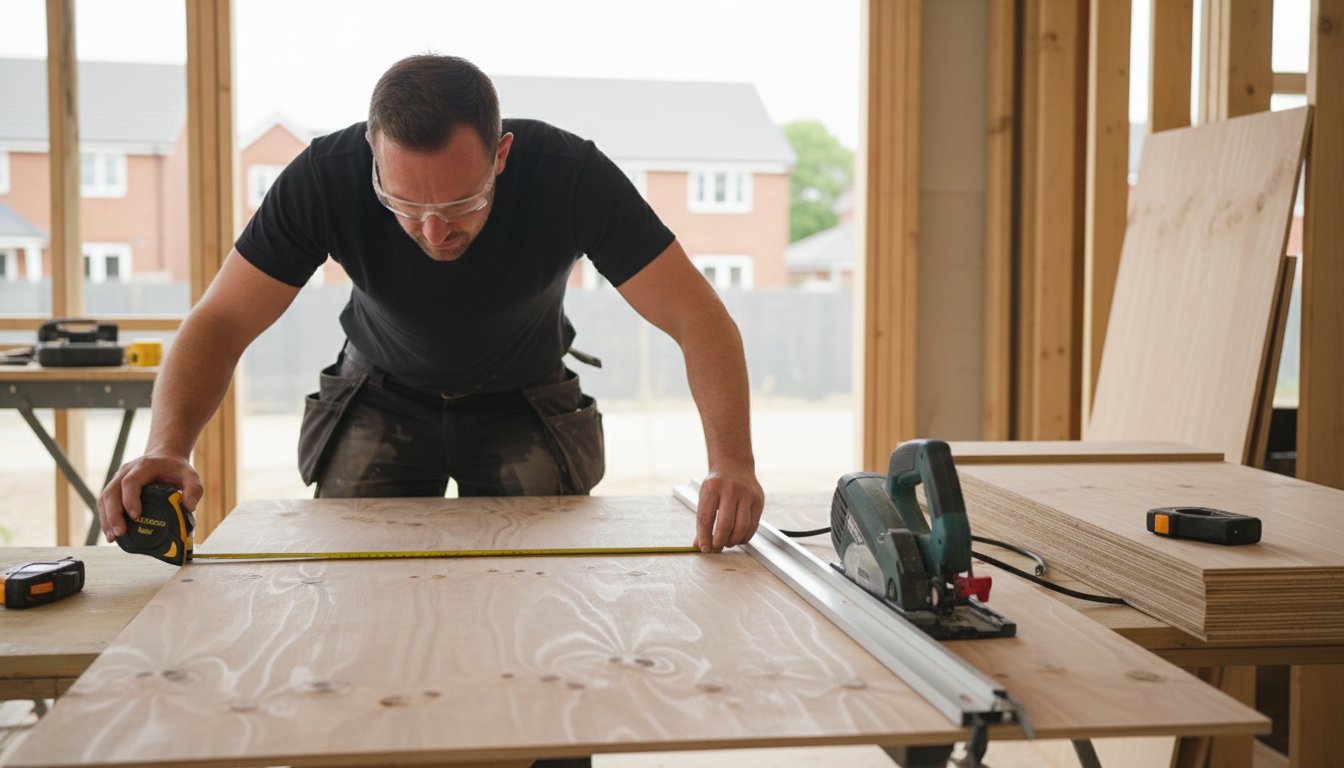
First, consider your cutting method. For straight, clean cuts on site, a circular saw paired with a guide rail is an excellent choice. To minimise tear-out on the top veneer, use a fine-finish blade with at least 60 teeth. A table saw offers superior accuracy for workshop-based projects like furniture or cabinetry. A simple but effective trick to prevent breakout is to score the cut line with a sharp utility knife before sawing, or apply masking tape along the line to support the wood fibres. For guaranteed precision and perfectly square edges without the hassle, our bespoke cutting service at the Braintree depot is the most efficient solution for any job.
Installation and Fixing Tips
When installing 18mm plywood as flooring or large panels, accounting for natural expansion and contraction is critical, especially in Essex’s variable humidity. We recommend leaving a 10-12mm expansion gap at all perimeter walls and a 2-3mm gap between board edges to prevent buckling over time. For a completely rigid and squeak-free structural finish, use a glue-and-screw method. Apply a continuous bead of a high-grab construction adhesive or D4-rated PVA to joists before fixing the boards down. This creates a solid, unified structure that won’t move.
Selecting the correct fixings is just as important. For general construction, use a 4mm gauge (No. 8) screw. The length depends on the application:
- For joining two 18mm boards, a 30mm or 35mm screw is ideal.
- When fixing to standard 47mm deep carcassing timber, use a 50mm screw to ensure sufficient grip.
Always drill a pilot hole, especially within 25mm of a board’s edge, to prevent the layers from splitting.
Finishing and Site Safety
The exposed edges of plywood are its most vulnerable point for moisture ingress. To prevent delamination in damp or external environments, you must seal the edges thoroughly. Apply at least two coats of a waterproof wood sealer, exterior-grade varnish, or a flexible acrylic paint. This small step significantly extends the life of the panel.
Finally, safety on site is non-negotiable. Cutting and sanding plywood generates fine dust containing wood particles and adhesive resins. All trade professionals must use on-tool dust extraction connected to an M-Class extractor to remain compliant with Health and Safety Executive (HSE) guidelines. Always wear appropriate Personal Protective Equipment (PPE), including an FFP3-rated dust mask, safety glasses, and hearing protection when operating power tools. For expert advice on the right fixings and finishes for your project, or to use our precision cutting service, visit our trade counter in Braintree today.
Sourcing 18mm Plywood in Braintree: Why Essex Board & Timber is the Trade Choice
For any construction, joinery, or DIY project in Essex, sourcing the right materials promptly is critical. While national chains have a presence, a dedicated, independent timber merchant offers advantages that simply can’t be matched. At Essex Board & Timber, we are rooted in the local trade community, providing a level of service and stock availability designed to keep your projects on track and on budget.
Choosing a local Braintree supplier means you’re not just a number in a queue. It means direct access to experienced staff, accountability you can rely on, and the assurance that you’re supporting the Essex economy. We understand the specific demands of local builders and tradespeople because we’re part of the same community. This local focus drives our commitment to genuine service.
Our core advantages include:
- Unrivalled Stock Levels: We keep our Braintree yard consistently stocked with over 500 sheets of structural, hardwood, and marine grade 18mm plywood. This means you can arrive and collect what you need, right when you need it, eliminating costly project delays.
- Reliable Essex-Wide Delivery: Our dedicated fleet of flatbed lorries operates daily, providing a dependable delivery service across Braintree, Chelmsford, Witham, and the wider Essex region. We provide clear delivery schedules so you can plan your workday with confidence.
- Streamlined Trade Accounts: For our regular trade customers, a dedicated account simplifies the entire procurement process. Benefit from consolidated invoicing, agreed payment terms, and a consistent point of contact who understands your business needs. It’s a no-nonsense system built for efficiency.
Bespoke Cutting and Machining Services
Our on-site cutting facility is a game-changer for both trade and DIY customers. Using our precision panel saws, we can cut full sheets of plywood to your exact specifications. For tradespeople, this saves valuable time and labour on-site. For DIY enthusiasts, it solves the logistical challenge of transporting an 8×4 sheet and ensures a perfectly square, accurate cut every time, reducing waste and project costs.
Simply provide your cutting list to our team via email or in person at our Braintree trade counter. We can even advise on the most efficient layout to minimise offcuts from each sheet.
Local Knowledge and Trade Support
You can’t buy experience. Our team has decades of combined knowledge in the timber industry, offering practical advice that you won’t find in a big-box retail store. Whether you need guidance on the correct grade of 18mm plywood for a specific structural application or advice on the best finish for a joinery project, our staff are here to provide straight-talking, expert support.
When you choose Essex Board & Timber, you’re investing in a local, independent business that is committed to serving the Essex trade community. Get the materials you need, backed by the expertise you deserve. For comprehensive guidance on all plywood specifications and grades available in Braintree, visit our Braintree yard today or call our team for a fast, competitive quote on your next project.
Secure Your Project’s Foundation with Braintree’s Plywood Experts
Choosing the right sheet material is critical for the success of any job. The structural integrity and versatility of 18mm plywood make it an indispensable asset for projects across Essex, from major carcassing to detailed joinery. Understanding the correct grade for your application isn’t just a detail; it’s what ensures your work stands the test of time.
As Braintree’s established independent timber merchant, Essex Board & Timber is the trade’s choice for a reason. We hold an extensive stock of structural and hardwood plywood, ensuring you get what you need, when you need it. Our on-site, bespoke precision cutting service means you don’t have to compromise on your plans. We deliver the exact specifications your project demands.
Ready to build with confidence? Contact Essex Board & Timber today for a competitive quote on 18mm plywood and local delivery. We’re here to supply the materials that get your job done right.
Frequently Asked Questions About 18mm Plywood
Is 18mm plywood strong enough for a mezzanine floor in a Braintree warehouse?
Yes, 18mm structural grade plywood (to EN 636-2 standard) is suitable for mezzanine decking, but its strength depends on the support structure. For typical commercial loads, joists should be spaced at a maximum of 400mm centres. For any warehouse or commercial application, we strongly advise you consult a structural engineer to ensure the design complies with all load-bearing requirements and building regulations. Safety and compliance are paramount for these projects.
What is the difference between 18mm hardwood and softwood plywood?
The main difference is the timber used for the veneers, which affects performance and cost. Hardwood plywood, made from species like birch, offers superior strength, a smoother surface finish, and greater durability, making it ideal for joinery and flooring. Softwood plywood, from pine or spruce, is more economical and lighter. It’s an excellent choice for general construction, site hoarding, and structural carcassing where a decorative finish isn’t the priority.
Can I use 18mm plywood for a flat roof in Essex?
Yes, 18mm structural plywood is the standard material for flat roof decking. You must use a board with a WBP (Water Boil Proof) glue line, conforming to standard EN 636-2 (humid conditions). This board acts as the substrate for your chosen waterproof membrane, such as felt or GRP. Proper installation and sealing are critical to creating a durable roof that can withstand the unpredictable Essex weather for years to come.
Does Essex Board & Timber offer a delivery service for 18mm plywood in Braintree?
Yes, we run a prompt and reliable delivery service for 18mm plywood across Braintree, Witham, and the wider Essex area. Our dedicated fleet of lorries ensures your sheet materials arrive on-site, ready for your project. We understand that getting materials when you need them is crucial, so we pride ourselves on an efficient service that trade and public customers can depend on. Just place your order and we’ll handle the rest.
Is 18mm plywood better than 18mm OSB for flooring?
Plywood is generally considered the superior option for flooring due to its stiffness and screw-holding ability. The cross-laminated veneer structure of 18mm plywood provides excellent dimensional stability and a more solid feel underfoot. While OSB3 is a strong, cost-effective sub-floor material, plywood is less prone to swelling at the edges if exposed to moisture during construction and provides a better base for floor finishes.
How many screws do I need for a standard 8×4 sheet of 18mm plywood?
As a rule of thumb for flooring, you’ll need around 48 screws for a 2440mm x 1220mm (8×4) sheet. The standard fixing pattern is to place screws every 150mm around the perimeter of the board and every 300mm on the intermediate joists in the “field” of the panel. Using 50mm countersunk wood screws will provide a secure fixing into the joists below, preventing squeaks and movement in the future.
Can 18mm plywood be used outside if it is treated?
Yes, but you must use the correct type and protect it thoroughly. Start with a plywood with a WBP glue line, specified to EN 636-2 for humid conditions or EN 636-3 for exterior use. It’s absolutely essential that you seal all faces and, most importantly, all cut edges with several coats of a suitable exterior-grade paint, varnish, or wood preservative. Without this protection, moisture will penetrate the veneers and cause delamination.
Do you provide a cutting service for 18mm plywood at your Essex yard?
Yes, we offer a comprehensive cutting service for all our sheet materials at our yard. Our on-site panel saws allow us to cut your 18mm plywood sheets to your exact measurements, saving you time and ensuring accuracy. Whether you need one board cut for a DIY project or a large volume for a commercial fit-out, our team can provide the precise cuts you require. This service is a core part of what we do as an independent timber merchant.
