
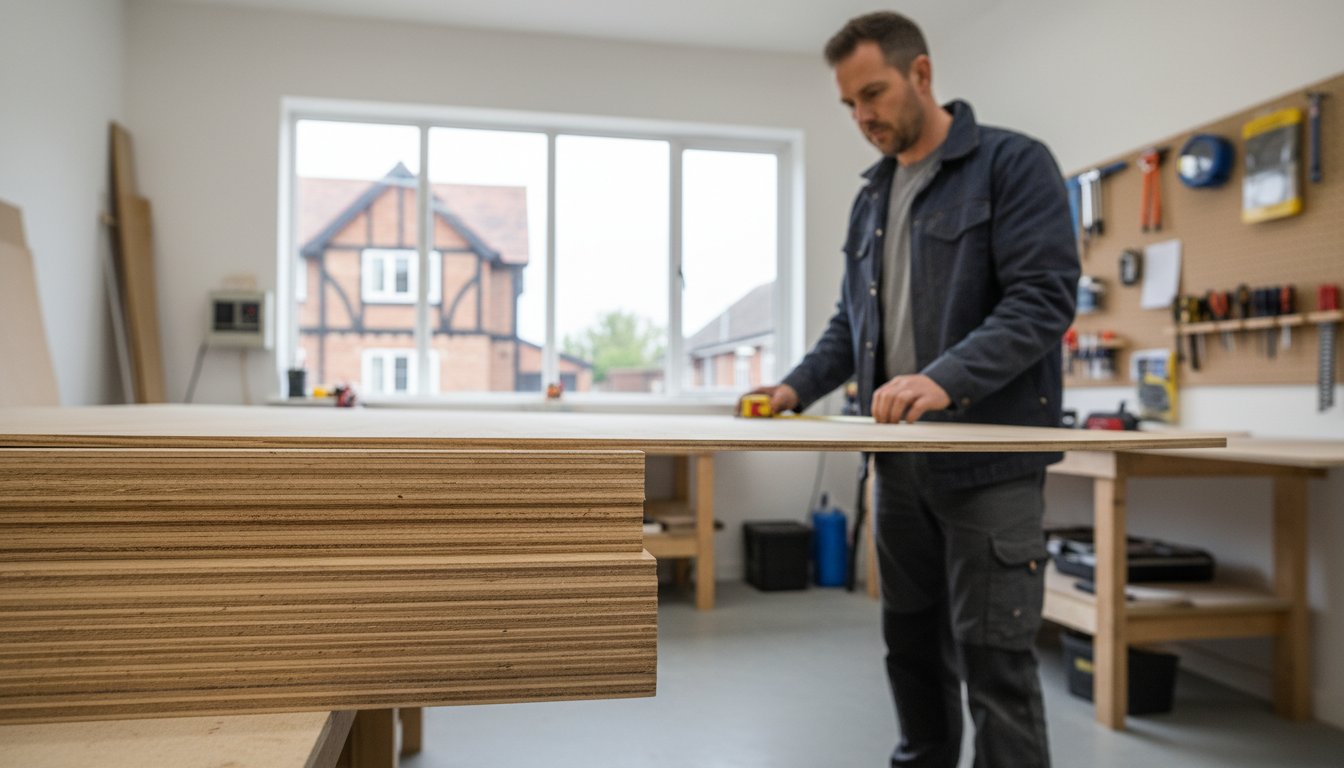
Most ‘exterior grade’ plywood sold across Essex simply isn’t engineered to withstand the constant damp and changing weather we see year after year. It’s a common and costly mistake to assume all boards with a WBP glueline are the same, an error that often leads to delamination and premature failure on exposed projects. You know that a job’s longevity depends entirely on using the correct structural materials from the start, especially when your reputation is on the line. This guide cuts through that confusion, providing the definitive specifications of genuine BS 1088 grade 18mm marine plywood.
We’ll detail its superior structural advantages and show you exactly how to source it for your Braintree projects. From confirming load-bearing capacities to arranging local delivery of cut-to-size 8×4 sheets from Essex Board & Timber, you’ll get the practical, no-nonsense information needed to ensure your work stands the test of time, whatever the Essex weather throws at it.
Key Takeaways
- Understand the BS 1088 standard and why the strict ‘no voids’ rule is essential for the structural integrity of your project.
- Learn why 18mm marine plywood is the superior choice over OSB and MDF for demanding applications like roofing and bathroom flooring.
- Discover practical uses for this versatile sheet material, from boat building on the Essex coast to durable van conversion floors.
- Find out how sourcing your boards from a Braintree specialist like Essex Board & Timber gives you access to precision cutting services.
What is 18mm Marine Plywood and Why is it Essential in Braintree?
At Essex Board & Timber, we often see customers looking for a robust, water-impermeable sheet material. For these jobs, we supply 18mm marine plywood. This isn’t just standard plywood; it’s a premium-grade hardwood sheet engineered for maximum durability in wet and humid conditions. Each sheet is constructed using high-quality veneers bonded with a waterproof adhesive that conforms to the BS 1088 standard, ensuring it withstands constant exposure to moisture without delaminating.
The 18mm thickness provides the structural integrity required for heavy-duty construction projects across Essex. It’s the go-to choice for applications demanding high strength and stability, from van linings and trailer floors to structural elements in boat building and high-exposure architectural features. For Braintree tradespeople, specifying this material means building with confidence, knowing the final product will resist warping and decay for years to come.
A common point of confusion is the difference between “water-resistant” and true “marine grade” plywood. A seasoned joiner knows the distinction is critical. While many exterior-grade sheets can handle occasional damp, genuine marine plywood is built for prolonged saturation. Its high-quality hardwood veneers offer not just superior function but also a clean, consistent finish suitable for visible applications where aesthetics matter as much as performance.
The Anatomy of a Marine Grade Sheet
The strength of marine plywood comes from its construction. Thin veneers of hardwood are cross-laminated, layered with the grain direction alternating at 90-degree angles. This creates a sheet with exceptional impact resistance and dimensional stability. Critically, high-quality hardwood is used throughout the core, not just for the face veneers. This void-free core is what prevents water from becoming trapped inside, which is a common cause of failure in lesser-grade sheets. The 18mm profile strikes an ideal balance between manageable weight for on-site handling and the load-bearing capacity needed for structural work.
Marine Plywood vs. Standard Exterior Plywood
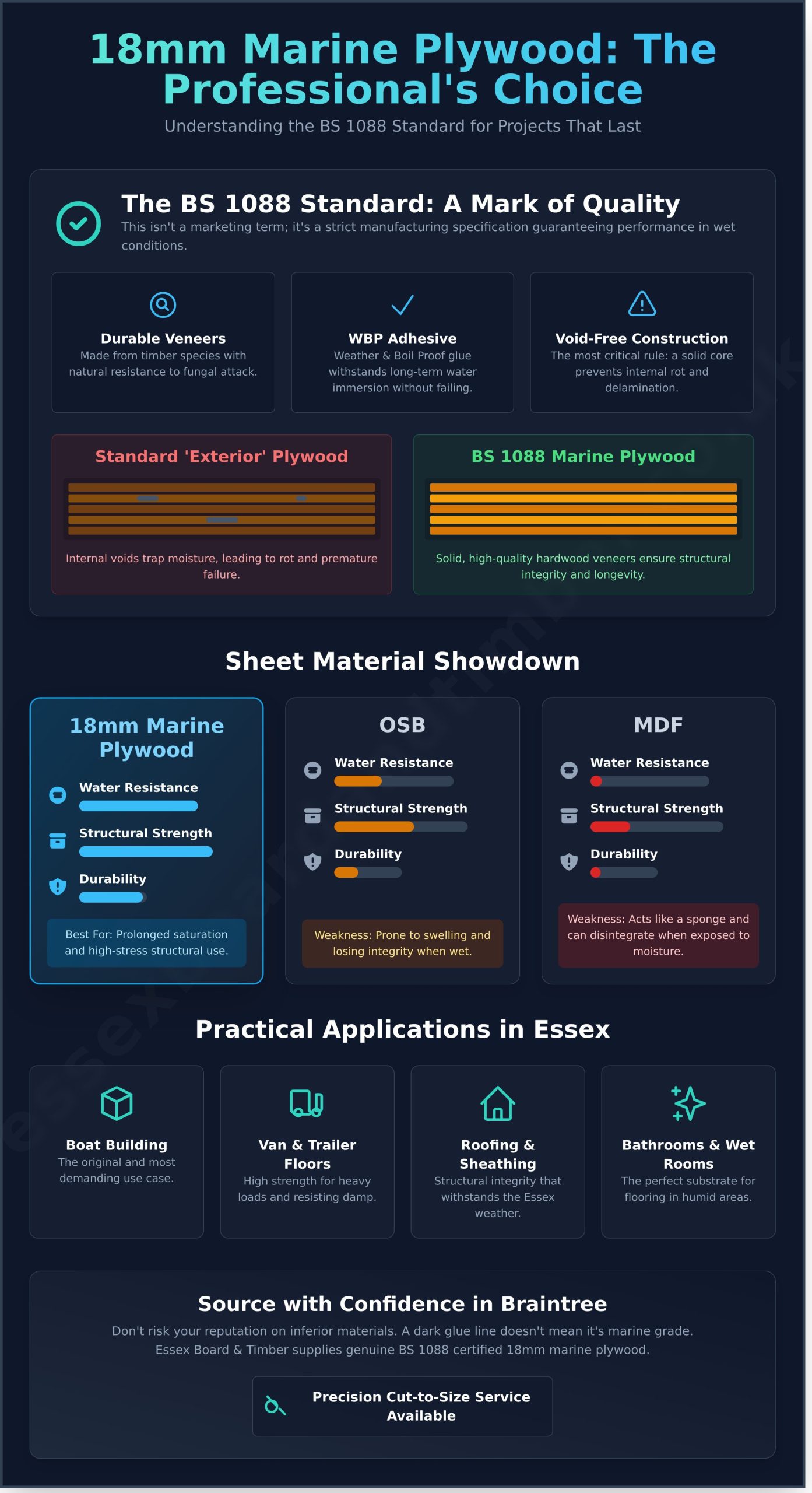
Don’t be misled by the colour of a plywood sheet; a dark glue line doesn’t automatically mean it’s marine grade. Many standard exterior plywoods use a WBP (Water and Boil Proof) adhesive, but their internal construction differs significantly. These standard sheets can contain voids or use lower-grade timber in their core layers, creating weak points. Understanding the technical details of what is marine plywood shows the standard is defined by the quality of the veneers and the absence of core gaps, not just the glue. For long-term projects exposed to the variable Essex climate, the cost-to-benefit ratio is clear. The initial investment in genuine 18mm marine plywood from a trusted supplier like Essex Board & Timber pays for itself through superior longevity and performance, preventing costly future repairs and ensuring your work stands the test of time.
Understanding the BS 1088 Standard for 18mm Boards
Not all plywood is created equal. When a project demands total resistance to moisture, the term “marine plywood” is often used, but its true meaning is defined by a single, rigorous benchmark: the British Standard 1088. This isn’t a marketing label; it’s a strict manufacturing specification that guarantees a panel’s performance in the most demanding wet conditions. Any sheet sold by Essex Board and Timber as marine grade is certified to this standard, ensuring you receive a product fit for purpose.
The standard dictates every aspect of the board’s construction, from the timber species to the adhesive used. These stringent requirements are officially documented in the BS 1088 standard and ensure predictable, reliable performance. Key criteria include:
- Durable Veneers: Only timber species with a known natural resistance to fungal attack are permitted. The face veneers must be high-quality, with very few knots or repairs allowed.
- Void-Free Construction: The inner layers, or core, must be solid wood veneers with no gaps or overlaps. This is a non-negotiable rule.
- WBP Adhesive: The glue holding the veneers together must be a Weather and Boil Proof (WBP) phenolic resin, proven to withstand long-term water immersion without failing.
At our Braintree yard, you can verify this for yourself. Every certified sheet carries a stamp marking it as “BS 1088”. Our team is always on hand to show you this mark of quality and explain the difference it makes to your project.
The Importance of Void-Free Cores
The “no voids” rule is perhaps the most critical part of the BS 1088 specification. Standard plywood often contains small internal air pockets or gaps in the core layers. In a damp environment, these voids trap moisture, creating a perfect breeding ground for rot and delamination to begin from the inside out. For a robust sheet like 18mm marine plywood, this integrity is achieved by using multiple, thinner layers of high-quality veneer, ensuring a solid, stable core. This meticulous construction also provides a direct practical benefit for machining, delivering a clean, sharp edge when cut and superior screw retention.
Adhesive Technology: Beyond Standard Glue
The adhesive used in marine plywood is as important as the wood itself. BS 1088 specifies a Weather and Boil Proof (WBP) glue, typically a dark-coloured phenolic resin. This isn’t just a water-resistant adhesive; it’s fully waterproof. The resin creates a permanent, cross-linked chemical bond between the wood veneers that will not break down, even after prolonged exposure to water. To earn its certification, the glue line must survive a 72-hour boiling test without any sign of delamination. Modern production also ensures these adhesives meet low formaldehyde emission standards (E1), making our 18mm marine plywood a safe choice for enclosed spaces like boat cabins or bathroom fit-outs.
Comparing 18mm Marine Plywood to OSB and MDF
Choosing the right sheet material for a job in Essex is more than a line item on a quote; it’s a decision that affects structural integrity, finish quality, and long-term durability. While OSB3 (Oriented Strand Board) and MDF (Medium-Density Fibreboard) have their places, they are fundamentally different products from marine grade plywood. Understanding these differences ensures you select the right board for the right application, avoiding costly failures down the line.
For many structural jobs, the choice comes down to marine ply versus OSB3. Let’s break down where each one excels.
Marine Plywood vs. OSB3 for Essex Builds
OSB3 is a highly effective and economical choice for general construction where moisture is not a primary concern. It’s ideal for wall sheathing, sarking, and standard roof decking in dry, well-ventilated structures. For a straightforward roofing project, OSB3 provides the necessary structural performance at a lower cost per sheet.
However, the moment a structure is exposed to the elements, the calculation changes. For exposed soffits, fascias, or the construction of outbuildings near the Essex coast, marine plywood becomes non-negotiable. Its construction, governed by the rigorous BS 1088 standard for marine plywood, features a waterproof WBP (Weather and Boil Proof) glue line and a core with zero voids. This prevents water from penetrating and causing delamination, a common failure point for lesser materials in damp conditions. For a completely robust roof structure, this high-performance decking must be paired with an equally strong frame, typically built from our C24 graded timber.
For Essex developers, the higher initial price of an 18mm marine plywood sheet is a strategic investment. It drastically reduces the risk of call-backs for moisture-related damage, protecting both the project’s integrity and the builder’s reputation.
Workability and Finishing Differences
The practical differences in the workshop are just as stark. OSB has a textured surface of compressed wood strands, making it difficult to achieve a smooth, high-quality painted finish without extensive filling and sanding. MDF, while offering a smooth face for painting, swells irreversibly at the first sign of moisture, making it unsuitable for anything other than dry, interior applications.
This is why 18mm marine plywood is the preferred choice for bespoke Braintree cabinetry, bathroom vanities, and high-end joinery. Its solid hardwood veneer face provides a stable, consistent surface that can be sanded to a flawless finish, taking paint, stain, or varnish beautifully. For bathroom and wet area flooring, its superior water resistance makes it the only truly reliable choice for a subfloor, providing a stable base for tiles or vinyl that won’t fail due to humidity or minor leaks.
A final consideration for the trade is tool wear. The density of marine plywood and its tough WBP glue line will wear saw blades and router bits faster than OSB or MDF. This is a direct trade-off for its superior strength and durability. At Essex Board and Timber, we advise customers to factor this in, ensuring they use sharp, quality blades for clean, precise cuts.
Practical Applications for 18mm Marine Plywood in Essex
While its name suggests purely nautical uses, marine grade plywood is one of the most versatile and durable sheet materials available at Essex Board & Timber. Its superior construction makes it the go-to choice for projects across the county that demand exceptional strength and resistance to moisture. From coastal boat repairs in Brightlingsea to high-specification garden rooms in Braintree, its applications are extensive.
The key is understanding where its BS 1088 standard brings genuine value. For tradespeople and skilled DIYers, choosing the right grade of plywood prevents costly failures and ensures a professional, long-lasting finish. Here are some of the most common and practical uses we see for it in our region.
Building for the Essex Climate
Our local weather can be unforgiving, with damp winters and humid summers. Standard plywoods can delaminate or rot when exposed to these conditions, but marine ply is engineered to resist them. To maximise its lifespan, it’s crucial to seal all cut edges with at least two coats of a quality waterproof sealant, such as an epoxy resin or a dedicated edge-sealing paint. This simple step prevents moisture from wicking into the core veneers, which is the most common point of failure.
This resilience makes it an excellent choice for sub-floors in bathrooms and utility rooms, where humidity is consistently high. We recently supplied marine grade sheets to a commercial sign maker in Braintree for a series of large external signs. They chose it over other materials because, once properly primed and painted, it provides a stable, warp-resistant base that can withstand years of Essex rain without deteriorating.
This durability is also why it’s specified for high-wear public and commercial settings, such as for creating bespoke furniture, climbing structures, or storage units in schools and daycare centres. While many builders create custom solutions, specialist suppliers like Kigata provide a benchmark for professionally manufactured equipment designed for these demanding environments.
Van Lining and Internal Fit-outs
The van conversion market has made 18mm marine plywood the gold standard for flooring and structural cabinetry. Its structural rigidity provides a solid foundation that won’t flex or creak, even with heavy foot traffic and built-in furniture. However, weight is a critical factor for any vehicle build. A standard 2440 x 1220mm sheet weighs approximately 31kg, a figure you must factor into your vehicle’s overall payload calculations.
Beyond its strength, the high-quality face veneer of marine ply creates a perfectly smooth surface. This is ideal for applying finishes like vinyl flooring, thin laminates, or carpet, as it won’t show imperfections through the final layer. When securing boards to the metal chassis or frame of a van, we advise customers to use specialist fixings for a secure, rattle-free installation.
- Rivnuts (Rivet Nuts): These create a threaded anchor point in the van’s metal ribs, allowing you to bolt the plywood down securely.
- Self-Drilling Screws: For fixing into thinner metal sections, these screws drill and tap their own thread in a single action, speeding up the process.
- Construction Adhesive: Always use a strong polyurethane adhesive alongside mechanical fixings to prevent vibration and add structural integrity.
From heavy-duty shelving in a Chelmsford workshop to the floor of a family campervan, the strength and reliability of this material are unmatched. If your project demands the highest level of performance against moisture and stress, it’s a sound investment.
Planning a build that requires robust, water-resistant materials? Contact the Essex Board & Timber team to discuss your project requirements and get a quote.
Sourcing 18mm Marine Plywood from Essex Board & Timber
When your project demands the specific performance of marine grade plywood, sourcing it from the right supplier is critical. As an independent Braintree timber merchant, Essex Board & Timber offers a service that goes beyond simply selling a sheet of wood. We provide a combination of extensive stock, expert knowledge, and practical support that helps our trade and DIY customers get the job done efficiently and to the highest standard.
Choosing a local, specialist supplier means you get direct access to a team that understands the materials they sell. Unlike large national chains, our focus is entirely on timber and sheet materials. This specialism ensures you receive accurate advice on whether 18mm marine plywood is the correct specification for your application, from boat building to high-moisture construction environments.
Our Braintree Cutting and Machining Service
Getting your materials cut to size before they leave our yard saves valuable time and labour on-site. Our professional cutting service is designed for precision and efficiency. Using industrial panel saws, we deliver a clean, accurate cut that is difficult to replicate with handheld tools. This accuracy is vital for projects requiring tight joins and a professional finish, and it significantly reduces the potential for costly waste from mis-cuts.
The process is straightforward. Simply provide our Braintree team with your cutting list, and we will machine your sheets to your exact measurements. This service ensures your components are ready for assembly the moment they arrive, streamlining your workflow and keeping your project on schedule.
Reliable Stock, Delivery and Expert Advice
For contractors across Essex, project delays are costly. That is why Essex Board & Timber is committed to maintaining a deep and consistent stock of core materials, including a full range of marine plywood thicknesses. We understand that when you need materials, you need them now. Our reliable supply chain and large Braintree yard are set up to meet the demands of large-scale construction and joinery projects without interruption.
We support our stock with a dependable local delivery service. Our fleet operates across Braintree, Chelmsford, Colchester, and the wider Essex region, ensuring your materials arrive on-site, on time. For our trade customers, we offer dedicated trade accounts, simplifying the process of ordering bulk stock and managing project costs effectively.
Ultimately, the advantage of working with Essex Board & Timber is the expertise of our team. We provide practical, honest advice grounded in years of industry experience. We can guide you on the best fixings, finishes, and applications for your materials.
Ready to start your project? Visit our timber yard in Braintree or call our team today for a competitive quote on your 18mm marine plywood requirements.
Source Your BS 1088 Marine Plywood in Braintree
Understanding the BS 1088 standard is crucial for ensuring your project has the durability it needs. For any application in Braintree and across Essex, from boat building to high-moisture construction, choosing genuine marine grade plywood over standard sheet materials like OSB or MDF is a non-negotiable step for long-term performance. At Essex Board & Timber, we provide trade and DIY customers with fully certified 18mm marine plywood that meets this exacting standard.
As an independent Essex timber merchant, we don’t just supply the board; we provide a complete service. Our on-site precision cutting service ensures your panels are machined to your exact specifications, and our reliable local delivery fleet gets your materials to site across Braintree when you need them. Your project deserves the best materials, and our team is ready to supply them.
Ready to get started? Contact our Braintree team for a quote on 18mm Marine Plywood and let’s get your project underway.
Frequently Asked Questions about Marine Plywood
Is 18mm marine plywood completely waterproof without treatment?
No, marine plywood is not completely waterproof on its own. While it’s manufactured with a waterproof WBP (Weather and Boil Proof) glue that prevents delamination, the wood veneers themselves are still porous and will absorb water. For any application exposed to moisture, you must seal all faces, edges, and any cut-outs with a suitable marine-grade paint, varnish, or epoxy resin. This ensures a fully waterproof and durable finish for your project.
What is the difference between BS 1088 and BS 5268 plywood?
These two standards refer to different things. BS 1088 is a British Standard for the manufacture of marine plywood, guaranteeing its quality. It specifies the use of durable veneers with no core voids and a WBP glue line. In contrast, BS 5268 is a code of practice for the structural use of timber. It provides guidance on design and engineering, but it isn’t a grade for the plywood sheet itself. At Essex Board & Timber, we supply plywood manufactured to the BS 1088 standard.
Can I use 18mm marine plywood for external garden decking?
While it is structurally strong and water-resistant once sealed, marine plywood isn’t the ideal choice for decking surfaces. It lacks the anti-slip properties of grooved decking boards and requires meticulous, regular maintenance of its sealant to prevent moisture ingress and rot. For a safer and more durable deck, we recommend using dedicated softwood, hardwood, or composite decking materials, all of which we keep in stock at our Essex depot.
How much does a full 8×4 sheet of 18mm marine plywood weigh?
A standard 8×4 foot (2440mm x 1220mm) sheet of 18mm marine plywood typically weighs between 30kg and 34kg. The exact weight can vary slightly depending on the specific species of hardwood used in its construction and the board’s moisture content. This is a manageable weight for two people to handle on site. If you’re concerned about transport, remember that Essex Board & Timber offers a reliable local delivery service.
Do I need special tools to cut 18mm marine grade boards?
No, you don’t need special tools. Marine plywood can be cut effectively using standard woodworking equipment such as a circular saw, track saw, or jigsaw. For the cleanest cut with minimal splintering on the face veneer, we recommend using a sharp, fine-toothed blade. If you require precise, clean cuts without the hassle, ask about the bespoke cutting service available at our Essex facility. For more detailed guidance on working with 18mm plywood for structural applications, our comprehensive guide covers everything from load-bearing calculations to precision cutting techniques.
Is marine plywood suitable for laser cutting or CNC machining?
Yes, marine plywood is an excellent material for CNC machining. Its high-quality construction with no core voids ensures a clean, consistent, and predictable cut without the risk of the tool dropping into a gap. It can be laser cut, but the WBP glue lines require a higher-powered laser and may produce more charring than you’d find with a standard birch plywood. For precision projects, CNC machining is the superior method.
Why is marine plywood more expensive than standard hardwood plywood?
Marine plywood’s higher price reflects its superior manufacturing process and materials. It’s constructed exclusively from high-quality, durable hardwood veneers, unlike standard plywood which may have a cheaper core. The BS 1088 standard also mandates that there are no core gaps or voids, which is a more demanding and costly process. Finally, the high-performance WBP adhesive adds to the overall cost. You are paying for a premium, highly engineered panel.
How should I store 18mm marine plywood sheets before use?
To keep your sheets in top condition, they must be stored flat in a dry, covered environment. Lay them on at least three level bearers (or dunnage) to keep them off the floor and allow for air circulation. Storing them upright or leaning against a wall for an extended period can cause the boards to bow or warp. Proper storage ensures your plywood remains flat and ready for a professional finish. For comprehensive guidance on selecting the right grade for your project, our detailed guide on plywood supplies in Braintree covers everything from structural specifications to transport considerations for Essex trades and DIY enthusiasts.
