Opting for the cheapest timber grade on your Braintree project could lead to a failed Building Control inspection before the roof is even on. At Essex Board & Timber, we know that balancing a tight budget with structural integrity is a constant challenge for local contractors and developers. It’s frustrating when conflicting advice makes it difficult to decide on c24 vs c16 timber for joists, especially with the latest 2026 updates to UK building standards. Choosing the wrong specification doesn’t just risk your reputation; it can lead to costly remedial work that stalls your timeline.
This guide provides the technical clarity you need to choose between these two grades, ensuring your structural work complies with BS EN 14081 requirements. We’ll break down the specific load-bearing differences, explain the cost implications for your project, and confirm the current availability at our local yard. You’ll finish this article knowing exactly when C24 is mandatory and how Essex Board & Timber supports your build with reliable stock and expert advice tailored to the Essex construction market.
Key Takeaways
- Learn the fundamental differences between C16 and C24 strength grades, focusing on how density and bending strength affect the structural integrity of your build.
- Identify when high-load applications or longer spans require c24 vs c16 timber for joists to ensure your project meets Braintree District Council building control standards.
- Avoid the common pitfall of “bouncy” floors by understanding the stiffness (Modulus of Elasticity) ratings required for modern UK residential construction.
- Understand why consulting a structural engineer is vital before making timber substitutions to maintain safety and regulatory compliance on-site.
- Discover how Essex Board & Timber provides the local trade with reliable stock and bespoke cutting services to keep your project moving efficiently.
What is Strength-Graded Timber? C16 vs C24 Explained
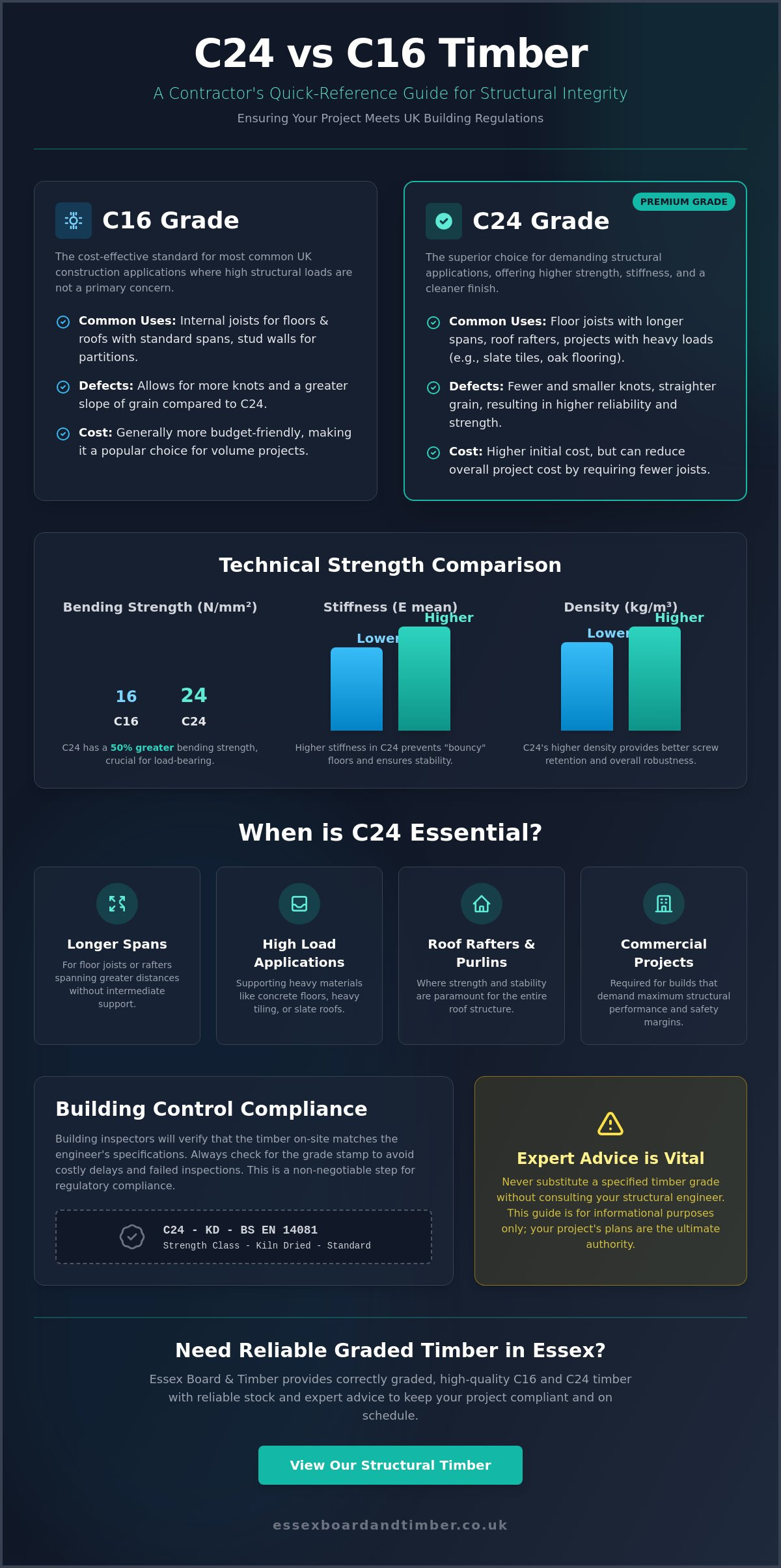
Structural timber isn’t just about the species of tree; it’s about the performance of the wood under pressure. The “C” prefix used in these classifications stands for Coniferous, meaning the timber comes from softwood trees like spruce or pine. The numbers 16 and 24 aren’t arbitrary. They represent the characteristic bending strength of the wood, measured in Newtons per square millimetre (N/mm²). When you’re deciding between c24 vs c16 timber for joists, you’re essentially choosing the level of load the floor or roof can safely support over a specific span.
Every piece of structural timber supplied by Essex Board & Timber is governed by the BS EN 14081 standard. This regulation ensures that the wood meets strict safety and quality benchmarks for UK construction. Before grading, the timber undergoes kiln-drying. This process reduces moisture content to a level that ensures structural stability. It prevents the timber from warping or shrinking after installation, which is a common cause of squeaky floors and cracked plaster in Braintree renovation projects.
The Visual and Machine Grading Process
Timber strength grading is carried out through two main methods. Visual grading involves an inspector checking for physical defects like the size of knots, the slope of the grain, and any fissures or rot. Machine grading is more common for the stock we hold at Essex Board & Timber. It uses sensors to test the actual stiffness and density of the board. C24 timber typically has fewer defects and a tighter grain than C16. This makes it a more reliable choice for demanding structural applications where maximum strength is required.
Identifying Grade Stamps on Site
You don’t want to be caught out during a building control visit. Every length of c24 vs c16 timber for joists must feature a legible grade stamp. This mark contains vital information, including the strength class, the standard it was graded to, and the authority that certified it. Braintree building inspectors are thorough. They will look for these stamps to verify that the materials on site match the structural engineer’s specifications.
When our team at Essex Board & Timber prepares your delivery, we ensure the timber is correctly marked and handled. This attention to detail saves time on site and prevents the headache of failed inspections. Whether you’re building a simple extension or a complex new build, checking for these stamps as the timber arrives is a standard trade practice that ensures your project remains compliant with local regulations.
Technical Comparison: Strength, Stiffness, and Density
Understanding the mechanical differences in the c24 vs c16 timber for joists debate is essential for ensuring your build meets UK Building Regulations. While both grades are typically sourced from the same slow-grown spruce or pine, the sorting process separates them based on physical performance. C24 timber is a premium grade that undergoes more rigorous testing. It offers a cleaner finish with fewer knots, which isn’t just about looks; fewer knots mean fewer weak points in the grain. This results in a product that’s more reliable for heavy-duty carcassing.
The density of the wood plays a significant role in its structural integrity. C24 timber is denser than C16, which means it’s heavier and provides better screw retention and overall stability. When you’re working on a site in Braintree, you’ll notice that C24 boards feel more substantial. This higher density is achieved by selecting timber with tighter growth rings, adhering to the EN14081-1 visual grading standards that dictate how structural timber is classified across Europe. At Essex Board & Timber, we ensure our stock meets these exact specifications so your project stays on the right side of the law.
Load-Bearing Capacity for Essex Projects
For commercial developments or larger residential extensions in Essex, load-bearing capacity is the primary concern. C24 timber offers an approximate 50% increase in bending strength compared to C16, making it the superior choice for high-load applications. This massive jump in strength allows builders to use fewer joists or support heavier floor finishes, such as thick oak flooring or heavy tiling. If you’re unsure which grade your specific span requires, the team at Essex Board & Timber can help you source the right C24 graded timber for the job.
The Impact of Stiffness on Floor Joists
Stiffness, or the Modulus of Elasticity (E), is what determines how much a floor “bounces” when you walk on it. C16 timber has a mean modulus of elasticity of 8.0 kN/mm2, while C24 sits much higher at 11.0 kN/mm2. This 37.5% increase in stiffness is vital for long spans. Using a stiffer timber reduces deflection, ensuring the floor remains rigid and doesn’t crack the plaster on the ceiling below. In height-restricted areas, such as loft conversions, the extra stiffness of C24 often allows for shallower joists to be used without sacrificing structural safety. It’s a practical solution that saves space while maintaining a solid feel underfoot. If you need a specific length for a tricky renovation, you can always contact our yard to discuss our bespoke cutting options.
Choosing Timber for Joists: When is C24 Essential?
Essex Board & Timber understands that every Braintree project has a budget to maintain, but choosing the wrong grade can lead to structural failure or a bouncy floor. When evaluating c24 vs c16 timber for joists, you must look at the clear span and the weight the floor must carry. C16 reaches its physical limits quickly as spans exceed three or four metres. For flat roofs and high-load floor joists, C24 is the industry standard because it offers superior density and fewer knots, ensuring the structure stays rigid under pressure.
While C16 is perfectly acceptable for internal stud walls where vertical loads are minimal, structural floor frames often require the higher performance of C24. It’s a matter of safety and compliance. If you’re building a space intended for heavy furniture or high foot traffic, the extra 10% to 20% investment in C24 is a wise choice. This small increase in material cost prevents expensive remedial work if a floor starts to sag after the project is signed off.
Spans and Joist Spacing
The distance between your joists significantly impacts your timber grade choice. At 400mm centres, you might find that C16 is sufficient for modest spans. However, if you move to 600mm centres to save on material or accommodate services, you’ll almost certainly need C24 Treated Timber. Using the higher grade often allows you to use fewer joists overall, as C24 can bridge longer gaps without compromising the floor’s integrity. Essex Board & Timber keeps large volumes of C24 in stock to ensure your project stays on schedule when these structural requirements arise.
Specific Use Cases in Braintree Homes
Loft conversions in Braintree’s older housing stock are a primary example of where C24 is essential. These projects require maximum strength with minimum timber depth to preserve precious headroom. C24 handles the increased live loads of a living space within a restricted height better than C16 ever could. For ground floor extensions, many builders balance their costs by using C24 for the main floor and roof spans while switching to more affordable options for non-load-bearing elements. If you’re framing internal partitions that aren’t supporting a floor above, read Your Complete Guide to CLS Timber for a more cost-effective alternative.
The decision between c24 vs c16 timber for joists ultimately depends on the specific engineering requirements of your build. Our team at Essex Board & Timber can help you source the exact specifications needed for your 2026 projects, ensuring you meet building regulations while keeping your site efficient. Whether you’re a trade professional or a competent DIYer, getting the grade right at the start is the only way to ensure a solid, dependable finish.
Building Regulations and Structural Safety in Essex
When you’re managing a project in Braintree, Braintree District Council building control officers will look for specific grade stamps on your carcassing. If your structural drawings specify C24 but you’ve installed C16 to save a few pounds, you’re likely to face a costly rejection notice. The structural differences in c24 vs c16 timber for joists aren’t just on paper; C24 can handle higher loads and longer spans because it has fewer knots and a tighter grain. Essex Board & Timber ensures all structural stock is kiln-dried and strength-graded to meet BS EN 14081 standards, so you don’t run into issues during site inspections.
Substituting C16 for C24 without consulting a structural engineer is a significant risk. While C16 is perfectly adequate for many applications, it lacks the stiffness required for the longer, open-plan spans common in modern Essex home extensions. Using a lower grade can lead to “bouncy” floors or, in extreme cases, structural failure. We maintain high stock levels of both grades at our yard to ensure you always have the right material for the job.
Meeting Building Control Requirements
You must keep your delivery notes and ensure grade stamps are visible for the inspector. Common reasons for joist rejection during Essex site inspections include using undersized timbers or failing to match the timber grade to the approved span calculations. If your plans were drawn up using TRADA span tables for C24, installing C16 will invalidate the structural design. Essex Board & Timber provides clear documentation with every delivery, giving you the evidence needed to satisfy building control that your materials meet the required specification.
The Importance of Treatment (UC2 and UC3)
Standard carcassing isn’t enough for ground floor joists or areas where moisture is a factor. You need pressure-treated timber, usually defined by Use Classes UC2 or UC3. UC2 is for internal timbers with a risk of occasional wetting, while UC3 is for external use. Using treated C24 is essential for ground floor joists in Essex builds to protect against fungal decay and wood-boring insects. This is particularly vital in older Braintree properties where sub-floor ventilation might be less than ideal. For projects requiring additional structural sheeting, check out our guide on Plywood Supplies in Braintree to ensure your entire floor deck is up to code.
If you’re ready to start your next project, you can order high-quality C24 structural timber
Sourcing Structural Timber from Essex Board & Timber
Essex Board & Timber maintains a massive inventory of carcassing timber at our Braintree headquarters. We don’t just stock the basics; we keep high volumes of both C16 and C24 structural timber ready for immediate dispatch. Whether you’re framing a simple extension or managing a multi-unit development, having local access to graded timber prevents costly project stalls. We understand that the choice between c24 vs c16 timber for joists often comes down to the specific structural calculations of your build, and we’re here to supply exactly what your architect has specified.
Our bespoke cutting services are designed to save you hours of labour on the job site. Instead of tasking your carpenters with repetitive cross-cutting, our team uses precision machinery to prepare your timber to your exact cutting list. This service reduces site waste and ensures every joist is uniform, which is vital for achieving a level floor. Reliability extends to our transport too. Our dedicated delivery fleet operates across Braintree and the wider Essex area, offering dependable lead times that national retailers struggle to match.
- Large on-site stock of C16 and C24 grades.
- Precision cutting and machining to your specifications.
- Reliable delivery across Braintree and Essex.
- Trade accounts for competitive pricing and priority service.
The Independent Merchant Advantage
Choosing an independent merchant like Essex Board & Timber offers benefits that national retailers can’t replicate. We’ve built our reputation on local knowledge and a genuine commitment to Braintree tradespeople. You won’t be dealing with a call centre; you get direct access to a helpful team that understands technical timber queries. We know the local building landscape and the specific requirements of Essex building control, making us a valuable resource for your project’s success. We prioritise long-term relationships over quick sales, ensuring you get the right materials for the job every time.
Next Steps for Your Project
Deciding between c24 vs c16 timber for joists is a critical step in your planning process. Once your requirements are clear, getting a quote from us is straightforward. You can send your list through our website or visit our Braintree yard to inspect the stock quality yourself. Seeing the timber firsthand allows you to appreciate the grain density and straightness of our C24 stock before it arrives on your site. For ongoing projects, opening a trade account provides access to our most competitive pricing and dedicated support from our expert team.
Contact Essex Board & Timber for a quote today to discuss your joist requirements or to set up a trade account.
Secure the Right Structural Timber for Your Braintree Project
Choosing the correct grade is vital for the structural integrity of any floor or roof. C16 remains a cost-effective choice for shorter spans and internal partitions, but C24 is the industry standard for high-load areas and wider openings. Adhering to UK Building Regulations ensures your project is safe and passes inspection without costly delays. Deciding between c24 vs c16 timber for joists depends on the specific load requirements and spans detailed in your structural calculations.
Essex Board & Timber is an independent merchant with over 25 years of technical expertise serving the local trade. We maintain a comprehensive stock of both C16 and C24 carcassing at our Braintree site, ready for immediate collection or reliable delivery across the county. Our bespoke cutting service means you get the exact lengths you need, reducing on-site waste and saving your team time. We pride ourselves on being a dependable partner for every builder and developer in the region.
Open a Trade Account with Essex Board & Timber today to benefit from our extensive stock levels and professional support. We’re ready to help you get the job done right.
Frequently Asked Questions
Can I mix C16 and C24 timber in the same floor joist run?
You shouldn’t mix C16 and C24 timber in the same floor joist run because they possess different structural properties and load-bearing capacities. Using a combination can lead to uneven floor deflection or structural failure as the joists won’t react to weight loads in a uniform manner. If your structural engineer specified C24, every single joist in that run must meet that standard to comply with safety regulations. Essex Board & Timber stocks both grades in depth to ensure you have the consistent supply needed for a professional finish.
Is C24 timber always treated for structural use?
C24 timber isn’t always treated for structural use, though the vast majority of kiln-dried carcassing we stock at Essex Board & Timber is pressure-treated to UC2 or UC3 standards. While you can find untreated C24 for specific internal applications, treated timber is the industry standard for joists and rafters to prevent rot and insect attack. It’s easy to check by looking for the green or brown tint on the wood, or you can ask the Essex Board & Timber team for the treatment certificate for your records.
Why is C24 more expensive than C16 timber?
C24 is more expensive than C16 timber because it’s sourced from slower-growing trees in colder climates, which results in a tighter grain and higher density. The grading process is more rigorous, and the wood must have fewer knots and defects to meet the C24 criteria. While the price difference varies based on monthly market fluctuations, the superior strength of C24 often allows for wider spans. This can actually save money on a Braintree build by reducing the total number of joists required for the project.
What happens if I use C16 timber where C24 was specified?
Using C16 timber where C24 was specified can lead to structural failure or a rejected inspection by Braintree District Council building control. C16 has lower strength and stiffness, meaning the floor might sag or bounce under loads that C24 would handle without issue. Correcting this mistake after the floor is laid often costs 3 times more than the initial material savings. Essex Board & Timber recommends following your structural drawings exactly to avoid the high costs of remedial work.
How do I know if my timber is C24 or C16?
You can identify the grade by checking the permanent stamp printed directly onto the wood surface, which includes the strength class and the sawmill’s certification. Every piece of graded timber should feature this mark to meet the BS EN 14081 standard. At Essex Board & Timber, we ensure all our graded carcassing is clearly marked so you and your building inspector can verify the material on-site quickly. If the stamp is missing or illegible, the timber shouldn’t be used for structural load-bearing purposes.
Do I need C24 timber for internal non-load bearing stud walls?
You don’t need C24 timber for internal non-load bearing stud walls; C16 is perfectly adequate and more cost-effective for these applications. Since these partition walls only support their own weight and the plasterboard, the extra density of C24 is unnecessary. Essex Board & Timber provides C16 in various dimensions that are ideal for internal studwork. This allows Braintree builders to manage their project budgets effectively while still maintaining high standards of construction.
Can I use C16 for roof rafters in an Essex home?
You can use C16 for roof rafters in an Essex home provided the spans and loads meet the specific requirements set out in the TRADA span tables. However, many modern extensions in Braintree require C24 to achieve longer spans without the need for intermediate support. It’s essential to consult your structural drawings before ordering, as the choice between c24 vs c16 timber for joists and rafters is a decision dictated by engineering calculations rather than personal preference.
Does Essex Board & Timber deliver C24 joists to Braintree?
Yes, Essex Board & Timber delivers C24 joists to Braintree and the surrounding CM7 and CM77 postcodes on a daily basis. We operate a fleet of vehicles designed to handle heavy timber loads, ensuring your materials arrive on-site and on time. Whether you’re working on a single-room renovation or a multi-plot development, our local delivery service is built to support the specific needs of Essex tradespeople. You can also open a trade account with Essex Board & Timber to streamline your ordering and delivery process.
