
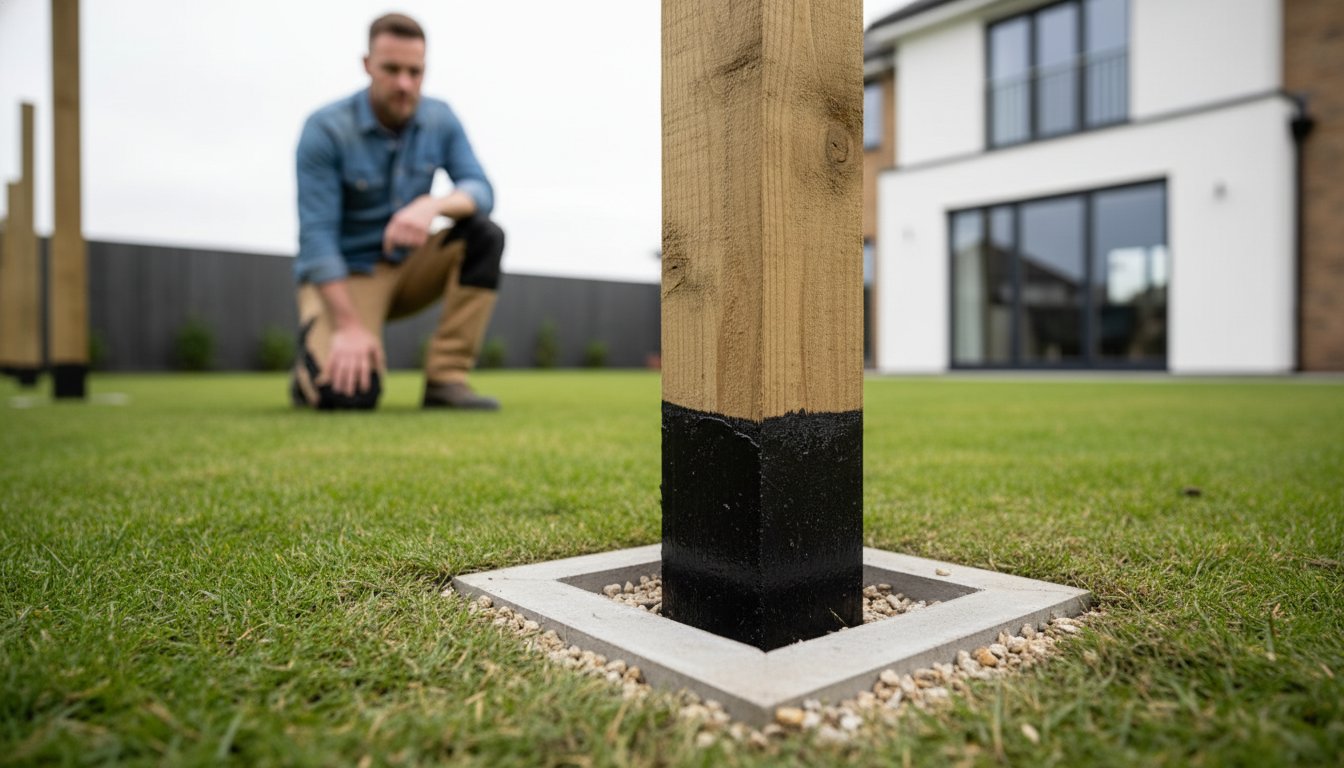
A standard fence post set in concrete should easily last two decades, yet many Braintree homeowners find themselves digging out snapped timber after just five years of service. It’s a frustrating cycle of wasted weekend labour and unnecessary expense, particularly when the next Essex winter storm arrives to finish off a weakened boundary. At Essex Board & Timber, we’ve seen countless projects fail prematurely because of simple mistakes made at the ground level.
You shouldn’t have to replace your garden perimeter every few seasons. We understand that a sturdy fence is a significant investment, and that’s why we’ve compiled this professional guide on how to stop fence posts rotting in concrete. By following these proven trade methods, you’ll ensure your posts remain solid for 15 to 20 years rather than failing at the first sign of damp weather.
Essex Board & Timber is committed to providing the right materials for the job, from high-grade UC4 treated timber to the correct aggregates. This guide covers the specific drainage techniques, timber selections, and post-setting secrets that local builders use to achieve a professional, long-lasting finish that stands up to the elements.
Key Takeaways
- Understand the critical difference between UC3 and UC4 timber treatments to ensure your posts are specifically rated for direct ground contact.
- Learn the professional secrets of how to stop fence posts rotting in concrete by tackling ground-line decay and the ‘concrete sponge’ effect.
- Implement effective drainage solutions, including deep-hole ballast bases, to keep moisture away from the timber-concrete interface.
- Identify the best protective barriers, such as bitumastic paints and post sleeves, to add years of life to your garden boundary.
- See why local builders trust Essex Board & Timber for the high-spec UC4 posts and C24 timber required for long-lasting Braintree projects.
Understanding Why Fence Posts Rot in Concrete
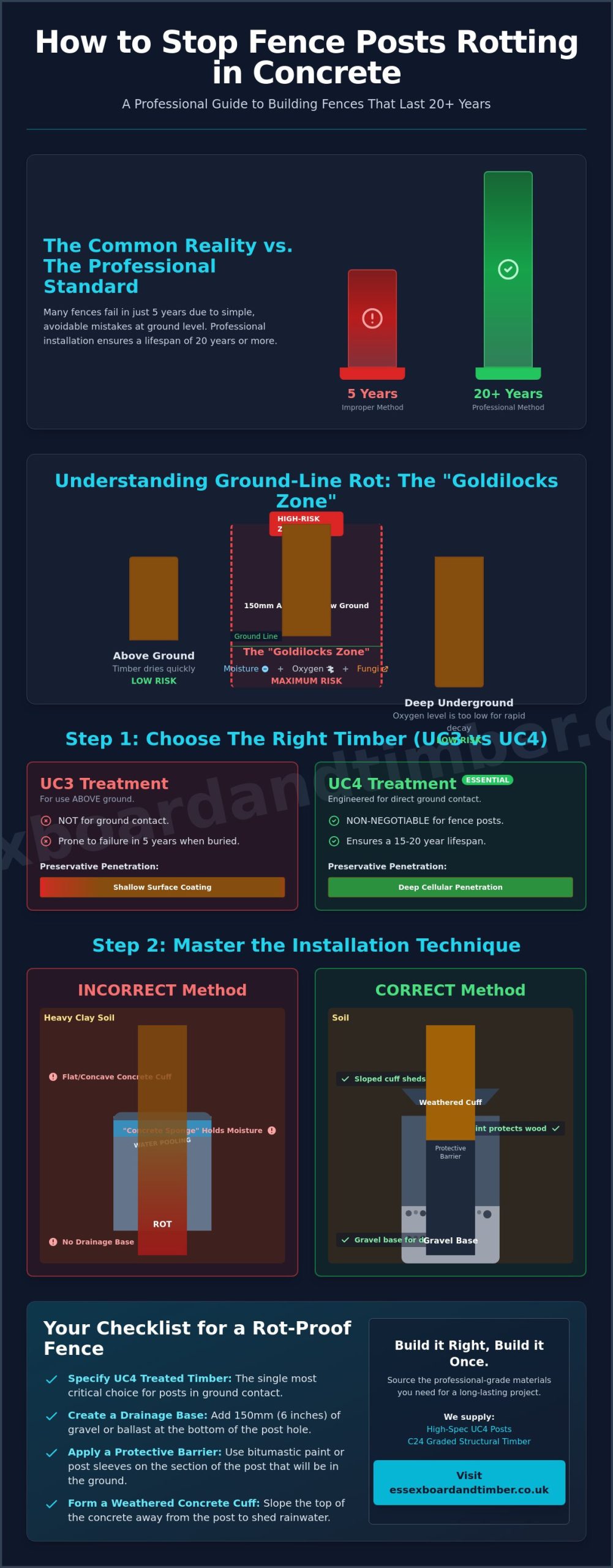
Ground-line rot is the leading cause of premature fence failure across Essex. It occurs most aggressively at the concrete-timber interface because this is where the three essential components of decay meet: moisture, fungi, and oxygen. In Braintree, the local landscape is often dominated by heavy clay soils that lack efficient drainage. These soils can remain saturated for over 100 days during a typical UK winter, keeping the base of a fence post in a state of constant dampness. Learning how to stop fence posts rotting in concrete starts with acknowledging that concrete alone is not a preservative.
Many builders mistakenly view concrete as a waterproof seal. In reality, concrete acts like a hard, porous sponge. It draws moisture from the surrounding earth and holds it directly against the wood fibres. This “concrete sponge” effect ensures the timber never truly dries out. Without proper Wood preservation and installation techniques, even pressure-treated timber will eventually succumb to the relentless moisture ingress provided by the surrounding footing.
The Problem with Improper Concrete Cuffs
The way the concrete is finished at the surface level dictates the lifespan of the post. “Pooling” occurs when the concrete is finished flat or, worse, with a concave dip. This creates a basin that collects rainwater exactly where the post is most vulnerable. Over time, the timber will naturally expand and contract due to seasonal changes. Because timber and concrete are both hygroscopic materials, meaning they naturally attract and hold water molecules from the surrounding environment, this movement creates a hairline gap. This gap allows water to bypass the surface and travel deep into the “cuff,” where it cannot evaporate.
Fungal Decay and Ground-Line Oxygen
Fungal decay is most active in the high-risk zone extending 150mm (6 inches) above and below the ground line. Fungi are aerobic organisms; they require oxygen to survive and thrive. Deep underground, oxygen levels are too low for rapid decay. High above the ground, the timber usually dries out too quickly for fungi to take hold. The ground line provides the perfect “Goldilocks zone” where moisture from the soil meets oxygen from the air.
To combat this, it is vital to source high-quality materials. At Essex Board & Timber, we supply professional-grade structural timber and fencing components designed to withstand these conditions. Using inferior, low-density wood increases the rate of absorption, leading to structural failure in as little as 5 years. By understanding the relationship between oxygen and moisture at the ground line, you can take the necessary steps to protect your installation for the long term.
Choosing the Right Timber: UC4 vs UC3 Treatment
The foundation of any long-lasting fence starts with understanding the British Standard for timber treatment. If you want to know how to stop fence posts rotting in concrete, the most critical factor is the Use Class (UC) rating of the wood you buy. In the UK, timber is graded according to BS EN 335-1, which defines the level of preservative protection based on the wood’s intended environment. Using the wrong grade is the primary reason why many Braintree fencing projects fail far sooner than they should.
Most timber found in standard retail outlets is treated to UC3. This grade is designed for components that are used above ground and can dry out between rain showers, such as fence rails, spindles, or cladding. For posts that are buried in the ground or encased in wet concrete, UC3 is simply not enough. You must use UC4 treatment, which is specifically engineered for timber in direct ground contact and permanent exposure to moisture.
Why UC4 Treatment is Non-Negotiable
UC4 timber undergoes a rigorous high-pressure treatment process in a vacuum chamber. This forces preservatives deep into the cellular structure of the wood, rather than just providing a thin surface coating. This deep penetration creates a robust barrier against the fungi and bacteria found in Essex soil. Standard DIY store posts often fail within five years because they’re only treated to UC3 levels. Essex Board & Timber is committed to stocking trade-quality timber that meets the higher UC4 threshold to ensure your fence stands for the long term. For the horizontal elements of your project, we also supply C24 Treated Timber to provide a sturdy, structural frame that matches the durability of your posts.
Incised Posts for Better Penetration
Many fence posts are manufactured from Spruce, a species that is naturally resistant to liquid penetration. To ensure the preservative reaches the heart of the wood, quality manufacturers use a process called incising. This involves making thousands of small, precise slits into the surface of the timber before it enters the treatment tank. These incisions allow the chemicals to bypass the tough outer grain and saturate the core.
- Lifespan expectations: An incised UC4 post typically carries a 15-year service life guarantee, whereas non-incised alternatives often rot in less than seven years.
- Better protection: The deeper chemical zone ensures that even if the post is scuffed or knocked during installation, the protective barrier remains intact.
- Quality marks: When you visit our Braintree yard, you can easily identify quality posts by the distinct pattern of incisions and the UC4 stamps on the end grain.
Selecting the right specification at the start of your build prevents the cost and labour of replacing a failed fence in just a few years. If you’re unsure which materials are best for your site, you can always ask the team at Essex Board & Timber for professional advice on current stock.
Professional Installation Techniques for Maximum Drainage
Getting the installation right is the most effective way to address how to stop fence posts rotting in concrete. At Essex Board & Timber, we see many fence failures that could have been avoided with better drainage. If you don’t provide a way for water to escape the bottom of the post hole, you’re essentially creating a bucket that holds moisture against the timber 24 hours a day. Following a professional five-step process ensures your fence stands for years rather than months.
- Step 1: Dig the hole 150mm deeper than the actual burial depth of the timber post.
- Step 2: Fill the bottom 6 inches of the hole with coarse gravel or 20mm ballast to create a drainage reservoir.
- Step 3: Position the post so it sits directly on top of the gravel. It shouldn’t be encased in the concrete at the very bottom.
- Step 4: Pour in your Post-Crete and water, using a spirit level to ensure the post remains plumb as the mixture sets.
- Step 5: Finish the top of the concrete by creating a “weathering” slope that directs water away from the post.
The Gravel Base Method
The gravel base is the most critical element of a professional installation. By placing 6 inches of ballast at the bottom, you create a porous channel. This allows rain that runs down the side of the post to drain into the subsoil instead of pooling at the base. This technique is particularly vital for projects in Braintree. Our local ground often consists of heavy clay which prevents natural drainage. Without this gravel buffer, the clay acts as a seal, trapping water and accelerating rot. When sourcing your materials, check our guide on essential construction fixings to ensure you have the right Post-Crete and tools for the job. This simple step is the best answer to how to stop fence posts rotting in concrete in Essex soil.
Weathering the Concrete Top
Once the Post-Crete starts to firm up, you need to address the surface finish. Most DIYers leave the concrete flat or even slightly recessed, which allows water to sit against the timber. You should build the concrete up so it sits slightly above ground level. Use a trowel to create a “shedding” slope, angling the concrete downwards from the post towards the grass or gravel. We recommend using high-quality Ox or Spear & Jackson trowels to achieve a smooth, professional finish. This slope acts like a roof for your post hole, shedding water away before it can penetrate the gap between the timber and the concrete collar. Essex Board & Timber stocks a full range of professional masonry tools to help you get this finish right every time.
Additional Protective Barriers and Maintenance
Installing a post directly into a wet hole without extra protection is often a recipe for disaster. Even when using high-quality pressure-treated timber, adding a physical barrier is the most effective method for how to stop fence posts rotting in concrete. These barriers prevent moisture and oxygen from reaching the wood, which are the two primary catalysts for fungal decay. At Essex Board & Timber, we recommend a multi-layered approach to ensure your fencing stands for decades rather than years.
Post Sleeves and Bitumen Coatings
Bitumastic paint is a cost-effective solution widely used by Braintree builders. This thick, rubberised coating creates an impermeable seal around the timber. To apply it correctly, follow these steps:
- Ensure the post is completely dry before you start application.
- Apply the coating from the base of the post to roughly 100mm above the expected ground line.
- Allow the paint to cure fully before the post comes into contact with wet concrete or soil.
For those seeking a more permanent solution, heat-shrink post sleeves offer a 20-year guarantee against ground-line rot. These sleeves consist of a heavy-duty thermoplastic outer shell with a bitumen inner liner. When heat is applied with a blowtorch, the sleeve shrinks tightly to the post. This creates a dual-layer shield that fungi and moisture cannot penetrate. You can find these professional-grade sleeves and bitumen treatments ready for collection at the Essex Board & Timber trade counter.
The Role of Gravel Boards
While the post is the structural heart of the fence, the panels are often the first to show signs of water damage. Gravel boards are essential for lifting your Fence Panels in Braintree away from the damp soil. Without a gravel board, the bottom of the panel sits in wet grass or dirt. This leads to “wicking,” where moisture is pulled up into the grain of the wood, causing premature failure.
Essex Board & Timber supplies both concrete and pressure-treated timber gravel boards. Concrete is the ultimate “fit and forget” option because it’s entirely immune to moisture and rot. If you prefer the look of natural wood, our UC4 treated timber boards provide excellent resistance. By using these boards, you ensure that if any rot does occur, it only affects the easily replaceable gravel board rather than the expensive main fence panel. Our team can help you select the right materials and arrange local delivery across the region when you order our fencing supplies and timber.
Source Your Fencing Supplies from Essex Board & Timber
Understanding how to stop fence posts rotting in concrete requires more than just good technique. It demands high-grade materials that can withstand the unique challenges of ground-contact applications. Essex Board & Timber supplies UC4 kiln-dried posts that are specifically engineered for this purpose. Unlike standard timber, UC4 posts undergo a rigorous high-pressure treatment process that forces preservative deep into the wood grain. This provides a robust barrier against the moisture and bacteria found in Essex soil, significantly extending the life of your fencing projects.
We maintain a massive inventory at our Braintree yard, including C24 graded timber for structural requirements and various sizes of fencing components. Essex Board & Timber is an independent, family-run merchant. We’ve built our reputation on providing straightforward, expert advice to the local building trade. We don’t hide behind jargon or sales fluff. We provide the stock you need to get the job done right the first time.
Trade Accounts and Professional Support
For contractors and developers, consistency is vital for maintaining margins and project timelines. Opening a trade account with Essex Board & Timber simplifies your procurement process. Trade customers benefit from consistent pricing structures and priority stock allocation on high-demand items. We understand that your reputation depends on the quality of the materials you install, which is why we only source timber that meets our strict quality standards.
DIY enthusiasts are equally welcome at our Braintree site. If you’re unsure which grade of timber is best for your garden project, our team is on hand to provide practical guidance. We also offer a bespoke cutting service. If your fencing plan involves non-standard heights or specific dimensions, we can machine the timber to your exact specifications on-site. This precision ensures a professional finish and reduces waste during installation.
Local Delivery Across Essex
Logistics shouldn’t be a headache for your project. Essex Board & Timber operates a reliable delivery fleet that services Braintree, Basildon, Chelmsford, and the wider Essex area. We’re committed to getting your materials to the site exactly when you need them. Our drivers are experienced in navigating busy construction sites and residential streets, ensuring your timber arrives in top condition.
As one of the leading Timber Merchants Near Me, we take pride in our local roots. We’ve invested heavily in our facilities and transport to ensure we can handle orders of any scale, from a single replacement post to materials for an entire housing development. We don’t just sell wood; we provide the foundation for durable, long-lasting structures across the county.
If you want to ensure your next project stands the test of time, start with the right materials. Visit the Essex Board & Timber yard in Braintree to see our stock for yourself, or call our expert team today for a competitive quote on your fencing requirements.
Build a Fence That Stands the Test of Time
Building a fence that lasts requires more than just digging a hole. You’ve got to prioritise the right materials and installation methods from the start. Using UC4 treated timber is the industry standard for ground contact because it’s specifically designed to handle constant moisture. When you combine high-grade timber with professional drainage techniques, you’ve found the secret of how to stop fence posts rotting in concrete for years to come.
At Essex Board & Timber, we’re an independent Essex timber merchant dedicated to supplying the trade with reliable materials. Our Braintree trade counter is staffed by experts who provide practical advice based on years of industry experience. We maintain an extensive stock of UC4 treated timber to ensure your project stays on schedule without compromising on quality. Whether you’re a professional builder or a DIY enthusiast, we’ve got the supplies you need to get the job done right.
Browse our range of high-quality fencing and treated timber at Essex Board & Timber
Stop by our yard today and let’s get your next fencing project off to a solid start.
Frequently Asked Questions
Is it better to set fence posts in concrete or soil?
Concrete provides the most reliable stability for fences in the UK, particularly in the exposed landscapes across Essex. While soil allows for natural drainage, it lacks the structural integrity to hold a 1.8m fence during a winter gale. Essex Board & Timber recommends using concrete but insists on a 100mm gravel base to ensure water doesn’t sit directly against the timber base.
How deep should a fence post be in the ground UK?
You should set a fence post at least 600mm into the ground to ensure long-term structural integrity. For a standard 1.8m high fence, this requires using a 2.4m post to maintain the correct proportions. Essex Board & Timber stocks these specific lengths to ensure local builders can achieve the necessary depth without compromising the finished height of the garden boundary.
Should I put gravel at the bottom of a fence post hole?
Yes, you must place at least 100mm of gravel or hardcore at the bottom of the hole before adding any concrete. This layer acts as a soakaway, allowing moisture to drain into the subsoil rather than pooling at the base of the wood. Essex Board & Timber supplies all the necessary aggregates alongside our timber to help you follow these professional installation standards.
What is the best wood for fence posts in the UK?
UC4 treated redwood is the most dependable choice for fence posts in the UK market. This timber is kiln-dried before pressure treatment, which allows the preservative to penetrate deep into the wood fibres. Essex Board & Timber sources UC4 posts specifically for ground contact, providing a much higher level of rot resistance than the cheaper UC3 alternatives found in many national retailers.
How long do treated timber fence posts last in concrete?
A properly installed UC4 treated post typically lasts 15 years, though the lifespan depends heavily on the drainage. Understanding how to stop fence posts rotting in concrete is vital; you must slope the concrete surface away from the post to shed rainwater effectively. Essex Board & Timber provides the professional-grade materials needed to ensure your fence remains standing for 15 to 20 years.
Can I use Post-Crete for all types of fence posts?
Post-Crete is perfectly suitable for timber, concrete, and metal posts and remains the preferred choice for efficiency. It sets in roughly 10 minutes, which allows trade professionals to complete fencing runs much faster than using traditional ballast and cement mixes. Essex Board & Timber maintains high stock levels of rapid-set products to support the fast-paced requirements of our Braintree trade customers.
How do I stop my existing fence posts from rotting further?
You can slow down decay by applying a bitumen-based coating or a Postsaver sleeve to the section of the post at the ground line. If the rot has already compromised the timber, installing a concrete repair spur is the most effective solution. Essex Board & Timber stocks these spurs and the required coach bolts to help you reinforce your fence without the cost of a full replacement.
