Planning a construction project in Braintree or the wider Essex area? If the term ‘CLS’ has you second-guessing which timber is right for the job, you’re not alone. The uncertainty over what the acronym means, whether to choose 3×2 or 2×4 for your stud wall, and the risk of buying warped wood can be a real headache for trades and DIY enthusiasts alike.
At Essex Board & Timber, we supply high-grade materials with no-nonsense advice. This guide is your definitive local resource for understanding cls timber. We cut through the industry jargon to give you clear, practical information you can rely on, ensuring you get the right product for the right price, every time.
We’ll cover exactly what CLS is, its most common applications in structural and carcassing work, and how to select the correct size and grade for your specific project. You’ll finish reading with the confidence to choose the best timber and the knowledge of where to find a dependable supply right here in Essex.
Key Takeaways
- Understand why kiln-dried CLS provides superior stability for internal studwork and framing in Essex properties.
- Identify the key construction projects where cls timber is the professional’s choice, from building stud walls to carcassing.
- Learn the critical difference between a timber’s ‘nominal’ and ‘actual’ size to prevent costly measurement errors on site.
- Discover how to source high-quality, straight timber in Braintree and avoid the common pitfalls of poor supplier storage.
What is CLS Timber? A Primer for Braintree Builders
If you’re undertaking an internal construction project in Braintree or across Essex, you’ll almost certainly encounter CLS timber. It’s a mainstay on building sites and for good reason. The acronym ‘CLS’ stands for Canadian Lumber Standard (CLS), a term that originated from its initial use in the Canadian housing market but is now a widely recognised grade in the UK.
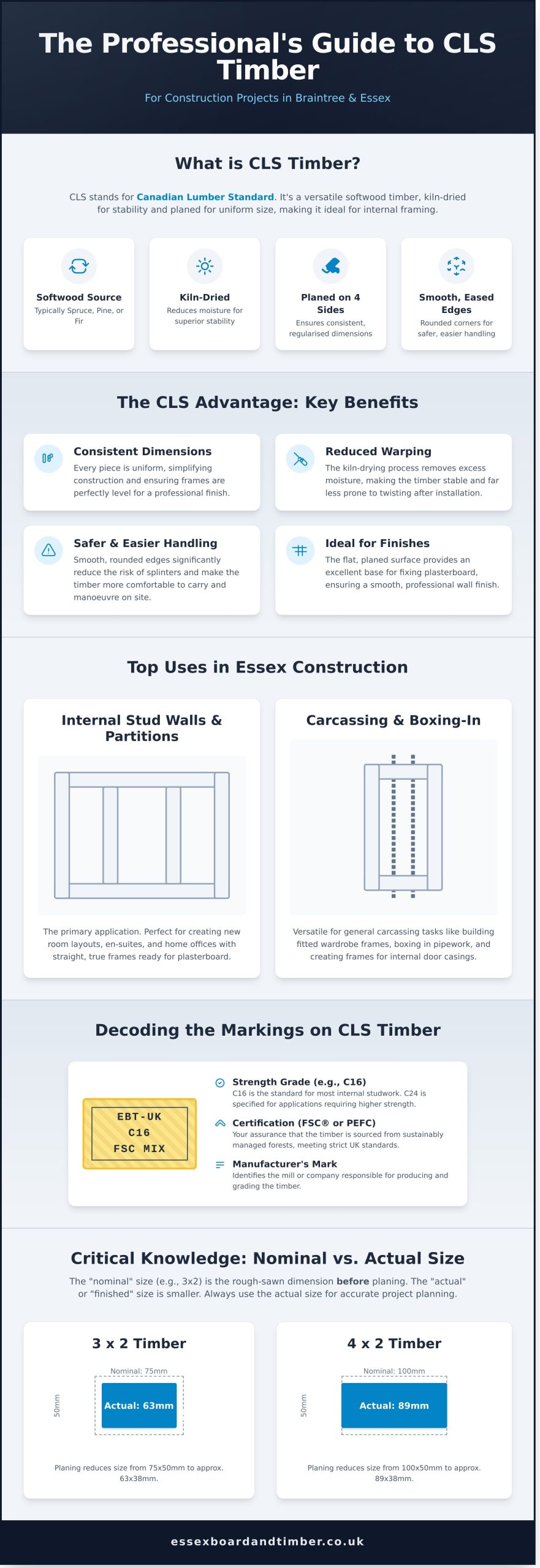
This versatile softwood, typically spruce, pine, or fir, is kiln-dried for stability and planed on all four sides. This process gives it consistent, regularised dimensions and its signature smooth, rounded (‘eased’) edges. Primarily, it is used for internal, non-structural applications like stud walls, partitions, and framing. Its reliability and ease of use make it the go-to carcassing timber for tradespeople and DIY enthusiasts alike.
Key Features and Benefits
The specific properties of CLS offer practical advantages on any job site. For projects in the Braintree area, these benefits translate to faster, safer, and higher-quality work.
- Easier and Safer Handling: The ‘eased’ or rounded edges significantly reduce the risk of splinters and make the timber more comfortable to carry and manoeuvre on site.
- Consistent Dimensions: Being planed and regularised means every piece is uniform in size. This precision simplifies the construction of frames and ensures a perfectly level finish.
- Reduced Warping and Twisting: The kiln-drying process lowers the moisture content, making the timber far more stable and less prone to movement after installation in a modern, centrally heated home.
- Ideal for Finishes: Its smooth, planed surface provides an excellent, flat base for fixing plasterboard, helping you achieve a professional finish for your walls with minimal fuss.
Understanding the Markings on CLS Timber
Every piece of reputable CLS is stamped with important information about its quality and origin. You will typically see a grade stamp, such as C16. This is a strength grading, and C16 is the standard for most internal partition and carcassing work. For applications requiring higher strength, a C24 grade is specified.
Alongside the grade, you’ll find the manufacturer’s mark and a certification logo, like FSC or PEFC. This is your assurance that the timber has been sourced from sustainably managed forests. At Essex Board and Timber, we ensure all our stock meets strict UK building standards, so you can build with confidence.
Top Uses for CLS Timber in Braintree & Essex Construction
For internal studwork and framing projects across Braintree and the wider Essex area, cls timber is the professional’s choice. Its consistent, uniform dimensions and inherent stability make it ideal for everything from modern new-build developments to renovating classic Essex properties. This reliability ensures frameworks are straight, true, and ready for finishing, saving time and guaranteeing a quality result on site.
Internal Stud Walls and Partitions
The primary application for CLS timber is constructing non-load-bearing internal stud walls. Its strength and straightness are perfect for creating new room layouts, such as dividing a large bedroom, adding a much-needed en-suite, or building a dedicated home office. The planed, smooth surface and radiused edges make handling easier and allow for plasterboard to be fixed flush and securely, providing a perfect substrate for plastering. This is one of the most common uses for CLS timber in residential construction, valued for its efficiency and performance.
Framing for Carcassing and Boxing-In
Beyond stud walls, CLS is exceptionally useful for general carcassing tasks. Its versatility makes it the go-to material for a range of jobs, including:
- Building the framework for fitted cupboards and wardrobes.
- Boxing in unsightly pipework or soil stacks in bathrooms and kitchens.
- Creating sturdy frames for internal door casings or new loft hatches.
Because it’s relatively lightweight, it’s easy to handle and cut on-site, even in awkward or tight spaces where heavier timbers would be impractical. Of course, the success of any framework depends not just on quality timber but also on using the correct fixings. Selecting the right screws, nails and bolts for your construction project ensures your CLS framework has the structural integrity to last.
When to Consider an Alternative
While versatile, it’s crucial
Choosing the Right CLS Timber Size for Your Project
Selecting the correct dimensions for your cls timber is fundamental to the structural integrity and overall success of your project. Whether you are building a simple partition wall or a more complex frame, the right size ensures strength, stability, and a professional finish. One of the first things to understand is the difference between nominal and finished sizing.
The sizes you see listed, such as 3×2 or 4×2, are the ‘nominal’ dimensions of the timber before it has been planed and finished. The machining process, which creates the smooth, rounded edges characteristic of CLS, reduces the final dimensions. This process is governed by strict regulations, such as those set by the Canadian Lumber Standards Accreditation Board, to guarantee consistency across the industry. Always work from the finished (actual) size for accurate planning.
Common Sizes: 3×2 (75x50mm) and 4×2 (100x50mm)
At our Braintree depot, we hold extensive stock of the most frequently used CLS sizes. Understanding their typical applications makes selection straightforward.
- 3×2 CLS (Finished size approx. 63x38mm): This is the industry standard for constructing internal, non-load-bearing stud walls. It provides ample strength for standard-height partitions and is a cost-effective, easy-to-handle choice for dividing rooms or creating features like media walls.
- 4×2 CLS (Finished size approx. 89x38mm): For applications requiring greater strength and rigidity, 4×2 is the superior option. We recommend it for taller walls, wider stud spacing, or any frame that needs to support heavier fixtures. The increased depth is also highly practical, providing more space for thicker acoustic or thermal insulation and for housing pipework or electrical wiring.
Other Available Sizes and Their Uses
While 3×2 and 4×2 cover most internal framing jobs, certain projects call for different dimensions. We also supply larger sections like 6×2 (150x50mm) for more demanding structural work where load-bearing capacity is a key consideration, such as in floor joists or some roofing applications. Conversely, smaller timber battens are available for non-structural tasks like fixing plasterboard or creating mounting points.
Unsure what size you need for your Essex project? Call our Braintree team for advice. Our experts are on hand to help you specify the right timber for the job.
Sourcing Quality CLS Timber in Braintree: Why Local Matters
The success of any studwork or framing project hinges on the quality of the materials used. Sourcing straight, consistent, and properly stored timber is not a luxury-it is a necessity for a professional finish. Buying from suppliers with poor storage facilities, where timber is exposed to the elements, often leads to warped, twisted, or damp wood that is difficult to work with and can compromise the structural integrity of your build. As a specialist independent timber merchant, we understand that your project’s quality starts with ours.
Ensuring this quality means managing a complex international supply chain. Since much of the best structural timber is imported, a reliable local merchant depends on expert logistics to ensure materials arrive from overseas in perfect condition. For any business involved in moving goods, working with a specialist freight forwarder such as Gateway Cargo is key to maintaining a dependable stock for customers.
What to Look For When Buying CLS
When you select your timber, a quick visual inspection can save you significant time and effort on site. We quality-check our stock, but it’s always good practice to know what defines a superior piece. Look for:
- Straightness: Sight down the length of the timber from one end. It should be straight and true, with no bowing, twisting, or cupping.
- Sound Knots: Knots are a natural feature, but they should be tight and sound. Avoid pieces with large, loose, or dead knots, as these create weak points.
- Consistent Sizing: Check that the dimensions are uniform across the batch. Consistent sizing makes for a faster, more accurate, and stronger frame.
Our Commitment to Braintree and Essex Tradespeople
Choosing a local, dedicated supplier like Essex Board & Timber provides more than just materials; it provides a reliable service designed around the needs of the trade. We are committed to supporting your projects with a service that national chains simply cannot match. When you work with us, you benefit from:
- Extensive On-Site Stock: We hold vast quantities of high-grade cls timber at our Braintree depot, ready for immediate collection or rapid delivery. No more waiting on out-of-stock items.
- Reliable Essex Delivery: Our dedicated fleet provides a prompt and dependable delivery service across Braintree and the wider Essex area, getting your materials to site when you need them.
- Bespoke Cutting Service: Our on-site machining facilities can cut your timber to precise lengths, saving you valuable time and reducing waste.
- Expert, Practical Advice: Our team has years of hands-on experience. We can offer straightforward advice on material selection and quantities for your specific application.
For a reliable supply of quality timber and a service you can depend on, look no further than your local specialist. To discuss your project requirements, visit our trade counter in Braintree or browse our services at essexboardandtimber.co.uk.
Your Trusted Source for CLS Timber in Braintree & Essex
From this guide, it’s clear that CLS is a cornerstone of modern construction, valued for its strength and consistency in applications like stud walls, partitions, and general carcassing. Selecting the correct size and grade is paramount for structural integrity, and sourcing your cls timber from a specialist local supplier is the surest way to guarantee quality for any project in Braintree or the wider Essex area. This ensures you not only get superior materials but also the practical advice to back them up.
At Essex Board and Timber, we are that trusted local merchant. We are committed to holding extensive on-site stock in our Braintree yard, ensuring you can get the materials you need without delay. Paired with our reliable delivery service across Essex and expert, no-nonsense advice from our experienced team, your project is in safe hands. We have the stock, the knowledge, and the service to help you succeed. For construction professionals seeking reliable timber merchants near me, our commitment to quality and service sets us apart from national chains.
Ready to get started? Browse our range of CLS timber online or visit our Braintree yard. We look forward to helping you build with confidence.
Frequently Asked Questions About CLS Timber
Is CLS timber treated? Can I use it outdoors?
Standard CLS timber is untreated and manufactured for internal use, such as stud walls and partitioning. While it is kiln-dried for stability, it does not have the preservative properties to resist moisture or insect attack outdoors. For any external work, you must use timber that has been pressure-treated (tanalised). At Essex Board and Timber, we stock a full range of treated carcassing suitable for outdoor projects, so always specify the application when ordering.
What is the difference between CLS and C24 grade timber?
The key difference is structural strength. C24 is a higher-grade timber with fewer knots and defects, making it stronger and suitable for more demanding applications like roof joists, floor joists, and decking frames where wider spans are required. Most CLS is graded to C16, which is perfectly adequate for internal studwork and partitioning. For projects where load-bearing capacity is critical, building regulations will often specify C24 grade timber.
Can I use CLS timber for decking frames or garden projects?
No, you should never use standard, untreated CLS for decking frames, pergolas, or any garden construction. It will quickly rot when exposed to the elements and ground contact. For these outdoor applications, it is essential to use a pressure-treated timber, graded to at least Use Class 3 or Use Class 4 for ground contact. This ensures the wood is properly protected against fungal decay and insect attack, providing the necessary durability for your project. For garden boundaries, consider our range of quality fence panels in Braintree that are specifically designed to withstand the Essex climate.
Is CLS timber suitable for load-bearing walls?
Yes, CLS timber is primarily designed for building the framework of internal stud walls, which are often load-bearing in UK house construction. The C16 strength grade is sufficient for most internal load-bearing partitions as specified in building plans. However, for external walls or applications requiring a higher structural integrity, a structural engineer may specify the superior C24 grade. Always consult your architectural drawings to ensure you use the correct material.
What does C16 mean on CLS timber?
C16 is a strength grade that certifies the timber’s structural properties, including its bending strength, density, and the size and frequency of knots. It is the most common grade found on cls timber in the UK and provides a reliable benchmark for its performance. This grading ensures the wood is strong enough for a wide range of applications, particularly non-structural and light structural work like internal framing, making it a dependable choice for builders and joiners.
Why are the edges of CLS timber rounded?
The four rounded, or ‘eased’, edges are a defining feature of CLS. This is primarily for practical reasons on the construction site. The smooth, rounded corners make the timber much easier and safer to handle, significantly reducing the risk of splinters. This finish also helps when fitting plasterboard or other sheet materials, as it allows the boards to sit flush against the framework without catching on sharp, uneven corners, resulting in a cleaner finish.
