
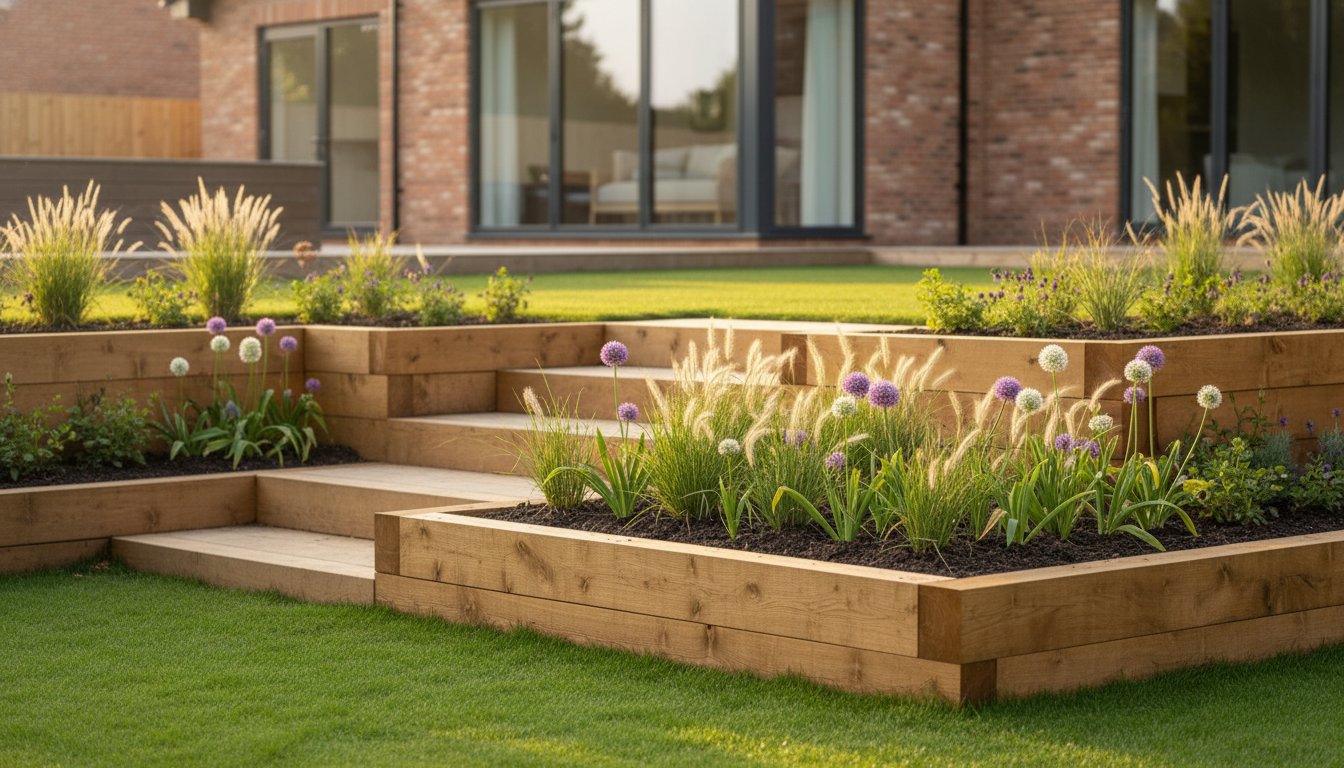
Choosing the wrong timber for a retaining wall or raised bed can reduce a garden’s lifespan by a full decade before the first plant is even in the ground. At Essex Board & Timber, we know that Braintree residents often struggle with the choice between cost-effective softwood and the long-term durability of hardwood. It’s a significant investment, and you don’t want to worry about timber rot or whether chemical treatments are safe for your vegetable patches. We also recognise that the logistics of moving heavy sleepers into a residential garden can be just as daunting as the construction itself.
When excavating for these structures, particularly near large trees, it is essential to consider the impact on root systems to prevent future instability; for those in the South Coast region, WGS Tree Services can provide expert guidance on balancing construction needs with tree preservation.
Essex Board & Timber provides the expert guidance you need to select, install, and maintain the perfect sleepers for your specific project. This guide offers a practical look at our current 2026 stock levels, technical specifications for different timber species, and how our local delivery service simplifies the heavy lifting. You’ll learn exactly how to achieve a professional finish that stays structural and attractive for years to come, backed by the reliability of an independent Essex Board & Timber merchant.
Key Takeaways
- Compare the performance and lifespans of softwood and hardwood species to make an informed investment for your specific landscaping project.
- Learn how to protect your garden structures against Braintree’s clay-heavy soil by selecting the correct pressure-treated sleepers for ground-contact applications.
- Master the planning phase with practical guidance on calculating timber volumes and choosing the right professional-grade fixings for retaining walls and raised beds.
- Discover the advantages of sourcing materials from an independent Braintree merchant like Essex Board & Timber for superior stock availability and expert technical advice.
Why Sleepers are the Essential Choice for Braintree Landscaping
Modern landscaping relies on materials that combine structural integrity with visual impact. At Essex Board & Timber, we define sleepers as versatile, large-section timber beams designed for heavy-duty garden construction. Originally salvaged from decommissioned rail tracks, the modern versions we supply are purpose-sawn from high-quality softwood or hardwood. These beams typically arrive in standard 2.4m lengths with profiles such as 100mm x 200mm, providing a substantial mass that stays stable under soil pressure. Local builders in Braintree increasingly select these over traditional bricks or blocks because they offer a faster, more cost-effective way to build height and definition in a garden.
Choosing timber over masonry provides a distinct financial advantage for Essex homeowners. On average, a timber retaining wall can be installed 40% faster than a brick equivalent, significantly reducing labor costs. While masonry requires deep concrete footings and precise mortar work, timber sections can often be secured with long-life landscape screws and basic ground preparation. This efficiency doesn’t sacrifice quality; it simply streamlines the build process. Essex Board & Timber sources all our stock from sustainable forests, ensuring that every beam delivered to a Braintree site meets strict environmental and structural standards. We maintain high stock levels year-round to ensure your project never stalls due to material shortages.
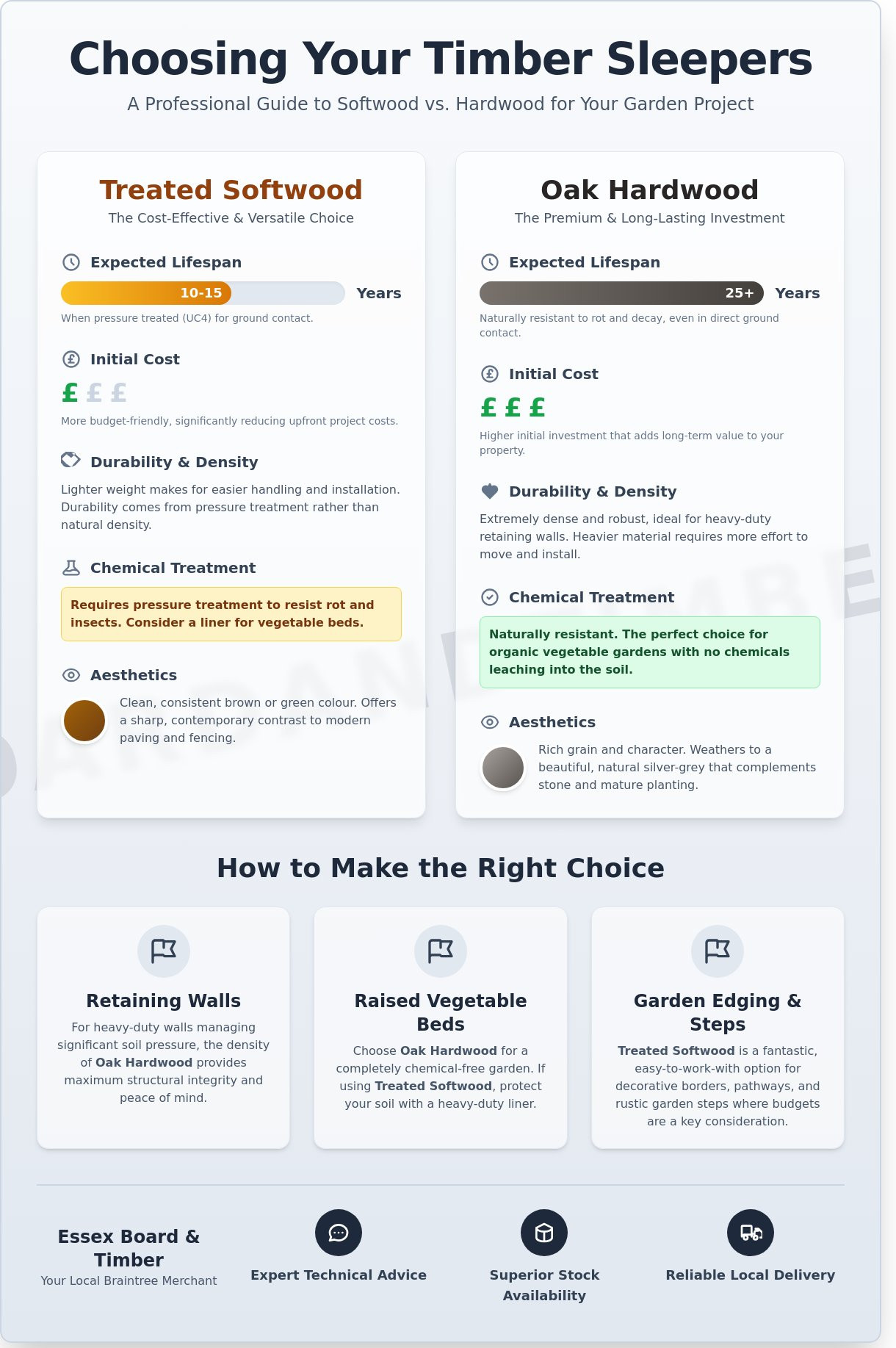
Understanding the technical differences in railway sleeper materials is vital for long-term durability. Softwood varieties are pressure-treated with preservatives to prevent rot, making them a lightweight and budget-friendly choice for most residential tasks. In contrast, oak options provide a denser, more robust alternative that can last decades without additional chemical treatments. As an independent merchant, Essex Board & Timber provides the expert advice needed to choose the right grade for your specific ground conditions and load-bearing requirements.
Transforming Essex Gardens with Timber
Braintree’s varied topography often features sloped plots that require clever management of different levels. Timber beams are the ideal solution for creating terraces, allowing homeowners to reclaim usable flat space from steep inclines. The natural wood grain offers an organic aesthetic that complements the Essex countryside, softening the transition between man-made structures and planting schemes. For first-time DIY builders, wood is far more forgiving than stone. If a measurement is slightly off, timber can be trimmed or adjusted with standard power tools, whereas a mistake in masonry often requires a complete dismantle.
The Versatility of Railway Sleepers
The applications for these heavy-duty beams extend far beyond simple boundary markers. They are the primary choice for constructing raised vegetable beds, providing the depth required for deep-root crops like carrots and parsnips. Many of our trade customers also use them as rugged edging for porcelain slab patios, creating a bold, contemporary border that prevents lateral movement of the paving. Beyond structural use, they are perfect for bespoke garden furniture. A simple stack of two or three beams can be transformed into a minimalist outdoor bench or a durable seating area around a fire pit. For homeowners seeking a complete outdoor living solution, composite decking in Braintree provides a low-maintenance alternative that complements timber sleeper structures perfectly. Essex Board & Timber stocks all the necessary fixings and wood treatments to ensure these installations remain a permanent fixture in your outdoor space.
Softwood vs Hardwood: Choosing the Right Timber for Your Project
Selecting the right material is a decision that dictates the next 20 years of your garden’s maintenance schedule. At Essex Board & Timber, we see Braintree homeowners balancing initial costs against long-term durability daily. Ground-contact applications require timber that can withstand constant moisture and soil acidity. Choosing a species that resists rot for two decades adds tangible value to a property, whereas inferior timber can become a liability within five years. Your choice affects more than just the budget; it defines the structural integrity of your landscaping.
Matching timber colour and texture to existing structures is a hallmark of a professional finish. If your Braintree home features an established cedar deck, the natural silvering of Oak provides a seamless aesthetic match. Conversely, for modern developments with anthracite grey bi-fold doors, the clean lines of a new brown-treated softwood sleeper offer a sharp, contemporary contrast. Our team at Essex Board & Timber recommends visiting the yard to see these textures in person before committing to a large order.
New Treated Softwood Sleepers
Pressure-treated softwood remains the most popular choice for 70% of domestic projects in Essex. These sleepers are typically Pine or Spruce, treated to Use Class 4 standards specifically for ground contact. This industrial process forces preservatives deep into the wood grain, ensuring a reliable lifespan of 15 to 20 years. Because softwood is less dense than hardwood, it’s significantly easier to cut and fix on-site. We ensure all our stock at Essex Board & Timber adheres to strict timber treatment regulations to guarantee both safety and performance. If you’re tackling a DIY raised bed, softwood is the most manageable and cost-effective route.
Untreated Oak and Hardwood Options
European Oak offers a premium, long-term alternative for permanent garden structures. These units don’t require chemical treatments because the natural density and tannin content of the wood resist decay. Initially, Oak displays a warm, golden-brown hue. Over a period of 12 to 18 months, it transitions into a classic silver-grey patina that complements traditional Essex architecture. Hardwood is significantly heavier and tougher than softwood. You’ll need high-quality 150mm structural timber screws and pre-drilled pilot holes to ensure a secure fit. While the upfront cost is often 45% higher than softwood, the 30-year-plus lifespan represents superior value for structural retaining walls.
Reclaimed Sleepers: Character vs Safety
Reclaimed timber brings a sense of history and rugged character to a garden. We source Grade A reclaimed sleepers that have spent decades on European rail networks. Grade A timber is generally straight and sound, whereas Grade B often features more pronounced cracks and rounded edges. You must consider safety when using these materials. Most original railway timber is treated with creosote, a coal-tar derivative. UK health regulations prohibit the use of creosoted wood inside residential buildings or in areas where frequent skin contact occurs. Don’t use reclaimed timber for children’s play areas or vegetable patches. They’re best suited for decorative boundaries and outer retaining walls where their rustic appearance can be appreciated from a distance.
Getting the right advice on timber species prevents costly mistakes in the future. You can view our full range of sleepers at our local yard to compare the different grades and finishes currently in stock.
Durability and Treatments: Protecting Timber from Essex Weather
Essex Board & Timber understands that Braintree gardens face specific environmental challenges that can compromise the integrity of any outdoor build. The local weather patterns, characterized by an average of 106 rainy days per year, require a no-nonsense approach to material selection. If you choose the wrong grade of timber for your project, your structure could begin to fail in under 60 months. We prioritise durability by supplying products that withstand the damp British climate through advanced chemical protection. For homeowners planning comprehensive outdoor spaces, understanding how different materials perform in these conditions is crucial, whether you’re installing timber sleepers or considering high-performance composite decking solutions that resist moisture damage entirely.
Understanding Tanalised and UC4 Treatment
While many people use the term Tanalised as a catch-all, there is a significant technical difference between standard treatment and Use Class 4 (UC4) specifications. At Essex Board & Timber, we stock timber that has undergone rigorous vacuum pressure impregnation. This industrial process involves placing the wood into a sealed cylinder, removing the air to create a vacuum, and then forcing preservative chemicals deep into the cellular structure of the wood. UC4 treatment remains the industry standard for ground-contact timber in 2026. This level of protection is essential for sleepers that will be partially or fully buried.
You can identify high-quality treatment by the depth of the preservative. Surface-level staining only coats the exterior, whereas pressure treatment penetrates the sapwood. At our yard, we advise trade customers to check the weight and “feel” of the timber; properly treated wood is often heavier due to the chemical retention. When you cut these materials on-site, you inevitably expose the untreated inner core. Essex Board & Timber always recommends applying a high-quality end-grain preservative to every cut surface. Failing to seal these ends creates a direct entry point for moisture and fungi, which can reduce the lifespan of your project by 40%.
Dealing with Braintree and North Essex Soil Conditions
The geography of Braintree and the surrounding North Essex villages is dominated by the London Clay formation. This heavy, poorly-draining soil creates a “sump” effect where water pools around the base of garden structures. If your sleepers sit in waterlogged clay for extended periods, even the best UC4 treatment will eventually succumb to soft rot. To prevent this, Essex Board & Timber suggests a clear drainage strategy. Installing a 100mm base of compacted 20mm shingle or hardcore provides a vital break between the clay and the timber.
We also supply heavy-duty weed membranes and gravel boards to further isolate the wood from constant ground moisture. Many local contractors find inspiration for managing these technical hurdles by looking at professional examples of landscaping with reclaimed sleepers, which demonstrate how robust drainage prevents timber from becoming saturated. Beyond the initial installation, maintenance is straightforward but necessary. We recommend applying a clear, water-repellent treatment every 24 months to maintain the surface tension of the wood. This simple step, combined with the professional-grade stock from Essex Board & Timber, ensures your garden project remains structurally sound for 15 years or more. Our team is always available at the trade counter to discuss specific drainage solutions for your postcode.
Planning Your Project: From Raised Beds to Retaining Walls
Calculating the exact number of sleepers prevents costly mid-project delays and unnecessary waste. You should measure the total linear length of your perimeter and divide it by the length of the timber, which is typically 2.4m at our yard. We recommend adding a 10% margin to your final tally to account for offcuts and staggered joints. For structural integrity, you’ll need an 18V impact driver, a circular saw with a high-tooth-count blade, and 150mm auger bits for drilling pilot holes. These tools ensure clean cuts and prevent the timber from splitting during assembly.
Building Long-Lasting Raised Beds
Stacking your timber in a brick-bond pattern, where the vertical joints are offset, ensures the structure won’t bow under the weight of wet soil. For maximum rigidity, Essex Board & Timber suggests using C24 treated timber as internal corner posts. Drive these posts 300mm into the ground and secure the sleepers from the inside with at least two screws per joint. Line the internal faces with a heavy-duty damp-proof membrane to prevent constant moisture contact, though you should leave the base open to allow for natural drainage and earthworm movement.
Construction of Timber Retaining Walls
Retaining walls require a different approach because they must resist significant lateral pressure from the earth behind them. If your wall is higher than 600mm, setting the bottom course into a concrete trench is a requirement. You should also incorporate a “batter,” which is a slight lean of about 10mm for every 100mm of height back into the slope. This angle uses gravity to help the wall resist soil pressure. For walls holding back large volumes of soil, “deadman” anchors, which are timbers buried perpendicular to the wall and into the bank, provide vital leverage. Selecting the right fixings is critical. We stock high-tensile landscape screws between 150mm and 250mm that are specifically designed to pull these heavy timbers tight and resist shearing forces that standard woodscrews can’t handle.
Ready to start your Braintree garden transformation? Contact Essex Board & Timber today for expert advice and rapid local delivery on all project materials.
Why Braintree Tradespeople Choose Essex Board & Timber
Braintree contractors don’t have time for the delays often associated with national chains. Essex Board & Timber operates as a dedicated partner for the local trade, providing a level of agility that larger corporations simply can’t match. We’ve spent over 25 years refining our inventory to meet the specific demands of Essex construction projects. Our yard holds a massive volume of on-site stock, including a wide variety of sleepers for garden transitions and structural landscaping. This availability means you aren’t waiting weeks for a shipment; you’re collecting your materials or receiving a delivery exactly when the project schedule demands it.
Our trade accounts are designed to simplify the financial and logistical side of a build. We provide transparent, competitive pricing that remains stable, allowing for accurate project costings. Beyond the numbers, it’s the personalised service that makes the difference. Our staff have decades of combined experience in the timber industry. They understand the difference between a standard softwood and a high-durability oak, and they’ll give you straight answers on what’s best for your specific Braintree site. We know the local landscape, the typical soil conditions, and the expectations of clients in this part of Essex.
Local Delivery and Bespoke Cutting
Logistics can make or break a landscaping project. Essex Board & Timber operates a specialised delivery fleet that covers Braintree, Chelmsford, and the surrounding Essex postcodes daily. Most orders are fulfilled within a 48-hour window, ensuring your team isn’t standing idle. For larger-scale projects requiring bulk deliveries of sleepers or heavy-duty carcassing, we coordinate drop-offs to suit your site access requirements. Our bespoke cutting service is another vital tool for the busy professional. By providing precision-cut timber to your exact specifications, we eliminate the need for extensive on-site machining. This reduces waste, lowers labour costs, and ensures a cleaner finish for the end client.
Supporting Independent Essex Merchants
Choosing an independent merchant like Essex Board & Timber keeps investment within the local economy. We have a deep-rooted history in Braintree and a genuine commitment to the success of local contractors. This local focus extends to the products we choose to stock. We select timber and treatments suited to the specific Essex climate and soil conditions, such as UC4 treated wood for high-moisture ground contact. We aren’t just selling materials; we’re providing the foundational components for the local community’s homes and gardens. Our reputation is built on the reliability of our products and the honesty of our advice. We’ve been a fixture of the Braintree construction scene for over two decades, and we continue to invest in our facilities to better serve our customers.
If you’re planning a project in the Braintree area, don’t settle for generic service and uncertain lead times. Experience the difference that expert local knowledge and significant stock levels can make to your workflow. Visit our Braintree yard or contact us for a quote today.
Start Your Braintree Landscaping Project Today
Building a garden that lasts in Braintree requires the right materials and a bit of local knowledge. Whether you’re constructing heavy-duty retaining walls or simple raised beds, choosing the correct timber is the first step. You’ve got to decide between the cost-effectiveness of treated softwood or the long-term resilience of hardwood to withstand the Essex weather. At Essex Board & Timber, we’ve spent over 20 years helping local tradespeople and homeowners navigate these choices. We understand the specific demands of our local climate and keep a massive range of stock ready for immediate collection or delivery.
Don’t settle for limited choices at national DIY chains. Our yard holds a vast selection of high-quality sleepers suited for any structural or decorative application. As an independent merchant, Essex Board & Timber prides itself on providing straightforward advice and reliable service to the Braintree community. We’ll help you calculate exactly what you need and get it to your site quickly with our dedicated local delivery fleet.
Browse our range of sleepers and landscaping timber at Essex Board & Timber and let’s get your next project moving.
Frequently Asked Questions
Do I need to treat my railway sleepers before using them in the garden?
New sleepers supplied by Essex Board & Timber are usually pressure-treated with Tanalith E to protect against rot. However, you must apply a brush-on end-grain preservative to any surfaces you cut to maintain the integrity of the seal. Without this, moisture will penetrate the 100mm to 125mm core of the timber. This simple step ensures your garden structure remains durable for its full lifespan.
How long do softwood sleepers last compared to hardwood oak?
Softwood sleepers typically have a service life of 8 to 12 years when in direct contact with the ground. Hardwood oak sleepers are naturally denser and often last 20 years or more without chemical treatment. Essex Board & Timber stocks both varieties to suit different project budgets and longevity requirements. Choosing the right material depends on whether you prioritise initial cost savings or decades of structural stability.
Can I use reclaimed sleepers for a vegetable patch or children’s play area?
You shouldn’t use reclaimed sleepers for vegetable patches or play areas because they often contain creosote. This substance can leach into the soil or rub off on skin. For these specific Braintree garden projects, Essex Board & Timber recommends new pressure-treated softwood or untreated oak to ensure a safe environment. These new options provide a clean finish without the risk of chemical contamination.
What is the best way to fix railway sleepers together?
The most secure method is using heavy-duty Timber Drive screws, which Essex Board & Timber stocks in lengths from 75mm to 250mm. These screws feature a hexagonal head and don’t require pre-drilling in most softwoods. Aim for at least 50mm of thread penetration into the second timber for a solid connection. Using two screws per joint prevents the timber from twisting as it seasons in the garden.
Do I need a concrete foundation for a sleeper retaining wall?
You’ll need a concrete foundation if your sleeper retaining wall exceeds 0.6 metres in height. For lower borders, a compacted hardcore base of 100mm depth is often sufficient for stability. Essex Board & Timber advises trade customers to install a perforated drainage pipe behind any wall over 3 courses high to prevent hydrostatic pressure buildup. This ensures the 200mm thick timber isn’t pushed out of alignment by waterlogged soil.
What is the difference between green and brown treated sleepers?
The difference is purely aesthetic as both green and brown sleepers undergo the same high-pressure preservative treatment. Green sleepers have a natural, pale hue that silver-greys over 12 to 18 months. Brown sleepers are dyed during the treatment process to provide a darker finish immediately, though both offer the same 15 year protection against fungal decay. Essex Board & Timber maintains high stock levels of both colours.
How do I cut railway sleepers at home?
You can cut sleepers using a circular saw with a 235mm blade, though you’ll need to flip the timber to finish the cut. For faster results, a petrol chainsaw is the standard choice for trade professionals. If you’d prefer to avoid the mess, Essex Board & Timber provides a bespoke cutting service at our yard to meet your exact dimensions. Always wear a mask to avoid inhaling treated sawdust.
How many sleepers do I need for a 2.4m long raised bed?
You’ll need 9 sleepers to build a standard 2.4m by 1.2m raised bed that is three courses high. This calculation assumes you’re using the standard 2.4m lengths stocked at Essex Board & Timber. Using 3 sleepers per layer allows for two full lengths and one cut in half for the ends, ensuring a sturdy 600mm high structure. This height is ideal for growing root vegetables or creating accessible seating areas.
