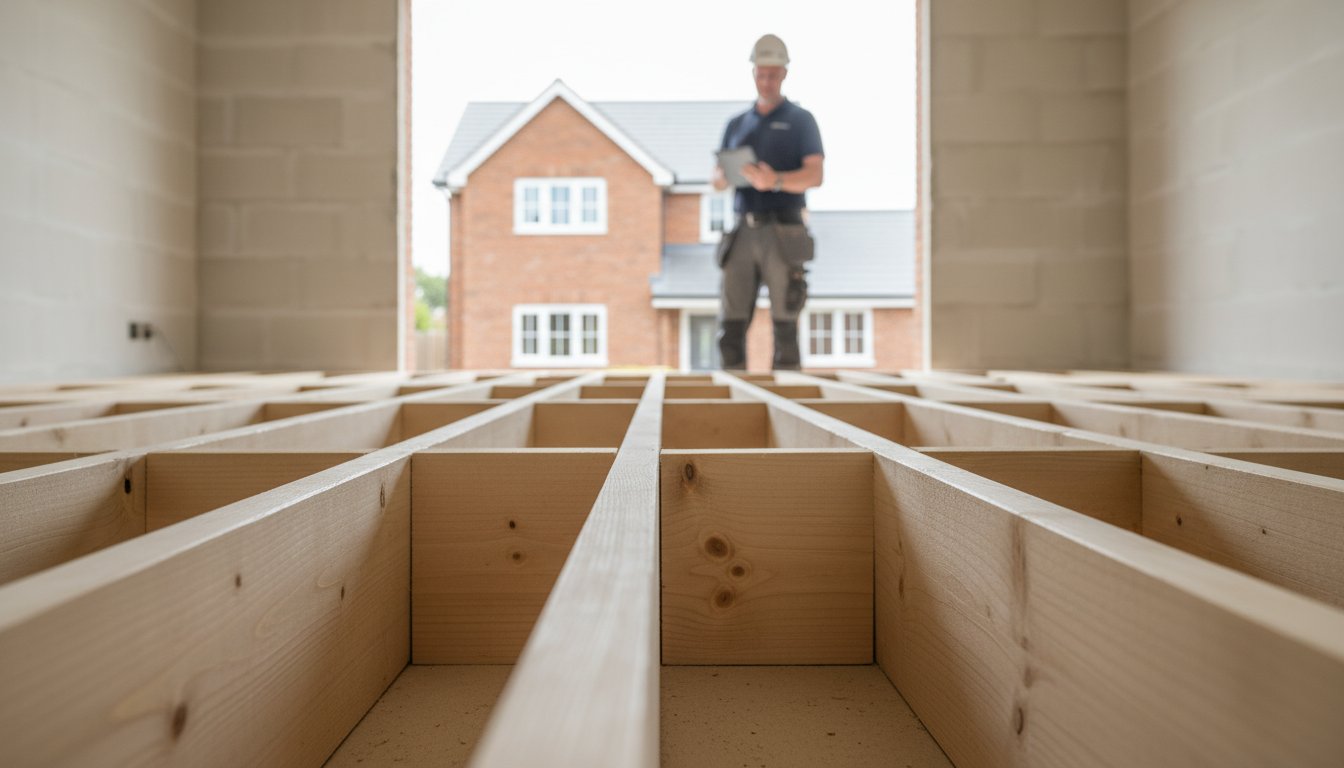
Is the C16 you’ve specified for that Braintree extension a false economy? For any serious Essex builder, getting the carcassing timber right is non-negotiable. We understand the pressure; a failed inspection from building control or a call-back to replace warped joists costs far more than the initial saving on materials. Sourcing a consistent, high-quality supply of properly graded structural timber locally only adds to that pressure.
This guide cuts through the noise. Here, we provide the definitive breakdown of c24 timber, detailing exactly why its superior strength, stiffness, and density make it the mandatory choice for demanding structural work. We promise you’ll finish this article understanding the technical specifications needed for compliance, the long-term benefits for your build’s integrity, and how to secure a reliable supply. We’ll cover everything from floor joists to roof rafters, showing how Essex Board & Timber ensures your next project in Braintree is built on the strongest possible foundation.
Key Takeaways
- Understand the key structural differences between C16 and C24 graded timber to select the correct strength for your project’s load-bearing requirements.
- Identify the most common applications for high-strength c24 timber, including its essential role in roof rafters, floor joists, and timber frame construction.
- Learn the correct on-site storage and handling techniques to protect the integrity of kiln-dried structural timber before installation.
- Discover the advantages of sourcing your structural timber from a local Braintree merchant, including access to bespoke cutting services for precise dimensions.
What is C24 Timber? The Structural Standard for Braintree Builds
For any serious construction project in Braintree, from a domestic extension to a commercial frame, understanding your materials is fundamental. At the top of the list for structural softwood is C24 graded timber. This isn’t just any piece of wood; it’s a premium, high-strength material engineered for load-bearing applications where performance and safety are non-negotiable.
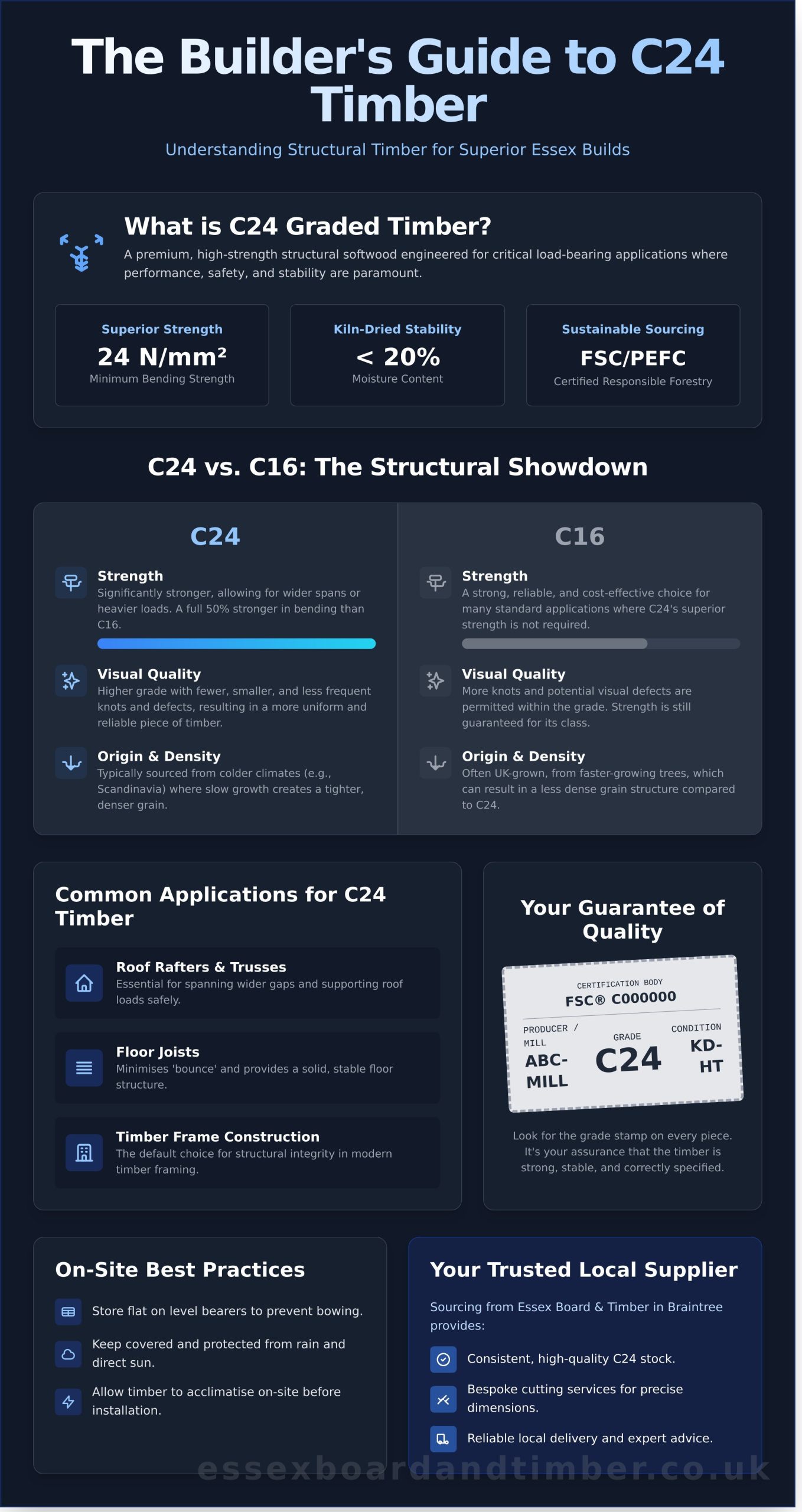
The name itself tells you its core attributes. The “C” stands for Coniferous, meaning it’s a softwood sourced from trees like spruce or pine. The “24” is the critical part: it represents the timber’s bending strength value, a minimum of 24 Newtons per square millimetre (N/mm²). This superior strength allows for wider spans and can sometimes mean using fewer joists compared to its C16 counterpart, making it a cost-effective choice for ambitious designs. At Essex Board & Timber, our stock of c24 timber is sourced from colder European climates, often Scandinavia. The slow growth in these regions produces a tighter, denser grain with fewer knots, resulting in a stronger, more reliable board.
This principle of wood quality defining the final product is seen in other high-value industries as well. The unique flavour of Jamaican pimento, for example, is a direct result of its specific growing climate, a concept explored by brands like Rastaman Stew. Similarly, the value in premium Scotch is heavily influenced by the oak casks it’s aged in, a concept explored by investment specialists like the Whisky Cask Club.
We also understand that modern construction in Essex demands sustainability. That’s why our entire C24 range is responsibly sourced and comes with full FSC (Forest Stewardship Council) or PEFC (Programme for the Endorsement of Forest Certification) chain of custody. This ensures your project not only meets structural regulations but also environmental ones.
The Kiln-Drying Process and Moisture Content
Every piece of our structural C24 timber undergoes a controlled kiln-drying process. This procedure reduces the moisture content to below 20%, a critical step for ensuring long-term stability. Timber with high moisture content is prone to warping, twisting, and shrinking as it dries naturally on-site. For a Braintree builder, this can lead to costly remedial work. Kiln-dried timber is a stable, reliable product that holds its shape, ensuring your framework remains true and your finishes stay flawless.
Understanding Visual and Machine Grading
To earn its C24 stamp, each piece of timber must pass a strict grading process. This involves both visual inspection and precise machine testing. Graders look for defects like knot size and distribution, grain slope, and fissures, as these can impact strength. This rigorous process, governed by European standards outlined in formal timber grading protocols, ensures every piece is fit for purpose. Machine grading then provides an objective verification of the wood’s density and stiffness, guaranteeing consistent performance across our stock.
When you purchase c24 timber from Essex Board & Timber, look for the grade stamp on the wood. This mark is your guarantee of quality. It will clearly display:
- The grade (C24)
- The mill of origin
- The certification body (e.g., FSC)
- Confirmation that it’s kiln-dried (KD or KD-HT)
This simple stamp provides all the assurance you need that you’re building with a material that is strong, stable, and specified correctly for the job.
C24 vs C16 Graded Timber: Making the Right Choice for Essex Projects
For any construction project in Braintree, from a simple garden shed to a multi-storey extension, selecting the correct carcassing timber is fundamental. The two most common grades you’ll encounter are C16 and C24. While both are structurally sound softwoods, understanding their differences is key to ensuring performance, safety, and cost-effectiveness. At Essex Board & Timber, we supply vast quantities of both, and our team frequently advises builders on making the right call for their specific job.
The choice isn’t simply about good versus better; it’s about fitness for purpose. Using C16 where it’s perfectly suitable saves your client money. Specifying c24 timber where strength is critical is non-negotiable for structural integrity. This guide breaks down the key distinctions to help you decide.
Strength and Load Distribution
The primary difference lies in the numbers. The ‘C’ stands for conifer, and the number indicates the bending strength in newtons per square millimetre (N/mm²). C16 timber has a bending strength of 16 N/mm², while C24 offers 24 N/mm². This means in specific load scenarios, C24 is a full 50% stronger than its C16 counterpart. This superior strength, combined with a higher modulus of elasticity, means C24 deflects less under load. It’s the preferred choice for applications like heavily-loaded floor joists or roof rafters, where minimising ‘bounce’ and maximising stability is essential. These are the two most common strength classes for structural timber used in the UK, each with its own clear application.
Visual Quality and Knot Density
Beyond raw strength, the grading process also assesses visual characteristics. C24 timber is sourced from trees grown in colder climates, resulting in a slower growth rate and a tighter, denser grain. The grading rules are stricter, permitting fewer and smaller knots, and fewer imperfections overall. This superior aesthetic finish makes c24 timber an excellent choice for projects where the wood will be partially visible, such as vaulted ceilings or exposed beams. The denser grain also provides a practical advantage: improved screw and nail retention, ensuring a more secure and durable fixing.
The Cost-Benefit Decision
With its higher performance, C24 timber carries a higher price point. Your project’s structural requirements and budget will dictate the best choice.
- When to use C16: For most standard applications like internal stud walls, non-load-bearing partitions, and floor joists with shorter spans, C16 is the industry’s cost-effective workhorse. It provides more than enough strength and is the smart choice for saving on material costs where a higher grade isn’t specified.
- When to use C24: It becomes essential for projects with wider spans, such as open-plan floor layouts or complex roof structures. Using C24 can allow for a smaller cross-section of timber to achieve the same load-bearing capacity as a larger piece of C16, saving space and weight. It is mandatory wherever specified by a structural engineer.
As a leading independent timber merchant in Essex, we understand that having the right material on-site is crucial. That’s why Essex Board & Timber is committed to maintaining extensive stock levels of both C16 and C24 graded timber in all standard dimensions. For guidance on your specific project requirements, our knowledgeable trade counter team is always ready to help you select the right timber for the job.
Common Applications of C24 Treated Timber in Local Construction
The superior strength and reliability of C24 graded timber make it the first choice for a vast range of structural applications across Braintree and the wider Essex area. From domestic extensions to large-scale commercial sites, its load-bearing capacity provides the structural backbone for sound construction. At Essex Board & Timber, we supply trade professionals and developers with the high-quality carcassing timber needed to get the job done right, ensuring every structure is built to last.
Roofing and Floor Joists
For residential projects, particularly the popular single-storey extensions seen across Essex, C24 is indispensable for floor joists and roof rafters. Its high strength-to-weight ratio allows for longer unsupported spans, a key factor in creating the open-plan kitchen and living areas that homeowners demand. Using C24 can mean achieving a clear span of over 4.5 metres without needing costly steel beams or internal support columns. This not only delivers on the architectural vision but also ensures full compliance with UK Building Regulations Part A (Structure). For any Braintree builder, specifying C24 is the most direct route to a structurally sound and regulation-compliant floor or roof system. Browse our C24 timber range for your next joist project and see the sizes we hold in stock.
The same principle applies to timber frame construction. When building load-bearing internal and external walls, the structural integrity rests on the quality of the studwork. C24’s density and minimal defects mean it can handle significant vertical loads without compromise, making it the only sensible choice for the core frame of a new build or extension. We see this consistently in projects from Braintree to Basildon, where our trade customers rely on our stock of c24 timber for everything from small commercial units to entire housing developments.
External Structural Framing
When construction moves outdoors, the specification becomes even more critical. The damp, humid Essex climate is unforgiving, and untreated timber simply won’t last. This is where pressure-treated C24 becomes the gold standard. At Essex Board & Timber, our treated timber is impregnated with preservatives to Use Class 3 or 4 standards, providing long-term protection against rot and insect attack. It’s the essential material for projects exposed to the elements, including:
- Decking Subframes: A high-end composite or hardwood deck is only as good as the frame beneath it. A treated C24 subframe guarantees a stable, long-lasting base.
- Balconies and Elevated Decks: For any raised structure, safety is paramount. The strength of C24 provides the necessary support for balustrades and flooring.
- Garden Rooms and Outbuildings: The entire frame, from the floor bearers to the roof structure, should be built with treated C24 to ensure decades of use.
Using the correct treated timber protects not just the structure itself, but the entire investment in the project. It’s a non-negotiable part of building responsibly in our local climate.
Once these robust outdoor structures are built, the next logical step is to enhance them for usability and comfort. For example, adding high-quality outdoor blinds or awnings can provide essential sun protection, a service exemplified by specialists such as QLD Shade, who demonstrate how to complete these spaces effectively.
Best Practices for Working with and Installing C24 Structural Wood
Selecting C24 graded timber is the first step towards a robust and reliable structure. The second, equally critical step, is handling and installing it correctly on site. At Essex Board & Timber, we ensure our carcassing timber is stored in optimal conditions before it reaches you. Maintaining that quality through to project completion is key to unlocking its full structural potential.
Improper handling can compromise the strength and integrity of even the highest-grade wood. Following professional best practices for storage, cutting, and fixing will protect your investment and ensure your build in Braintree stands the test of time.
On-Site Storage in Braintree
Once your delivery arrives, proper storage is your first priority. Kiln-dried timber can quickly re-absorb atmospheric moisture, which is a particular risk during damp Essex winters. To prevent this:
- Keep it raised and covered. Never store timber directly on the ground. Use bearers to lift the stack, allowing air to circulate underneath. Cover the top and sides with a waterproof sheet, but leave the ends open to prevent condensation from building up.
- Avoid dead-stacking. For any storage period longer than a few days, place small timber fillets or bearers between each layer of wood. This practice prevents moisture from getting trapped between boards, which can lead to mould or warping.
- Allow it to acclimatise. Before installation, give the timber 48-72 hours to adjust to the local humidity and temperature of the site. This simple step helps to minimise shrinking or swelling after it has been fixed in place.
Fixing and Fastening Technical Advice
The dense grain that gives c24 timber its superior strength also demands the correct fixing techniques. Using the wrong hardware or methods can lead to splitting and weakened joints, undermining the entire structure.
For secure structural joints, always use appropriate galvanised joist hangers and connectors, ensuring the fixings you use are compatible with the manufacturer’s specifications. When it comes to screws and bolts, select a gauge that reflects the load-bearing requirements of the joint. The density of C24 provides excellent grip, but it also creates more resistance. Driving a screw that is too thin can cause it to shear.
Perhaps the most important tip is to pre-drill pilot holes, especially when fixing near the end of a board. This prevents the wood from splitting as the screw is driven in. It’s a small step that marks the difference between amateur and professional work, guaranteeing a stronger, cleaner finish.
Finally, remember that any cuts made to pressure-treated timber expose the untreated core. This instantly creates a weak point for moisture and insects to attack. It is absolutely essential to treat all cut ends with an appropriate end-grain preservative. This simple action maintains the protective chemical barrier and ensures the timber’s longevity. For advice on the correct fixings or to order your end-grain preservative with your next delivery of structural timber, contact the knowledgeable team at Essex Board & Timber today.
Why Essex Board & Timber is Braintree’s Trusted C24 Supplier
Selecting the right grade of timber is only half the battle; partnering with the right supplier ensures your project runs smoothly from start to finish. For builders and developers in Braintree, Essex Board & Timber isn’t just another merchant. We are an independent, local business built on a foundation of reliability, expertise, and a deep understanding of the trade’s demands. Choosing a local supplier means direct accountability and a level of service that national chains simply cannot match.
Our commitment goes beyond just supplying materials. We provide practical solutions that save you time and money on site. Key to this is our bespoke cutting service. Instead of spending valuable hours machining timber on-site, you can provide us with your exact specifications. We’ll cut your C24 timber to the precise dimensions you need, ensuring a perfect fit for joists, rafters, and framing. This precision minimises waste and allows your team to focus on construction, not preparation.
What truly sets Essex Board & Timber apart is our team. We don’t just sell timber; we understand it. Our staff have years of hands-on experience in the building trade. When you call or visit our yard, you get straightforward, practical advice from people who know what it takes to get a job done right in Essex. We can help you calculate quantities, advise on the best fixings, and ensure you have everything you need for the task at hand.
Unbeatable Local Stock and Variety
A project can grind to a halt without a consistent supply of materials. At Essex Board & Timber, we hold a vast on-site stock of C24 graded carcassing timber in dozens of standard lengths and dimensions. This means you can get the materials you need, when you need them. For Braintree contractors, our trade accounts offer competitive pricing and a streamlined ordering process, making us a cost-effective partner. For larger property developments across Essex, our consistent supply chain provides the reliability needed to keep even the most ambitious projects on schedule.
This forward-thinking approach to business efficiency isn’t just limited to materials and logistics. Many leading construction and manufacturing firms are also implementing smart systems to manage their energy consumption, a significant operational cost. Enterprise-level platforms like Intelli-EMS help these businesses monitor and reduce energy usage, supporting standards like ISO 50001 and further improving their bottom line.
Braintree Delivery and Support
We understand that timing is critical in construction. That’s why Essex Board & Timber runs a fleet of dedicated delivery vehicles, ensuring prompt and reliable service to sites across Braintree, Basildon, and the wider Essex area. You can count on us to get your order to you on time, keeping your project moving forward without costly delays. We also welcome you to visit our Braintree yard to see the quality of our stock for yourself and discuss your requirements directly with our team. For a dependable supply of high-quality structural timber, look no further.
Contact Essex Board & Timber today to discuss your C24 requirements.
Secure the Right Timber for Your Braintree Project
Choosing the right structural timber is fundamental to the integrity of any build. For projects in Braintree and across Essex, C24 grade timber provides the superior strength and reliability needed for critical applications like roof joists and floor structures. Understanding this distinction is key to ensuring your work meets the highest standards and regulations.
At Essex Board & Timber, we provide the foundation for your project’s success. As an independent, Braintree-based merchant, we understand the needs of local tradespeople. That’s why we maintain a vast on-site stock of high-quality c24 timber, alongside C16, ready for immediate collection or delivery. Need specific lengths? Our bespoke cutting service ensures you get precisely what you require, saving time and reducing waste on site.
Ready to get started? Order your C24 Graded Timber from Essex Board & Timber online today, or contact our team for straightforward, expert advice.
We’re here to help you build with confidence.
Just as a project needs a solid foundation, so do the professionals building it. Managing the physical and mental stress of the trade is crucial for a long career. For those working in or near London, wellness centres like the Battersea Park Clinic provide holistic therapies to help maintain that personal foundation.
Building with confidence also means appreciating the incredible structures of the past. For inspiration from one of the UK’s most iconic and enduring buildings, you can explore Windsor Castle Tour on a private day trip from London.
C24 Timber: Your Questions Answered
Is C24 timber better than C16 for my project?
Yes, for structural applications requiring greater strength, C24 is superior to C16. C24 grade timber is denser and has fewer knots, giving it a higher bending strength and load-bearing capacity. This makes it the ideal choice for projects with wider spans or heavier loads, such as floor joists, roof rafters, and structural frames. While C16 is perfectly adequate for many standard applications like internal stud walls, C24 provides an essential, higher margin of performance for more demanding jobs.
Can C24 timber be used for external projects in Essex?
Yes, C24 timber can be used externally, provided it has been correctly pressure treated. Untreated timber will quickly succumb to rot and insect attack when exposed to the damp Essex climate. At Essex Board & Timber, we supply a comprehensive stock of pressure-treated (tanalised) C24 suitable for decking subframes, pergolas, carports, and other outdoor structures. This treatment ensures long-term durability against the elements, giving you a robust framework that is built to last.
What is the maximum span for a C24 47x195mm floor joist?
The maximum span depends on joist spacing and the specific load, but a C24 47x195mm joist can typically span up to 3.99 metres for a domestic floor with joists spaced at 400mm centres. It’s crucial to understand this is an indicative figure. For any structural work, you must consult official TRADA span tables or get a calculation from a qualified structural engineer to ensure your project complies with UK Building Regulations and is completely safe.
Does C24 timber need to be treated?
It depends entirely on the application. For internal projects in a dry environment, such as floor joists or an internal roof structure, untreated kiln-dried C24 timber is sufficient. However, if the timber will be used externally, in direct contact with the ground, or in areas with high humidity like sole plates, treatment is essential to prevent rot and decay. We always recommend using pressure-treated timber for any application where it might get wet.
Why is C24 timber more expensive than standard carcassing wood?
C24 timber commands a higher price because of its superior strength and the rigorous grading process it undergoes. It is sourced from slower-growing trees, typically in colder climates, which results in a denser wood with fewer and smaller knots. This means a smaller percentage of the raw log meets the strict C24 visual and machine grading standards compared to C16. The higher quality and structural reliability are what you are paying for, and at Essex Board & Timber, we ensure our prices remain competitive.
Do I need a grading stamp for my Braintree building inspection?
Yes, you absolutely do. For any structural work that requires building control sign-off in Braintree or anywhere else in the UK, the timber must have a visible grade stamp. This stamp is the inspector’s proof that the wood meets the required British Standard for its intended purpose. It confirms the strength grade (e.g., C24), the mill of origin, and that it’s kiln-dried. All structural carcassing timber supplied by Essex Board & Timber is correctly stamped for full compliance.
Can I cut C24 timber on-site?
Yes, C24 timber can be cut to length on-site using standard carpentry tools. It’s a common and necessary practice. However, if you are cutting pressure-treated C24, it is vital that you apply an end-grain preservative to any newly exposed cut surface. This re-seals the timber and maintains its protective barrier against moisture ingress, which would otherwise compromise the treatment. For precision cuts or large orders, consider using the cutting service at our Essex yard.
Where can I find C24 timber suppliers near Braintree?
Essex Board & Timber is a leading independent supplier of C24 timber for Braintree and the surrounding Essex area. We hold extensive stock of all common C24 dimensions, both treated and untreated, ready for collection or rapid delivery directly to your site. As a trusted local merchant, we pride ourselves on reliable stock levels, knowledgeable staff, and a first-class delivery service. Give our team a call or visit our yard to discuss your project’s requirements.
