
Understand everything about 4×2 timber, from its actual metric size and strength grades to its best uses in Braintree homes and gardens, ensuring you buy the right wood for the job. Whether you search for "2×4 timber" or "4×2," this guide provides the definitive answers for your UK-based project.
Demystifying 4×2 Timber: What "4×2" Really Means in Braintree
When starting a construction or DIY project, one of the most common timber sizes you’ll encounter is the versatile "two-by-four." However, while many people search for 2×4 timber, in the UK trade, it’s correctly known as 4×2. This simple guide will clarify what that means, ensuring you get the exact size and finish you need for your project in Braintree.
We’ll explain the difference between the traditional name and the actual metric dimensions you’ll receive (approximately 47mm x 100mm). We’ll also cover the different finishes available and why consistent sizing is absolutely critical for any framing or construction job. Our yard stocks common lengths from 2.4m to 4.8m, ready for delivery across Essex.
Nominal vs. Actual Size: The Key Difference
The main point of confusion for many is the difference between a timber’s ‘nominal’ size and its ‘actual’ size.
-
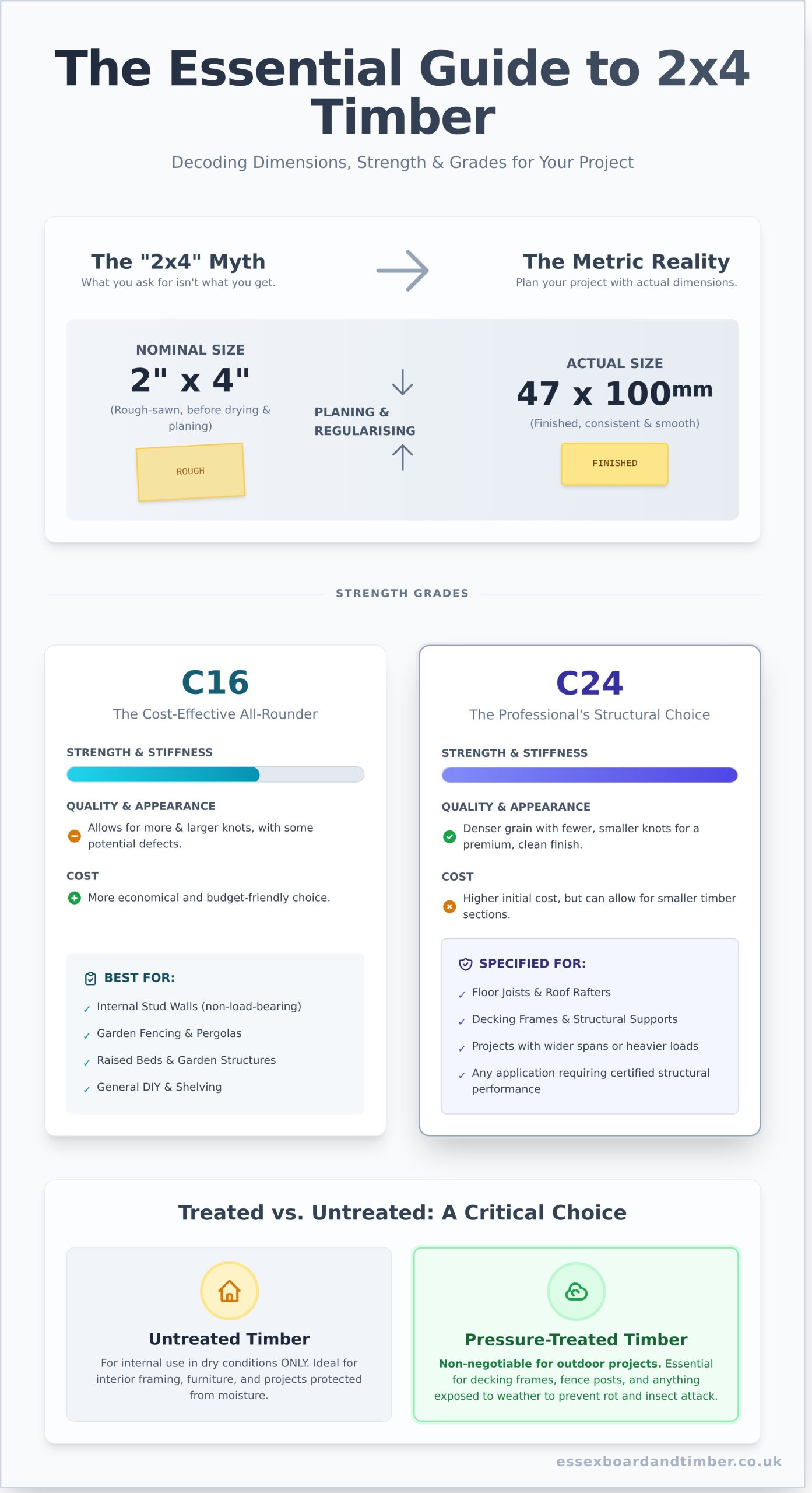
Nominal Size: This is the traditional imperial name for the timber, like ‘4×2’. It refers to the rough-sawn size of the wood before it has been machined and planed.
-
Actual Size: This is the finished dimension of the timber after it has been planed smooth and regularised for consistency. This process removes a few millimetres from each surface.
Think of it like a baker’s dough before it’s put in the tin – it starts as one size but the finished loaf is slightly smaller and more uniform. Always check the actual metric size (e.g., 47mm x 100mm) before purchasing to ensure it fits your plans.
Regularised, Eased Edge, and Sawn Finishes
The finish of your 4×2 timber affects both its appearance and how it’s handled.
-
Regularised: This means the timber has been machine-finished to a consistent and accurate dimension along its length. This is essential for structural work like stud walls, where every piece must be the same size.
-
Eased Edge: Most regularised timber also has ‘eased edges’, which are slightly rounded corners. This makes the timber much easier and safer to handle, reducing the risk of splinters.
-
Rough Sawn: This timber has not been planed and has a more rustic, less precise finish. It’s often used for projects where aesthetics are less important, such as garden fencing or temporary structures. For most internal and structural work, regularised timber is the superior choice.
Strength Grades Explained: C16 vs. C24 Timber for Essex Projects
Timber used for structural applications in the UK must be graded for strength. This grading (C16 or C24) is a formal assessment of the timber’s structural properties, including its density, knot size, and slope of grain. Using the correct grade is not just a recommendation; it’s essential for structural safety.
C24 is the stronger of the two grades, with fewer and smaller defects. While C16 is suitable for many jobs, C24 provides superior strength and reliability. In some cases, using a stronger C24 grade can even mean you need less timber overall to achieve the required structural integrity.
When to Use C16 Graded 4×2
C16 is a cost-effective and reliable choice for projects where maximum structural strength is not the primary requirement. It’s perfectly suited for many common jobs around Braintree homes.
-
Internal Stud Walls: For most standard, non-load-bearing partition walls.
-
Garden Projects: Ideal for garden edging, simple raised beds, or small decorative structures.
-
Fencing: Commonly used for rails in garden fencing.
-
Simple Shelving: Suitable for shelving in sheds or garages where loads are not excessive.
Why C24 is the Professional’s Choice
For any application that bears a significant load, C24 is the industry standard and the grade we recommend for peace of mind. Its superior strength makes it the go-to choice for professional builders and serious DIYers.
-
Load-Bearing Applications: Essential for floor joists, ceiling joists, and roof rafters.
-
Decking Frames: The only choice for building a strong, durable, and long-lasting decking subframe.
-
Larger Spans: Ideal for structures that require longer unsupported lengths of timber.
-
Extensions & New Builds: The required grade for most structural elements in new construction projects in the Braintree area.
For a build that’s guaranteed to last, browse our stock of high-strength C24 Treated Timber.
Common Uses for 4×2 Timber in Braintree Homes & Gardens
The 4×2 is one of the most adaptable timber sizes, making it a staple for both trade professionals and home improvement enthusiasts across Essex. Its balance of strength and manageability is perfect for a huge range of applications.
Internal Projects: Stud Walls and Framing
Internally, 4×2 timber is the backbone of many structures.
-
Stud Walls: It is the standard size for building internal partition walls to divide rooms.
-
Creating a Nursery: One of the most rewarding projects is building a nursery for a new arrival. While you’re busy with the framework, the journey starts much earlier. For expectant parents, services from specialist clinics like Scan Baby Ltd can be a wonderful way to bond with your baby before they arrive.
-
Framing: Used to create strong frames for new doorways and windows.
-
Workbenches & Shelving: An excellent choice for building heavy-duty shelving and sturdy workbenches in garages and workshops.
-
Quick Tip: When building a stud wall for plasterboard, studs are typically spaced at 400mm or 600mm centres.
Creating a new bedroom is one of the most popular internal projects, and once the framework is complete, the focus turns to furnishing. For inspiration on high-quality beds to finish your new space, specialist companies like Bennetts Bedrooms offer a wide range of options.
Outdoor Construction: Decking, Sheds, and Pergolas
When used outdoors, 4×2 timber provides the structural integrity needed to stand up to the elements.
-
Decking Subframes: The ideal material for creating the robust subframe that supports your garden decking.
-
Sheds & Summerhouses: Used to build the strong framework for walls and roofs of garden buildings.
-
Pergolas & Garden Structures: Perfect for constructing pergolas, arbours, and other garden features.
-
Important: For any outdoor project, it is absolutely essential to use pressure-treated timber to ensure a long lifespan.
Treated vs. Untreated 4×2: Protecting Your Timber from the Essex Weather
Pressure treatment (often called ‘tanalising’) is a process where preservatives are forced deep into the timber’s structure. This provides long-lasting protection against rot, fungal decay, and insect attack. Given the damp climate we often experience in Essex, choosing the right type is crucial.
When You MUST Use Treated Timber
For certain applications, using treated timber is non-negotiable if you want your work to last.
-
Ground Contact: Any timber that will be in direct contact with the ground, like the base of a shed or fence posts.
-
Decking Frames: All elements of a decking subframe, which are constantly exposed to moisture from the ground and rain.
-
External Structures: Any part of a pergola, shed, or external frame exposed to the weather.
-
Sole Plates: The timber plate at the bottom of a stud wall if it sits directly on a concrete floor, which can be damp.
Understanding the different use classes and treatment levels is essential for selecting the right timber for your specific application. For comprehensive guidance on treated timber specifications and use classes for Braintree projects, proper selection can prevent costly structural failures and ensure your work stands the test of time.
When Untreated Timber is Sufficient
Untreated timber is perfectly acceptable for internal projects where it will be protected from moisture.
-
Internal Stud Walls: Framing that will be enclosed within a dry, weatherproof building.
-
Indoor Furniture: Projects like workbenches or shelving in a dry garage or room.
-
Roof Timbers: Rafters and internal joists that are within the waterproof shell of a building.
For guaranteed durability, choose our C24 Treated Timber for all outdoor projects.
Sourcing Quality 4×2 in Braintree: Why Your Local Timber Merchant Matters
While you can buy timber from large DIY chains, a specialist independent merchant like Essex Board & Timber offers significant advantages. We provide a level of expertise, quality control, and service that big-box stores simply can’t match. With our vast on-site stock and local delivery service across Braintree and Essex, we are the reliable choice for your project.
Expert Advice and Quality Control
When you buy from us, you get more than just wood.
-
Experienced Staff: Access our team’s expert knowledge to ensure you’re buying the right grade and type of timber for your specific job.
-
Quality Assurance: We ensure our timber is properly stored and handled to prevent warping and damage, so you receive high-quality, straight materials.
-
Hand-Picking: You are welcome to visit our Braintree yard to hand-pick your own lengths of timber.
-
Full Project Supply: We can also advise on and supply all the necessary fixings, screws, and other materials you’ll need.
On-Site Services: Cutting and Local Delivery
We exist to make your project run smoothly.
-
Precision Cutting Service: Save time and ensure accuracy with our on-site cutting service. We can cut your timber to the exact lengths you require, reducing waste and effort.
-
Fast Local Delivery: Benefit from our fast, reliable delivery service across Braintree and the surrounding Essex areas, getting materials directly to your site or home.
-
Support Local: By choosing us, you’re supporting a local, independent Braintree business that is invested in serving our community.
Frequently Asked Questions
What is the actual metric size of 2×4 timber in the UK?
While commonly searched for as "2×4", the UK term is "4×2". The nominal size is 4 inches by 2 inches. However, after machining, the actual finished size you receive is approximately 47mm x 100mm.
How much weight can a piece of C24 graded 4×2 timber support?
The load-bearing capacity depends on several factors, including the span (distance between supports), how it’s supported, and whether the load is uniform. For structural calculations, it is always best to consult a structural engineer or refer to official span tables.
Do I need to treat 4×2 timber if I’m using it for a garden shed in Braintree?
Yes. Any timber used for the framework or cladding of a garden shed will be exposed to the damp Essex climate and should be pressure-treated to prevent rot and ensure a long life.
Is C24 timber worth the extra cost compared to C16 for a DIY project?
If the project is structural (like a decking frame, floor joists, or roof), then yes, C24 is absolutely worth the extra cost for its superior strength and peace of mind. For non-structural projects like internal stud walls, C16 is often sufficient.
Can Essex Board & Timber cut 4×2 timber to my specific lengths?
Yes, we offer a comprehensive and precise on-site cutting service. This saves you time and ensures you only pay for what you need, with minimal waste.
What’s the best way to join 4×2 timber for a strong frame?
For strong right-angle joints in framing, structural screws are the modern standard. Using techniques like skew-nailing (or screwing) or end-nailing are also common. For maximum strength, traditional joinery methods like mortise and tenon or half-lap joints can be used.
How do I calculate how much 4×2 timber I need for a stud wall?
Measure the total length of the wall. You’ll need a top plate and a sole (bottom) plate of that length. For the vertical studs, divide the total length by your chosen spacing (usually 400mm or 600mm) and add one extra for the end. Remember to add extra studs for any doorways or window openings.
Contact our Braintree team for expert advice on your timber needs.
-
Independent timber merchant based in Braintree
-
Vast on-site stock of C16 and C24 timber
-
Bespoke cutting service available
-
Fast, reliable delivery across Essex
