Traditional softwood decking is no longer the smart choice for the damp, unpredictable climate we face in the East of England. You’ve likely spent too many weekends power-washing slippery, algae-covered boards or replacing softwood joists that simply couldn’t withstand a typical Essex winter. At Essex Board & Timber, we see trade professionals and homeowners alike making the switch to more resilient materials. We understand the frustration of seeing a significant investment rot away, which is why we prioritise stocking durable alternatives that stand up to the elements.
This guide explains why composite decking essex has become the go-to solution for those seeking a splinter-free, low-maintenance garden space that lasts. We’ll show you how to source high-quality boards and the necessary C24 graded structural timber directly from our Braintree yard. You’ll also learn the technical specifications required to ensure your project meets professional standards, from joist spacing to drainage requirements. By the end of this article, you’ll have a clear roadmap for building a deck that looks as good in ten years as it does on the day of installation. Whether you’re a contractor managing a large-scale project or a DIY enthusiast tackling a garden renovation, Essex Board & Timber provides the expertise and stock levels you need to get the job done right.
Key Takeaways
- Learn why high-performance composite decking essex is the superior, low-maintenance alternative to traditional softwood for local garden projects.
- Understand the technical specifications of capped versus uncapped boards to ensure your decking remains resistant to moisture and fading.
- Discover why using C24 treated timber for your subframe is critical to ensuring the long-term structural integrity of your installation.
- Master the essentials of site surveying and material calculation to streamline your project and reduce waste during the construction process.
- See how sourcing from Essex Board & Timber provides access to deep stock levels and expert local knowledge that national retailers cannot match.
Why Composite Decking is the Top Choice for Essex Gardens
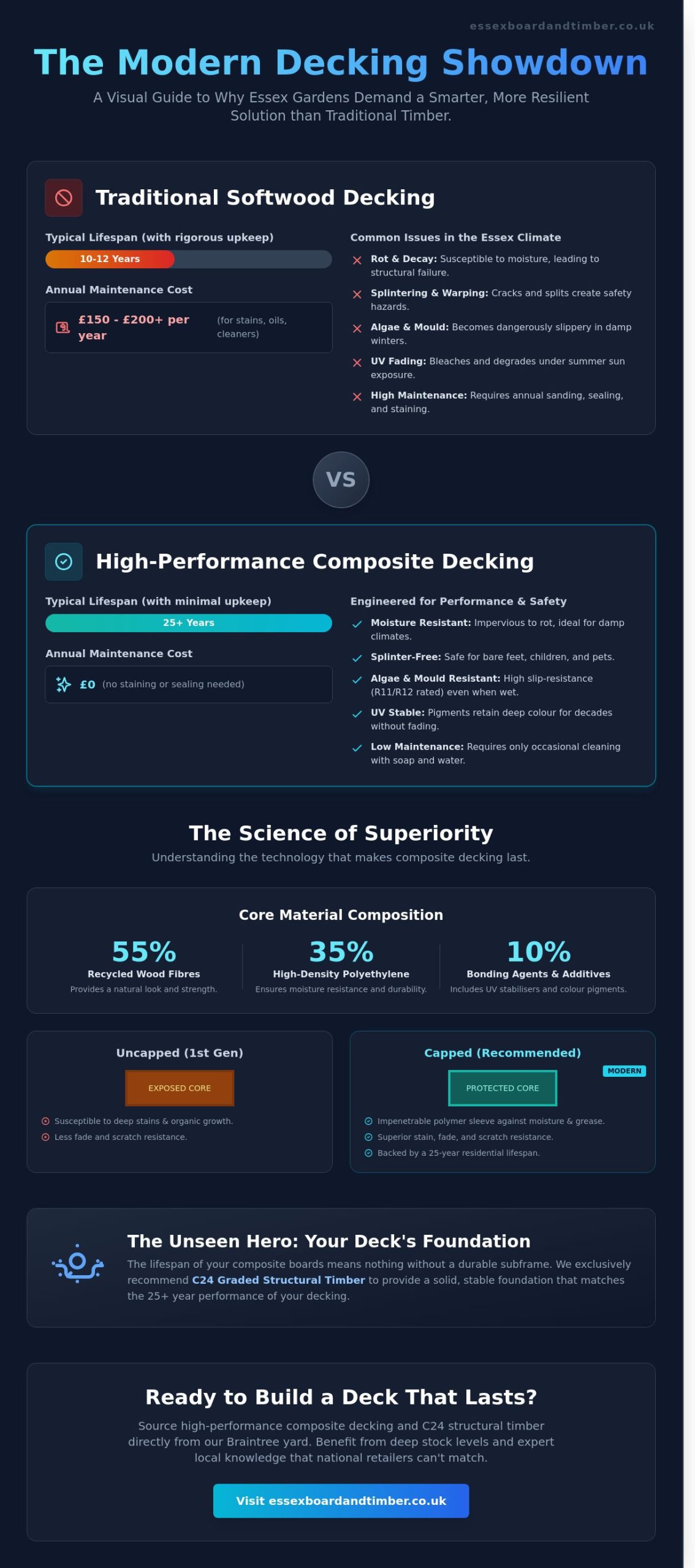
Essex gardens have undergone a significant transformation over the last 15 years. Traditional softwood decking, once the standard for outdoor spaces in Chelmsford and Braintree, is increasingly being replaced by more advanced materials. At Essex Board & Timber, we’ve seen a clear shift in demand as homeowners and tradespeople prioritise longevity over the low initial purchase price of basic timber. While a standard pressure-treated deck might last 10 to 12 years with rigorous upkeep, modern composite decking essex installations are designed to perform for 25 years or more with minimal intervention.
The core of this durability lies in the material composition. Most high-quality boards are Wood-plastic composites (WPCs), which blend recycled wood fibres with polymer components. This creates a dense, moisture-resistant product that doesn’t suffer from the natural defects found in organic wood. For Braintree residents looking for long-term value, the investment in composite materials removes the cycle of replacement that often plagues softwood installations. To ensure the entire structure lasts as long as the surface, we recommend using high-quality C24 structural timber for the subframe, providing a solid, stable foundation that matches the lifespan of the composite boards.
Timber vs Composite: The Maintenance Reality
The primary reason tradespeople recommend composite decking essex to their clients is the reduction in lifetime costs. Maintaining a timber deck requires an annual investment of approximately £150 to £200 for high-quality oils, stains, and cleaners, alongside hours of labour for sanding and sealing. Composite boards eliminate these requirements entirely. They’re engineered to resist the growth of mould and algae, which is a common issue during damp Essex winters where timber can become dangerously slick. For families and commercial venues, the splinter-free nature of composite is a decisive safety advantage. It provides a consistent, smooth surface that doesn’t crack or warp, making it ideal for bare feet and high-traffic areas.
Weather Resistance in the East of England
The climate in the East of England presents specific challenges for outdoor materials. Essex often experiences hot, dry summers where UV exposure can cause traditional timber to bleach and split. Quality composite boards feature UV-stable pigments that retain their colour depth for decades. Thermal expansion is another critical factor; professional-grade boards are designed to handle temperature fluctuations without buckling or losing structural integrity. Safety is also a priority for poolside areas or garden paths. Most composite ranges carry high slip ratings, often exceeding R11 or R12 standards, ensuring the surface remains grippy even when wet. Essex Board & Timber stocks a range of profiles that balance these technical requirements with a clean, modern aesthetic suitable for any domestic or trade project.
Understanding Composite Decking Specifications and Styles
Essex Board & Timber supplies boards engineered specifically for the unpredictable British climate. A standard composite board comprises a precise blend of approximately 55% recycled wood flour and 35% high-density polyethylene (HDPE). The remaining 10% consists of high-grade bonding agents and UV stabilisers. This specific ratio ensures the material won’t rot or warp in the damp conditions often found across the South East. When sourcing composite decking essex builders often prioritise this technical makeup to ensure the finished structure remains stable for decades.
Capped vs Uncapped: Which is Best for You?
Uncapped boards represent the first generation of composite technology. These have an exposed core that can be susceptible to organic growth and deep-set stains if not cleaned regularly. Essex Board & Timber recommends capped boards for almost all residential and commercial applications. A protective polymer sleeve, or “cap”, is co-extruded around the core during manufacturing. This creates an impenetrable barrier against moisture and grease. Most premium capped products we stock carry a 25-year residential lifespan, providing long-term peace of mind for homeowners in high-traffic areas.
Colour Trends for 2026
Aesthetic preferences in the region are shifting toward bold, architectural tones. In modern Braintree developments, Graphite Grey and Charcoal are the dominant choices for their ability to provide a sleek, minimalist finish. For traditional cottage gardens in areas like Great Dunmow, warm Teak and Chocolate tones remain popular as they complement classic red-brick masonry. To achieve a professional, framed look, many tradespeople use contrasting fascia boards. Installing a Silver Grey border around a Charcoal main deck creates a bespoke finish that immediately elevates the property’s value.
Texture is just as vital as colour. You can choose between deep-embossed wood grain finishes or contemporary grooved designs. Grooved boards provide excellent slip resistance, which is a critical safety consideration for north-facing gardens or commercial smoking areas. Wood grain finishes offer the visual warmth of natural timber without the risk of splinters or the need for annual staining. If you’re building a new subframe for these boards, it’s best to use high-quality C24 structural timber to ensure the foundation matches the longevity of the composite surface.
Essex Board & Timber maintains high stock levels of both hollow and solid board profiles. Hollow boards offer a lightweight, cost-effective solution for residential projects, while solid boards provide the extra density required for heavy commercial footfall. Our team can help you calculate the exact linear meterage required for your specific layout, reducing waste and keeping your project on budget. For a closer look at these materials, you can visit the Essex Board & Timber trade counter to see samples in person.
The Hidden Importance of a Quality Subframe
A composite deck is only as durable as the structure supporting it. While the boards often carry a 25 year warranty, the timber subframe is frequently the first part of a project to fail. At Essex Board & Timber, we see many installations where high end boards are laid over substandard frames, leading to structural sagging or rot within a decade. Choosing the right materials for your subframe ensures your investment remains safe and level for its entire lifespan. It’s a critical step that shouldn’t be overlooked by any trade professional or DIYer.
Why C24 Graded Timber Matters
For any professional composite decking essex installation, C24 graded timber is the industry standard. While C16 timber is common for basic garden projects, C24 offers superior structural integrity and can handle the heavier weight of composite materials. Essex Board & Timber stocks C24 treated timber that has been kiln dried and pressure treated to resist fungal attack. Using this higher grade from our Braintree merchant yard means fewer knots and a straighter grain, which prevents the frame from twisting and pulling the composite clips out of alignment over time.
Technical specifications for composite differ from traditional wood. You can’t rely on standard 400mm joist centres in every scenario. Most composite manufacturers require 300mm centres to provide adequate support for the increased density of the boards. This tighter spacing prevents the deck from flexing or feeling “bouncy” underfoot. Protecting the top of these joists with bitumen joist tape adds another layer of security, stopping water from sitting on the timber surface. It’s a small cost that significantly extends the life of your composite decking essex project.
Ventilation and Drainage Requirements
Trapped moisture is the primary enemy of any timber structure. Without proper airflow, a “ground effect” occurs where damp air is trapped under the deck, accelerating rot in the joists. We recommend a minimum 50mm clearance between the ground and the joists to allow air to circulate freely. A slight fall of at least 1 in 100 is also essential to ensure water runs off the boards and away from the property during heavy rainfall.
- Install a heavy duty weed membrane to prevent growth beneath the structure.
- Use a 40mm layer of gravel or MOT Type 1 to facilitate better drainage.
- Ensure the perimeter isn’t completely boxed in so airflow is maintained.
Essex Board & Timber provides the trade with the exact specifications needed for these builds. We focus on supplying the right carcassing timber and accessories to ensure your subframe is as permanent as the boards themselves. Whether you’re a contractor or a competent DIYer, getting the foundation right is the difference between a deck that lasts five years and one that lasts thirty.
Planning and Installing Your Decking in Braintree
Successful installation of composite decking essex projects begins with a precise survey of your garden. You need to measure the total square meterage of your site and factor in a 10% allowance for offcuts and wastage. If you’re building a complex pattern like a herringbone or diagonal layout, increase this to 15%. Essex Board & Timber stocks full board lengths to help you minimise joins, which is a key consideration for a professional finish in any Braintree garden.
You’ll need specific tools to handle composite materials effectively. A mitre saw with a high tooth-count carbide blade ensures clean cuts without melting the plastic content of the boards. Because composite boards expand and contract with temperature changes, managing expansion gaps is the most critical part of the build. You must leave a 5mm to 8mm gap at butt joints to prevent warping when the Essex sun hits the deck. Without these precise measurements, the structural integrity of the installation is at risk.
Essential Fixings and Accessories
A major advantage of modern composite decking essex is the hidden fixing system. Essex Board & Timber supplies T-clip kits that sit in the side grooves of the boards, creating a completely screw-free surface. This isn’t just about aesthetics; it prevents water ingress into the core of the board. Always use 304 or 316-grade stainless steel screws for your starter clips and perimeter fixings. Standard zinc-coated screws will corrode quickly in the damp British climate, leading to structural failure within a few seasons.
Ground Preparation and Foundations
The heavy clay soil common across Braintree requires a stable foundation to prevent the deck from sinking over time. For uneven terrain, adjustable pedestals allow for millimetre-perfect levelling without the need for extensive digging. If you’re building on a flat, solid surface, concrete pads provide a permanent base. For the structural skeleton, trade professionals often use C24 graded timber from Essex Board & Timber to ensure the subframe can support the weight of the composite boards, which are significantly heavier than traditional softwood alternatives.
To finish the project, use matching fascia boards and end caps to hide the hollow or solid cores of the deck boards. This provides a clean, boxed-in look that protects the subframe from the elements. If you’re ready to start your build, you can contact the team at Essex Board & Timber to arrange delivery or discuss your material requirements.
Sourcing Composite Decking from Essex Board & Timber
Choosing the right supplier is just as critical as the installation itself. While national DIY chains often rely on central distribution hubs and long lead times, Essex Board & Timber operates as a dedicated independent merchant with deep stock levels ready for immediate collection. We don’t believe in making customers wait for weeks for a delivery slot. Instead, we prioritise holding high volumes of boards, trims, and fixings on-site in Braintree. This ensures your project doesn’t stall due to logistics delays or stock shortages. Our team provides practical advice rooted in decades of experience with both traditional timber and modern composite materials. We understand how these products perform in the local climate, helping you choose the best composite decking essex has to offer for long-term durability and performance.
Local Delivery and Trade Support
Logistics shouldn’t be a headache for a busy contractor or a homeowner. Essex Board & Timber operates a dedicated delivery fleet that services Braintree, Chelmsford, and the wider county daily. We provide a reliable service that gets materials to your site exactly when they’re needed. If your project requires specific dimensions for your subframe or support structures, our Essex timber yard offers bespoke cutting services to save you time on-site. For those building a structural base, we stock high-quality C24 timber to provide a sturdy foundation for your deck. For professional landscapers and contractors, opening a trade account with Essex Board & Timber provides access to bulk pricing and streamlined invoicing. It’s a straightforward process designed to support the local trade with efficiency and precision.
- Dedicated delivery fleet serving the entire Essex region.
- Bespoke cutting services available at our Braintree yard.
- Trade accounts for contractors with competitive bulk pricing.
- Deep stock levels of joists, fixings, and finishing trims.
Visit Our Braintree Yard
Buying from a screen isn’t the same as seeing the product in person. We encourage all our customers to visit our Braintree yard to handle the boards and compare textures. Selecting composite decking essex becomes much simpler when you can see how different shades and wood-grain patterns look in natural light. It’s the best way to ensure the finish matches your property’s aesthetic. Our expert staff are always on hand to assist with material calculations, helping you determine exactly how many boards and clips you’ll need to minimise waste. Essex Board & Timber is the dependable partner for your next project, combining high-quality stock with the traditional service values of a local independent merchant. Whether you’re a professional builder or a competent DIY enthusiast, we have the expertise and the materials to help you get the job done right.
Build Your Next Project with Confidence
Choosing the right materials transforms a garden project into a durable, long-term investment. Successful installations rely on high-specification boards and a structural C24 timber subframe to prevent rot and sagging over time. Essex Board & Timber has operated as an independent merchant for over 20 years, providing the technical expertise required for both complex trade builds and straightforward DIY upgrades. We maintain a massive on-site stock of carcassing timber and finishing boards at our Braintree depot to ensure your project stays on schedule.
When you’re ready to start, sourcing quality composite decking essex wide ensures you get a finish that stands up to the British weather. Our team provides reliable local delivery across Braintree and the surrounding areas, bringing professional-grade materials directly to your site or driveway. We focus on practical solutions and dependable service, helping you achieve a professional result without the stress of stock shortages or poor-quality supplies. We’ve got the stock and the local knowledge to help you get the job done right.
Visit Essex Board & Timber in Braintree for your composite decking and C24 subframe materials and start your garden transformation today.
Frequently Asked Questions
Is composite decking more slippery than timber when wet?
Modern composite decking is generally less slippery than traditional timber because it doesn’t absorb water or encourage the same level of algae growth. Algae is the primary cause of slipperiness on wooden decks during the damp months. Many of the high quality boards stocked at Essex Board and Timber feature deep embossed wood grains or grooved textures. These designs provide a high level of grip that outperforms standard softwood in typical UK weather conditions.
Do I need a special saw blade to cut composite decking boards?
You should use a fine-toothed, carbide-tipped saw blade to achieve the cleanest finish on your boards. A blade with 60 to 80 teeth on a standard 254mm mitre saw is ideal for preventing the plastic components from fraying or melting during the cut. Essex Board and Timber recommends avoiding coarse blades used for rough carcassing work. Using the correct sharp blade ensures the ends of your composite decking in Essex stay crisp and professional for a better overall look.
How much does composite decking cost per square metre in Essex?
Prices for composite decking typically range from £40 to £85 per square metre depending on whether you choose hollow or solid core boards. Lower end capped products might start at the £40 mark, while premium, dual-sided textured boards sit at the higher end of the scale. At Essex Board and Timber, we provide competitive trade rates for bulk orders and consistent local supply. You should also factor in an additional 15% to 20% of your budget for fixings and subframe materials.
Can I install composite decking directly onto a concrete patio?
You shouldn’t install composite boards directly onto concrete as they require a subframe to allow for essential drainage and airflow. Without a minimum 50mm clearance, moisture builds up and heat expansion can cause the boards to warp or buckle over time. Essex Board and Timber supplies adjustable pedestals and plastic joists that work perfectly for low-profile installations over existing patios. This method ensures your manufacturer warranty remains valid and the deck lasts for its full 25 year lifespan.
Does composite decking fade in the sun over time?
Most composite decking undergoes a slight weathering period during the first 12 weeks of UV exposure before the colour stabilises. While older first-generation boards were prone to significant fading, modern capped composites are engineered with UV inhibitors to protect the pigment. Essex Board and Timber stocks advanced capped products that retain 95% of their original hue over a decade of use. This makes it a superior long-term investment for south-facing gardens compared to traditional wood stains.
What is the best way to clean and maintain composite decking?
The best way to maintain your deck is by using warm soapy water and a soft-bristled brush at least twice a year. You don’t need to sand, stain, or seal the boards like you would with traditional larch or oak products. For tougher debris, a jet wash can be used on a low-pressure setting, typically under 1500 PSI, to avoid damaging the surface finish. Essex Board and Timber advises regular sweeping to prevent organic matter from sitting in the grooves and encouraging mould growth.
Do I need planning permission for a new deck in Braintree?
Planning permission is generally not required in Braintree if the decking is no more than 300mm above the ground and doesn’t cover more than 50% of your garden. If you’re planning a raised platform or a balcony, you must consult Braintree District Council’s planning department before starting. Essex Board and Timber recommends checking the 2008 Permitted Development rights for your specific property type. This prevents potential legal issues or the need to dismantle the structure later.
Why should I use C24 timber for my decking subframe?
You should use C24 grade timber because it offers higher structural strength and a more consistent finish than the standard C16 grade. C24 timber is grown in colder climates, resulting in tighter grain patterns and fewer knots, which is vital for supporting the heavy weight of composite boards. Essex Board and Timber stocks a wide range of pressure-treated C24 carcassing timber for this purpose. This ensures your subframe is as durable as the composite decking it supports, preventing sagging or structural failure.
